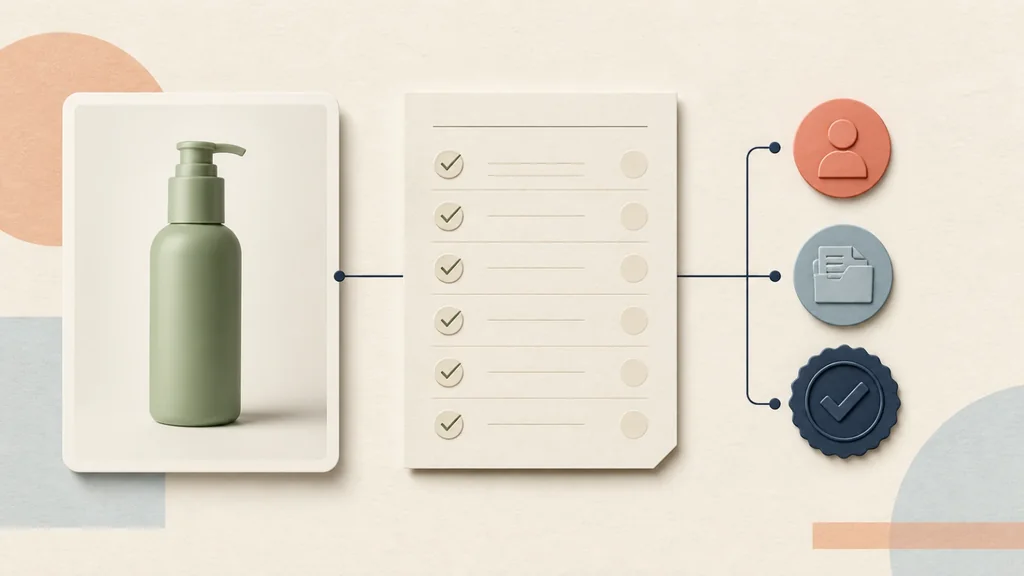
The commercially usable AI product photo is not necessarily the prettiest candidate. It is the file a merchant can connect to an approved source, a specific generation record, an accurate SKU, a current destination rule, and a named publish decision.
That is a right-to-publish gate, not an automatic clearance result. A model choice or paid plan cannot settle every source, output, trademark, likeness, advertising, platform, and jurisdiction question at once.
Scope: this is an operational evidence checklist for ecommerce teams, not legal advice, a clearance opinion, or a guarantee against a claim. NORTHLINE is fictional. Laws and channel rules vary and change; involve qualified counsel when the record exposes an unresolved rights question.
The 10-minute release gate
Download the completed AI product-photo commercial-use release record. Duplicate the row group for each final asset and placement. Do not approve a folder or campaign in bulk when the files, products, and destinations differ.
| Gate | Evidence to attach | Hold when |
|---|---|---|
| Source authority | ownership, commission, or license record for every input | an input arrived without a traceable authority record |
| Vendor permission | dated terms and the plan or agreement used on generation day | the team relies on memory, marketing copy, or a different plan |
| Generation record | route, model, date, prompt, references, job ID, transformations, hashes | the final file cannot be mapped back to the run and edits |
| Product truth | full-resolution comparison with the exact approved variant | count, geometry, color, material, label, or included items changed |
| Marks and identity | approved-mark list plus review for invented or familiar marks | an unapproved logo, symbol, package, character, or trade dress appears |
| Releases and assets | people, property, location, prop, stock, texture, and font records | a recognizable person or third-party asset has no required release or permission |
| Claims | substantiation for express and implied claims | pixels imply an unapproved benefit, result, endorsement, price, or award |
| Provenance and labels | metadata inspection, preserved credentials, and edit/export log | required AI-source metadata was removed or provenance is unexplained |
| Destination | current channel rule snapshot and the exact named placement | the team checked a generic policy instead of the actual feed, ad, or storefront slot |
| Approval | named reviewer, date, file hash, SKU, placement, market, decision | the record says only “looks good” or does not identify the final file |
The final states should be explicit: APPROVED_NAMED_PLACEMENT, HOLD_RIGHTS_REVIEW, REJECT_PRODUCT_MISMATCH, REPAIR_METADATA, or DO_NOT_PUBLISH. “Approved” without a named file and placement is not a release state.
Start with authority, not the output
List every ingredient before deciding whether the result can ship:
- product packshots and customer-supplied references;
- brand artwork, packaging, fonts, patterns, and copy;
- people, hands, recognizable likenesses, voices, and signatures;
- locations, interiors, artworks, props, stock assets, and textures;
- model, route, plan, API, editor, upscaler, and export tool;
- every human edit, composite, crop, overlay, and retouch.
For each item, save what gives the business authority to use it in the intended way. A file being downloadable, public, customer-supplied, or AI-generated is not itself an authority record.
Capture the applicable vendor terms and plan when the asset is generated. Terms can differ by product, account tier, geography, or date. The evidence belongs with the job record, not in somebody's browser history.
Keep copyrightability and permission separate
The U.S. Copyright Office's current AI copyrightability report says copyright protection depends on human-authored expression and is assessed case by case; wholly AI-generated material is not protected by copyright in the United States. That question is different from whether a merchant has permission to use every input and every element in an output.
Record both:
- Authority to use: what permissions, ownership, releases, and agreements support the intended placement?
- Protectability: which human-authored selection, arrangement, modification, or other expression might be protectable, if that matters to the campaign?
Do not turn a vendor's “commercial use” sentence into a claim that the output is exclusive, protectable, non-infringing, or cleared everywhere. The release record deliberately uses HOLD_RIGHTS_REVIEW when the evidence does not support that conclusion.
Reject product and advertising inventions
A release workflow must check what customers may believe, not just whether the frame contains a recognizable logo.
Compare the final candidate against the exact product variant at full resolution. Verify quantity, silhouette, dimensions visible in the image, components, material, color, closure, packaging, label, warnings, and included accessories. An attractive invented cap or larger-looking bottle is a product mismatch.
Then read the whole image as an advertisement. A generated badge can imply an award. A before-and-after composition can imply a result. A clinician-like person can imply endorsement. An ingredient placed beside a product can imply composition. The FTC's advertising guidance for businesses says advertising claims must be truthful, non-deceptive, and evidence-based. Remove or substantiate the implication before release.
Text in a prompt is not evidence that an output contains no unapproved mark or claim. Review the pixels, including tiny label text, props, clothing, walls, reflections, and background signage.
Preserve metadata through the final export
Google Merchant Center's current AI-generated content policy says images created with generative AI must contain IPTC DigitalSourceType metadata indicating the source type, including TrainedAlgorithmicMedia. It also says not to remove embedded source metadata.
Inspect the actual exported file after resizing, compression, CDN processing, and feed preparation. A metadata tag on the original does not prove the delivered derivative retained it. Store the inspection result and final checksum in the release record.
Content Credentials can bind signed provenance assertions to an asset and its transformations. Preserve and validate them where the workflow supplies them. They are useful provenance evidence; they do not prove rights clearance, product fidelity, or claim substantiation.
Release by destination, not by image
The same file can be acceptable as a clearly conceptual blog illustration and unacceptable as a marketplace primary image. Name the actual destination:
- storefront primary, secondary, swatch, collection card, or editorial module;
- Google Shopping
image_link,additional_image_link, orlifestyle_image_link; - marketplace listing, paid-social placement, display ad, email, affiliate creative, or print;
- country or regional launch.
Attach the current policy snapshot and review the category-specific rules. Re-run the gate when the file, SKU, claim, channel, market, or terms change. Approval does not automatically travel with the pixels.
A practical evidence folder
Keep one immutable folder or record per final asset. The fictional NORTHLINE-SERUM-04 example has eight sections: 01-source-authority, 02-vendor-terms, 03-generation-and-edits, 04-product-truth-review, 05-marks-releases-claims, 06-metadata-and-provenance, 07-destination-policy, and 08-final-file-and-approval.
Use a checksum to connect the approval to the delivered file. If a later optimization creates a different file, give it a new record or new version. That small discipline prevents a reviewed source from being confused with an unreviewed export.
What the model choice can—and cannot—answer
Models differ in source preservation, typography, people, materials, instruction following, and editing controls. Test those behaviors on your own difficult SKUs. But no leaderboard can decide whether your source license covers an input, whether a familiar design needs review, whether a person's release covers an ad, or whether a product claim is substantiated.
Choose a model for production behavior. Use the release gate for the business decision.
For generation inputs, start with the AI product-photography prompt pack. For consistent camera, light, crop, and catalog tolerances, use the AI product-photography style guide. This checklist is the final handoff: it connects the exact output to the evidence and placement that let an accountable reviewer decide whether it ships.