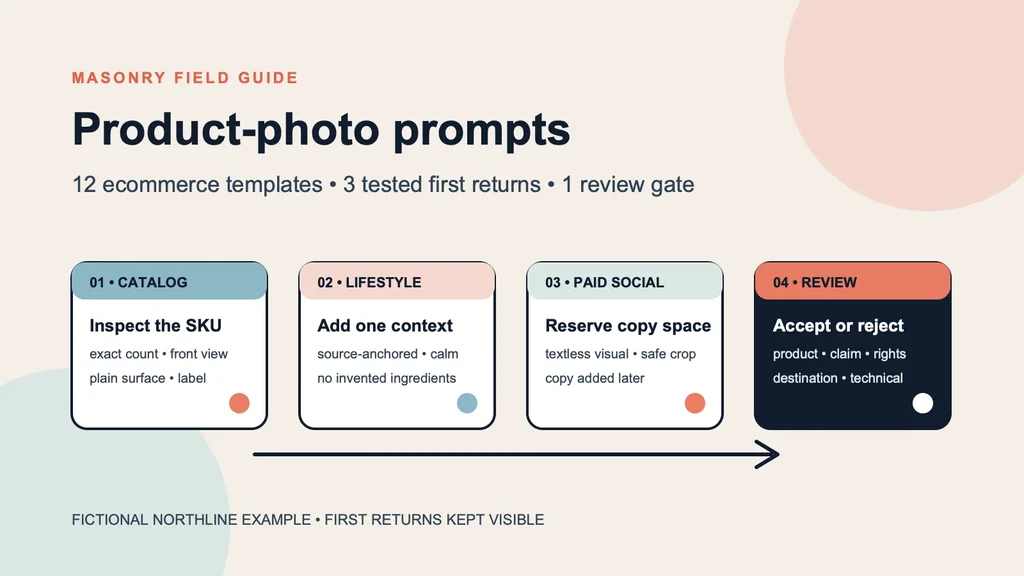
An ecommerce product-photo prompt should define a placement, not merely a mood. “Put this bottle in a luxury bathroom” leaves the model free to redraw the bottle, invent ingredients, add a second unit, and compose an image that cannot fit your product page or ad. A useful prompt says what the source controls, what may change, where the product sits, which light creates which shadow, what must not appear, and how a merchant will reject the result.
This guide gives you 12 copy-ready product-photography prompts, three first-hand Masonry returns, and the exact review record. The examples use one fictional NORTHLINE Vitamin C bottle so the prompt—not a changing SKU—remains the variable.
Evidence boundary: NORTHLINE is fictional. We generated one first return for each of three prompts using the same approved source and Nano Banana 2 (gemini-3.1-flash-image-preview). The screenshots below are those returned files, not hand-picked winners from a large batch. All three remained in SECONDARY_REVIEW because readable label text and attractive composition did not eliminate subtle product re-rendering. This is not a model win-rate study, marketplace approval, performance benchmark, legal advice, or evidence that an image increased conversion.
Why ecommerce prompts need a product authority
Current merchant discussions repeatedly describe the same failure: a generator creates a beautiful scene while altering the object that must be sold. In one ecommerce thread, merchants distinguish source-anchored secondary lifestyle images from factual photos needed to inspect real texture, geometry, and small details. Another asks how to make lifestyle images without logos, labels, and proportions drifting between rerolls. These are anonymous qualitative accounts, not measured error rates, but the job is consistent: preserve the real product while changing its context.
A current practitioner example makes the complementary point: “product on a white background” describes almost none of the production decision. The useful part of that discussion is the distinction between a listing image that answers a purchase question and a cinematic scene that mainly supplies atmosphere. Its promotional claims are not used here. Read the prompt-process discussion.
The supplied non-brand Search Console export does not contain the exact query AI product photography prompts for ecommerce. It does show adjacent demand: best ai prompts for realistic photos produced 80 clicks from 1,751 impressions at average position 5.48, while best ai model for product photography produced 27 impressions at position 5.78. That proves broader prompt and product-photography discovery, not demand or ranking for this exact page.
The revenue signal is also directional. In the mature PostHog cohort, the product-photography model comparison has the strongest observed downstream path: two assisted signups, one generation, two checkout starts, and one checkout completion. Only 17 readers had a full seven-day window, below the charter's stability floor. We are using that signal to choose the product-image cluster—not claiming content-caused revenue.
The six-part prompt grammar
Use the same order every time. The order will not force perfect obedience, but it makes omissions and failures easier to diagnose.
- Authority: name the supplied approved image as immutable product truth. A URL or category name is not enough.
- Placement job: state catalog secondary, lifestyle secondary, collection card, email hero, or paid-social visual. Each has a different crop and truth burden.
- Fixed facts: write the exact SKU, variant, count, silhouette, materials, closure, visible label, and sold configuration that cannot change.
- Mutable layer: permit one environment, surface, background, or light change. Do not say “be creative” around the product.
- Composition and light: define aspect ratio, product position, scale, margins, source direction, softness, and expected contact shadow.
- Negative constraints and acceptance: prohibit people, ingredients, extra units, claims, prices, badges, watermarks, and new text as appropriate; request a review candidate rather than a publish-ready fact.
Prompt length is not the goal. Traceability is. If a sentence does not define authority, a visible relationship, a prohibition, or an acceptance rule, remove it. If the product has reflective metal, transparent liquid, tiny curved text, a complex pattern, or an unseen reverse panel, include those details in the review sheet even when the prompt mentions them.
The approved source for this test
The source is intentionally demanding. Transparent boundaries, a reflective pump, liquid level, narrow type, label spacing, and cylindrical proportions give a reviewer several places to detect drift. The source remains factual authority; a generation may become a secondary scene candidate only after comparison.
Tested prompt 1: clean catalog secondary
Use the supplied approved product photo as immutable product truth. Create one square ecommerce catalog-secondary photograph. Keep exactly one NORTHLINE VITAMIN C 30 ML bottle upright, centered, fully visible, and front-facing. Preserve the exact silhouette, proportions, amber-orange liquid, clear cylindrical bottle and cap, silver pump assembly, white rectangular label, and every visible character NORTHLINE, VITAMIN C, and 30 ML. Change only the environment to a seamless warm off-white studio surface with one large soft light from camera-left, controlled highlights, and a short natural contact shadow to camera-right. No prop, person, hand, ingredient, extra bottle, package, splash, reflection, claim, price, badge, logo, watermark, or new text. Return a review candidate, not product authority.
The image passes count, front view, visible words, background, and unwanted-prop checks. It does not pass an exact pixel-level product identity claim. Compare the pump stack, cap height, shoulder, base thickness, and label size with the source. This is the critical difference between “the model wrote the name correctly” and “the image documents the product accurately.”
Tested prompt 2: quiet lifestyle secondary
Use the supplied approved product photo as immutable product truth. Create one 4:5 ecommerce secondary lifestyle photograph. Keep exactly one NORTHLINE VITAMIN C 30 ML bottle upright, fully visible, front-facing, and large enough to inspect. Preserve the exact silhouette, proportions, amber-orange liquid, clear cylindrical bottle and cap, silver pump assembly, white rectangular label, and every visible character NORTHLINE, VITAMIN C, and 30 ML. Change only the environment to a quiet pale-limestone bathroom shelf with soft morning window light from camera-left, restrained warm-gray wall, and one natural contact shadow. No person, hand, skin, ingredient, fruit, flower, towel, mirror reflection, extra bottle, package, splash, claim, price, badge, watermark, or new text. Return a review candidate, not product authority.
The negative constraints did useful work: the model did not add citrus, flowers, towels, a hand, or an invented skincare ritual. That makes the output easier to review and avoids implying ingredients or use. It still created a fresh rendering of the product. The proper decision is not “good” or “bad”; it is “potential secondary lifestyle candidate, pending product-owner comparison and named-placement approval.”
Tested prompt 3: paid-social visual with deterministic copy space
Use the supplied approved product photo as immutable product truth. Create one 4:5 paid-social ecommerce product photograph. Place exactly one NORTHLINE VITAMIN C 30 ML bottle in the lower-left third, upright, fully visible, front-facing, and large enough to inspect. Preserve the exact silhouette, proportions, amber-orange liquid, clear cylindrical bottle and cap, silver pump assembly, white rectangular label, and every visible character NORTHLINE, VITAMIN C, and 30 ML. Change only the environment to a minimal warm-paper studio with a pale coral light gradient and soft camera-left illumination. Reserve the upper-right 40 percent as quiet empty negative space for deterministic copy added later. No generated copy, person, hand, ingredient, prop, extra bottle, package, splash, claim, price, badge, CTA, logo, watermark, or new text. Return a review candidate, not a publish-ready ad.
This prompt separates visual generation from advertising copy. A designer can place the approved headline, offer, price, disclosure, and CTA in a deterministic layer after the image passes. That is more editable, more legible, and less likely to turn model-invented typography into an accidental claim. The empty region is a production requirement, not permission to publish the visual without product and rights review.
The 12 ecommerce prompt jobs
The downloadable pack contains full text for these placement-specific jobs:
| Prompt | Placement decision | Acceptance-critical detail |
|---|---|---|
| Clean catalog secondary | Neutral supporting gallery image | exact count, full front view, contact shadow |
| White-background listing candidate | Channel-specific clean listing | safe margins, uniform field, no inferred reverse |
| Detail crop | Show one approved construction detail | recognizable context around the crop |
| Material proof | Make a real material inspectable | no invented gloss, embossing, grain, or wetness |
| Quiet bathroom lifestyle | Add restrained skincare context | no ingredient, person, mirror, or efficacy implication |
| Kitchen-counter context | Add domestic context | no food or use claim unless approved |
| Desk or workspace context | Place a product in a work setting | background objects cannot imply a feature |
| Seasonal context | Express one occasion through art direction | no unapproved cultural symbol, gift, or ingredient |
| Paid-social negative space | Create a textless acquisition visual | measured copy area and crop-safe product |
| Email hero | Support deterministic headline and CTA | full product plus safe margins in a wide crop |
| Collection-card crop | Survive responsive grid crops | product contained in a central safe box |
| One-variable scene test | Learn whether one change helps | all other prompt and production fields frozen |
These prompts deliberately do not ask the model to write benefits, prices, social proof, ingredient names, discount badges, or CTAs. Those inputs belong to a claims record and a deterministic design layer. If your team needs to repeat one approved recipe across dozens of products, move from this page to the batch product-photography workflow. A prompt pack chooses and reviews the recipe; a batch system controls its reuse.
Review with five gates, in order
1. Product gate
Compare the return and source side by side at full resolution. Check object count, exact variant, silhouette, proportions, color, materials, closure, label placement, every readable character, transparent boundaries, reflections, quantity, included parts, and sold configuration. Use the product-photo fidelity test when you need a repeatable same-source scoring method.
2. Claim gate
Inspect what the image states or implies, not only its visible words. Fruit can imply an ingredient. Water droplets can imply freshness or waterproofing. A clinical surface can imply medical authority. A person using a product can imply fit, safety, or results. Remove any statement or implication that lacks the correct merchant evidence and approval.
3. Rights gate
Record the authority for source photography, people, likenesses, marks, locations, stock assets, and downstream commercial use. “AI generated” does not settle rights, and “no logo” in a prompt does not prove that no protected identity appeared. Escalate uncertain cases to the responsible owner.
4. Technical gate
Check full dimensions, file format, color, crop, safe areas, text readability, compression, background behavior, and required channel rules. Review mobile crops and responsive collection cards. Keep master files and record the exact file hash rather than approving a filename that can later be overwritten.
5. Destination gate
Open the exact linked product page and confirm the same SKU, variant, count, package, color, and available configuration. A beautiful image of a nearby variant is a customer-experience failure. Use APPROVED_FOR_NAMED_PLACEMENT, not generic “approved,” so an email secondary cannot silently become a factual-primary marketplace image.
How to revise without destroying product truth
When a candidate fails, change the smallest prompt field that corresponds to the failure. If a label drifts, improve the source crop, transcribe the exact visible lines, reduce product transformation, or preserve source pixels in a deterministic composite. Do not simultaneously change model, prompt, aspect ratio, scene, and seed policy; that produces another attractive unknown.
If the product passes but the composition fails, alter only product location or margin. If the scene adds an ingredient, strengthen the prohibited list and simplify the environment. If every generated version alters critical geometry, stop rerolling and choose a source-preserving workflow. The right answer may be background removal, masking, a deterministic layout, or real photography rather than another prompt.
For model selection, use the AI product-photography model comparison and run your own difficult SKU. For operational economics, calculate cost per accepted product image, including prompt time, rejection, repair, review, and any fallback shoot. Generation price alone does not measure the deliverable.
Bottom line
The useful ecommerce prompt is a small production contract. Attach approved product authority. Name the placement. Freeze exact product facts. Permit one scene layer. Specify composition and light. Prohibit invented products, props, claims, and copy. Then compare the return against the source with product, claim, rights, technical, and destination owners.
Use the templates to reduce blank-page work, not to skip judgment. The three first returns here are visually coherent and readable; they also re-render the product enough to remain secondary-review candidates. Keeping both truths visible is how an ecommerce team gets real value from AI product photography without confusing polish with proof.