The safest AI Black Friday ad workflow is approved product → accepted creative control → versioned offer record → textless seasonal candidate → deterministic offer overlay → channel test. AI can explore the visual layer. It should not invent the discount, code, sale window, eligibility, prior-price basis, or sold product.
We ran that workflow on the fictional NORTHLINE Vitamin C serum. The controlled campaign uses a fictional US offer: 20% OFF, SKU NL-VITC-30 only, code WARM20, from November 23 through November 30, 2026 in America/Los_Angeles. Nothing is connected to a real checkout, so every asset remains a draft.
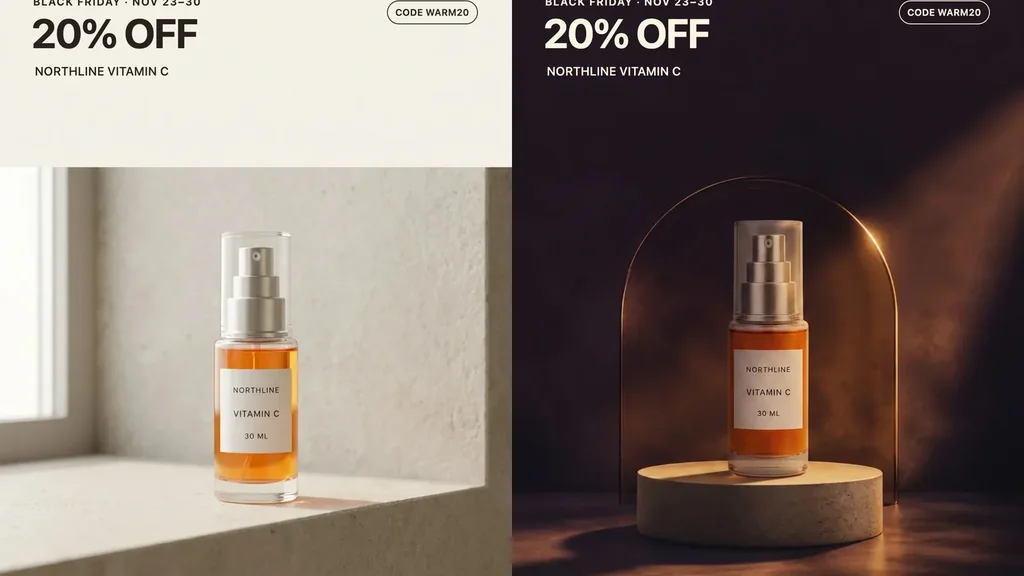
One cell keeps an existing accepted routine creative and adds the offer as a deterministic layer. A second cell combines the approved product reference with a textless seasonal style board in a live Nano Banana 2 job, then applies the same offer layer. That isolates the useful decision: does the new seasonal visual earn a production test, or is the controlled refresh enough?
Evidence boundary: NORTHLINE, the offer, the code, and the campaign window are fictional controlled records. The style board, multi-reference Masonry job, generated candidate, exact offer overlays, visual review, and manifest are real. This article does not report ad performance, validate a legal promotion, or establish a universal BFCM winner.
Why this is a distinct merchant job
A current ecommerce merchant asked whether a first Black Friday campaign needed entirely new creative, aggressive countdown graphics, or a simple overlay on existing work. The budget constraint was explicit: they could not afford to test every style. Read the merchant question.
The replies generally favored keeping the existing visual structure and making the offer unmistakable, but they are anecdotes—not a benchmark. Another advertiser described reusing year-to-date creative with a Black Friday offer layer while also producing separate challengers. Read the qualitative BFCM workflow.
Shopify's current sales guidance treats BFCM and flash sales as high-demand events that require advance promotion, customer-service, inventory, checkout, and fulfillment preparation—not merely new ad files. Read Shopify's current sales-event guidance.
The supplied three-month Search Console export contains no non-brand black friday ad creative, bfcm creative, holiday ad generator, or seasonal-product-photo query row. This article is an adjacent revenue-intent expansion from Masonry's existing product-photography and ad-creative coverage, not proof that the site already ranks for the exact job.
Step 1: freeze the offer before touching pixels
The visual team should receive a versioned promotion record, not “make it feel Black Friday.”
| Field | Controlled campaign value |
|---|---|
| Campaign | NL_BFCM_2026 |
| Product scope | fictional NL-VITC-30 only |
| Market / currency | US / USD |
| Offer | 20% OFF |
| Code | WARM20 |
| Window | Nov 23, 2026 00:00 through Nov 30, 2026 23:59:59 |
| Timezone | America/Los_Angeles |
| Price basis | fictional demo; no live prior-price basis |
| Legal status | merchant review required |
| Checkout status | not connected; publication blocked |
Download the completed offer and creative manifest. It maps the offer record, existing-creative control, generated visual candidate, offer-overlay challenger, product review, channel, and disposition.
Do not bury the timezone, product scope, or end time in a design comment. Those fields determine whether an otherwise correct image becomes a stale or misleading promotion.
Step 2: create the lowest-risk control first
The first cell keeps the existing accepted routine creative and changes only the deterministic offer layer:
This cell answers a practical question with minimal production risk: can the existing visual carry the seasonal offer clearly? It does not require the image model to redraw the product, and a code or date change touches only the copy layer.
Keep the control even if the team loves a new seasonal scene. Without it, the test cannot distinguish “seasonal art helped” from “the offer itself helped.”
Step 3: separate mood from product truth
The challenger begins with a nonfactual style board generated in the built-in image workflow. It carries color, materials, lighting, and composition—but no product and no offer:
That separation makes the multi-reference contract explicit:
- Reference 1 — product truth: the approved NORTHLINE source controls bottle, liquid, cap, pump, label, text, quantity, and variant.
- Reference 2 — style only: the board can influence background, surface, lighting, mood, and composition. It cannot invent product facts or a promotion.
- Offer record — promotion truth: the manifest controls discount, scope, code, dates, timezone, price basis, reviewer, and release state.
Step 4: generate a textless seasonal challenger
The live Nano Banana 2 route received both references, a 4:5 output request, and seed 2608155:
masonry image "Create one 4:5 paid-social seasonal product photograph from two references. Reference 1 is immutable product truth. Reference 2 is style direction only. Preserve exactly the NORTHLINE Vitamin C bottle and every character of NORTHLINE, VITAMIN C, 30 ML. Use the aubergine set, smoked-amber arch, warm stone plinth, amber rim light, haze, and upper negative space. No campaign text, letters, numbers, price, percentage, discount, badge, CTA, countdown, confetti, gift box, ribbon, person, extra product, watermark, or claim." \ --model gemini-3.1-flash-image-preview \ --aspect 4:5 \ --seed 2608155 \ --ref ./NL-VITC-30-approved.webp \ --ref ./bfcm-style-board.webp
Job 661ef97f-18a2-4a07-bfcd-f2241fa127b3 succeeded in 10.116 seconds and returned a 928 × 1152 file.
The candidate passed:
- one bottle and no extra product;
- exact visible
NORTHLINE,VITAMIN C, and30 MLlabel text; - orange liquid, transparent cap, silver pump, and white label;
- the requested aubergine, amber, stone, arch, haze, and upper copy zone;
- no generated discount, code, date, price, badge, countdown, gift prop, or claim.
It remains a visual candidate because a plausible bottle is not proof of exact source geometry, material, fill line, or production package. For identity-sensitive products, generate the background plate and composite the approved packshot instead of approving a redraw.
Step 5: add the same offer layer deterministically
The two cells now differ in one declared variable:
| Cell | Visual | Offer | Product scope | Destination | Test role |
|---|---|---|---|---|---|
| C0 | existing accepted routine creative | fixed V1 record | fixed NL-VITC-30 | exact SKU page | controlled refresh |
| N1 | new aubergine seasonal scene | fixed V1 record | fixed NL-VITC-30 | exact SKU page | visual challenger |
Do not generate ten countdown layouts before confirming the offer, checkout, and destination agree. A clean two-cell test is more useful than a folder of uncontrolled combinations.
Step 6: run offer, product, and channel review separately
| Gate | Required check | Controlled run |
|---|---|---|
| Product | SKU, variant, quantity, label, geometry, color, fill, package | C0 preserves accepted visual; N1 needs source-geometry review |
| Offer | value, scope, code, start, end, timezone, eligibility | exact overlay; fictional and blocked |
| Price basis | compare-at or prior-price record matches market rules | absent; merchant review required |
| Landing page | selected product, displayed offer, code behavior, inventory | not connected |
| Channel | crop, safe area, generated enhancements, alt text, policy | pending |
| Measurement | fixed audience, optimization, attribution, budget treatment, window | plan only |
If the campaign targets customers in the European Economic Area, Shopify's current Price Indication Directive guidance says an announced reduction can require the lowest price charged during the previous 30 days or more, subject to national rules and exceptions. That includes percentage-off, flash-sale, Black Friday, and Cyber Monday language. Read Shopify's current PID guidance. This is an operational flag, not legal advice; route the actual promotion through the merchant's legal process for each market.
Review platform-created versions too. Automatic crops, background variants, text suggestions, catalog pairings, and placement adaptations can create a new unapproved asset after upload.
Step 7: test a business decision, not seasonal taste
Fix these variables across C0 and N1:
- offer record and code behavior;
- SKU, variant, inventory treatment, and landing page;
- primary text, headline, CTA, and legal qualifiers;
- audience, exclusions, optimization event, placements, attribution, and budget treatment;
- launch and stop timestamps.
Use purchase or the downstream event the campaign is genuinely optimized for as the decision metric. Read thumb-stop, click-through, landing-page view, add-to-cart, and checkout as diagnostics. Guard against contribution-margin deterioration, customer confusion, code failures, wrong-variant purchases, support contacts, and returns.
Track the production and measurement funnel:
offer-record-approved → visual-candidate-generated → product-review-passed → deterministic-offer-rendered → checkout-and-destination-verified → channel-review-passed → published → purchase-and-margin-readout
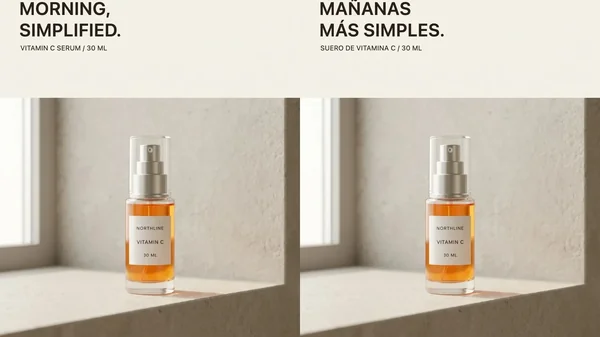
The one-SKU ad creative matrix defines the broader controlled-test structure. The same-SKU fidelity benchmark explains why readable label text does not prove source geometry. Use the product-image localization workflow when the same offer moves into another language or market, and the real-product AI UGC workflow when the seasonal challenger becomes motion.
When the promotion renews instead of ending on a campaign date, use the AI subscription ad creative workflow to keep price, billing cadence, delivery cadence, renewal, cancellation, and the selected selling plan consistent after the click.
The useful BFCM deliverable is not “a Black Friday image.” It is one approved product, one versioned offer, one controlled refresh, one reviewable challenger, and one test that can change the next decision.