The safest AI product-image localization workflow is not “upload an image and ask for Spanish.” It is source asset → approved copy record → localized draft → native-market review → deterministic export → channel QA. The generated image is a candidate; the manifest decides whether it can ship.
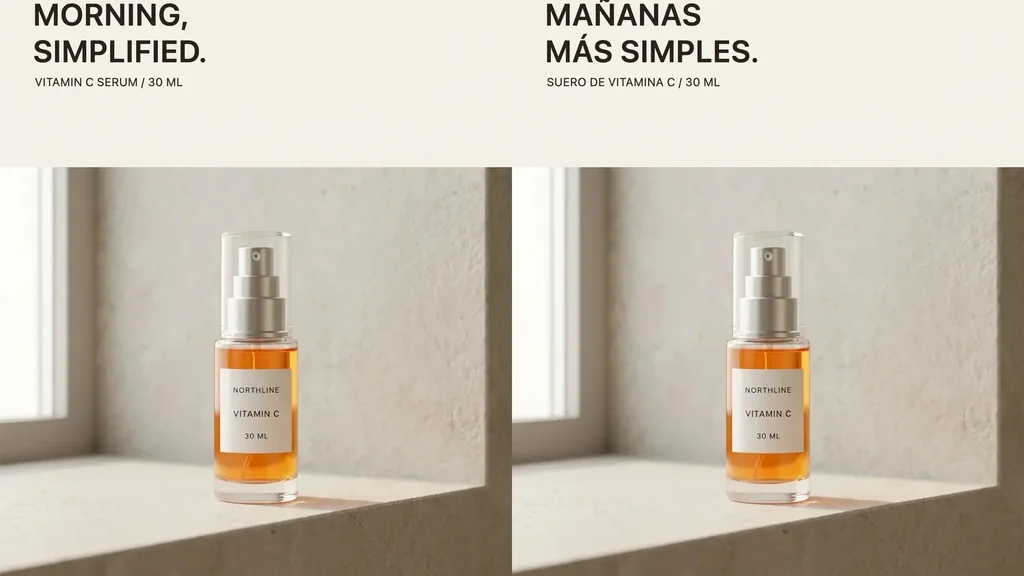
We ran that workflow on one fictional NORTHLINE Vitamin C creative. The en-US source says MORNING, SIMPLIFIED. and VITAMIN C SERUM / 30 ML. A live Nano Banana 2 job produced an es-US candidate with both requested strings and accents correct. It also regenerated the full 4:5 image, changed the headline wrap, and produced a new 928 × 1152 rendition instead of preserving the approved 1200 × 1500 pixels.
The controlled es-US version therefore reuses the approved scene pixels and swaps only the copy layer. It is still marked linguistic review pending. Correct-looking Spanish is not approval, and this article does not pretend we had a native es-US reviewer when we did not.
Evidence boundary: NORTHLINE is a fictional controlled product. The source creative, live generation job, generated candidate, deterministic target draft, exact-copy review, and release block are real. This run does not prove translation quality, model reliability, conversion lift, or market compliance.
Why image localization falls through the normal store workflow
The merchant job is specific: change the language customers see inside a product or campaign image without changing the item being sold. A Shopify merchant described exactly that gap after translating the rest of a store: one or two images per product still contained information, and they needed the displayed file to change with the shopper's language. Read the merchant question.
Shopify's current Translate & Adapt documentation makes the platform boundary important. It supports manual and automatic content translation and recommends reviewing automatic translations, but it explicitly lists product images among the content types the app cannot translate. It does support market-specific content elsewhere, so do not assume a translated product description automatically swaps text embedded in media. Read the current Shopify documentation.
A more recent Shopify discussion describes embedded storefront-image text as a gap that ordinary translation flows miss. The comment comes from a vendor and is qualitative evidence, not neutral demand measurement, but it matches the older merchant's concrete problem. Read the current discussion.
The supplied three-month Search Console export contains no non-brand product image localization, translate product image, or multilingual-creative query row. This page is therefore an adjacent merchant-intent expansion, not a claim that Masonry already ranks for the exact phrase.
Step 1: define the market contract before generating
“Spanish” is not a complete brief. Record the market, locale, channel, product, variant, offer, units, currency, legal basis, and reviewer before creating pixels.
| Contract field | Controlled run |
|---|---|
| Source | NL_VITC_ROUTINE_V1, en-US, 1200 × 1500 |
| Target | es-US paid-social draft |
| Product truth | NORTHLINE Vitamin C serum, orange liquid, silver pump, 30 ML label |
| Copy change | headline and subhead only |
| Offer / currency | none / none |
| Claims | none added |
| Native reviewer | unassigned |
| Release state | blocked |
Download the completed localization manifest. The important field is not the translated string; it is the explicit block disposition while the native reviewer is unassigned.
Step 2: keep an approved source creative
Separate the asset into three authorities:
- Product layer: approved SKU or variant pixels and label.
- Campaign layer: headline, subhead, offer, CTA, badge, and legal copy.
- Market record: target wording, units, currency, reviewer, channel, and status.
If only a flattened source file exists, keep it as the audit reference and rebuild the campaign copy as a removable layer. Do not use the model's redrawn bottle as the new factual source simply because the translated text looks right.
Step 3: generate one bounded localization candidate
The live gemini-3.1-flash-image-preview route received the en-US creative, 4:5 output, seed 2608154, and two exact target strings:
masonry image "Localize this approved ecommerce creative from en-US to es-US. Preserve the supplied image and replace only the campaign copy. Render exactly: 'MAÑANAS MÁS SIMPLES.' and 'SUERO DE VITAMINA C / 30 ML'. Preserve the product label exactly as NORTHLINE, VITAMIN C, 30 ML. Add no offer, claim, price, badge, CTA, or extra text." \ --model gemini-3.1-flash-image-preview \ --aspect 4:5 \ --seed 2608154 \ --ref ./NL_VITC_ROUTINE_V1_en-US.webp
Job cb3417c8-cff1-470a-9065-79081231b99a succeeded in 10.125 seconds.
This candidate passed the visible checks we could perform:
MAÑANAS MÁS SIMPLES.is exact, includingÑandÁ;SUERO DE VITAMINA C / 30 MLis exact;NORTHLINE,VITAMIN C, and30 MLremain visible on the bottle;- no price, currency, discount, claim, badge, CTA, or extra product appeared.
It did not pass linguistic release because no native es-US reviewer approved meaning, tone, regional fit, or the use of suero. It also cannot pass exact source-pixel preservation: the service returned a fresh 928 × 1152 image, moved the line break, and re-rendered the product scene.
Step 4: swap approved copy deterministically
Once the target copy is approved, render it from the manifest in the original design system. HTML/CSS, SVG, a Figma variable set, or a graphics pipeline can all work if they preserve these controls:
- copy is keyed by locale and field ID, not pasted from prompt history;
- the source asset and product variant remain recoverable;
- line breaks are reviewed at each channel size;
- offer, price, currency, units, and legal qualifiers have separate approval fields;
- the export records version, reviewer, timestamp, channel, and disposition.
The deterministic output is not automatically safer linguistically. It is safer operationally because it limits the visual change to the fields a reviewer can inspect and revise.
Step 5: use separate release gates
Do not collapse “looks good” into one approval checkbox.
| Gate | Reviewer question | This run |
|---|---|---|
| Product | Is the exact SKU, variant, label, quantity, and sold configuration intact? | visible pass; fictional source |
| Linguistic | Is the target copy accurate, natural, and appropriate for es-US? | pending |
| Brand | Do typography, hierarchy, line breaks, and tone match the system? | deterministic draft passes visual review |
| Offer | Do price, currency, discount, dates, and eligibility match the market? | no offer present |
| Legal | Are claims, warnings, and qualifiers approved for the market? | no claims added; review still required |
| Channel | Does the placement allow this text and render the right locale? | pending |
Stop publication when any required reviewer is blank. A filename ending in _es is not a release record.
Step 6: hand off by channel, not just language
One localized creative is not valid everywhere.
| Channel | Recommended disposition |
|---|---|
| Shopify factual primary product image | keep textless or product-only; do not replace product truth with campaign art |
| Shopify secondary product media | use only after language routing, native review, product review, mobile crop, zoom, and alt-text checks |
| Paid social | review placement crops, offer, landing-page locale, destination variant, and platform-generated variations |
| Email or onsite campaign module | map the asset to the same locale and market as the visible copy and destination |
| Google Merchant Center main image | keep promotional overlays out; Google's current image guidance rejects promotional elements in the main image (official guidance) |
For Shopify, verify the actual storefront behavior instead of documenting an imagined native swap. Translate & Adapt currently cannot translate product images. Depending on the theme and stack, the reviewed file may need textless product media, a localized theme section, an app, or explicit custom implementation. Shopify can assign languages to markets and generates hreflang from that configuration, but the asset still has to follow the same market-language mapping. Read Shopify's current domains and languages guidance.
Measure accepted assets, not translated downloads
Track the operating funnel:
source-approved → target-copy-drafted → native-review-passed → deterministic-exported → product-review-passed → channel-review-passed → published
Useful production metrics are time and cost per accepted localized asset, first-pass linguistic acceptance, visual rework rate, blocked-asset count, wrong-locale incidents, stale-offer incidents, and publication coverage by priority market. Downstream, compare landing-page view, add-to-cart, checkout, purchase, support contacts, and returns by market while treating those counts as diagnostic—not proof that one image caused a sale.
Use the text-rendering model comparison to choose candidate-generation routes, the one-SKU ad creative matrix to keep the tested visual hypothesis stable, and the fact-safe listing infographic workflow when the image contains dimensions, capacity, compatibility, or included-item facts.
For a versioned seasonal discount before market adaptation, start with the AI Black Friday ad creative workflow and approve the offer, price basis, dates, code, destination, and product before translating the asset.
For market-specific restock messaging, continue to the AI back-in-stock email workflow and keep notification permission, exact variant, inventory state, batch policy, localized copy, and destination under separate review.
The shippable unit is not a translated JPEG. It is one approved source, one market contract, one reviewed target-copy record, one controlled export, and one verified channel mapping.