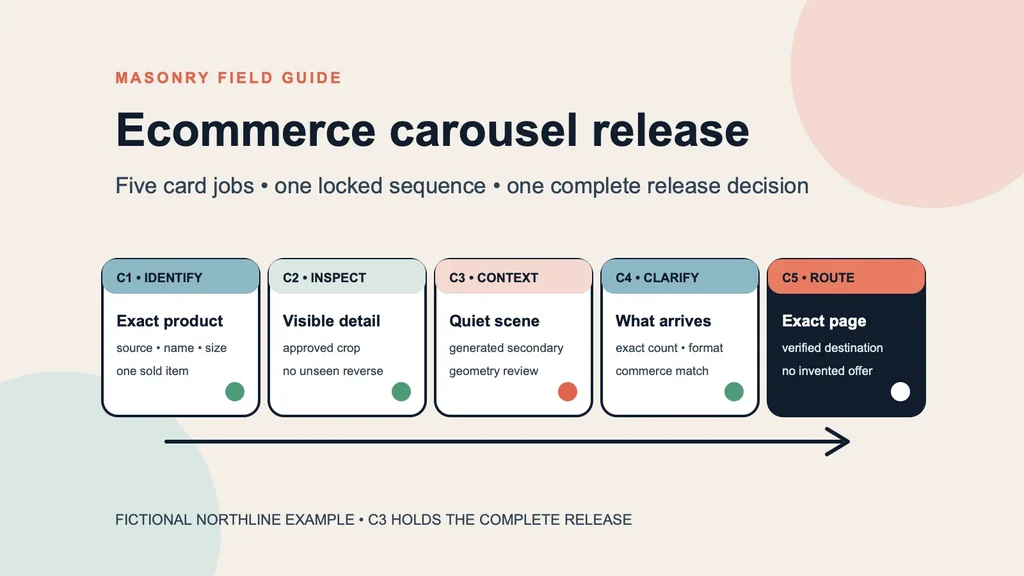
An ecommerce carousel should not be five attractive images that happen to share a product. It should be a sequence of five declared card jobs, each tied to an approved asset, authorized copy, an exact destination, and a release state. If one card changes the product or invents a claim, the complete carousel is not ready merely because the other four cards pass.
This workflow gives you a filled five-card manual carousel brief and the card-level release manifest. The fictional NORTHLINE example moves from product identity to inspectable detail, quiet context, sold-configuration clarity, and exact destination. Card 3 remains in SECONDARY_REVIEW, so the example release honestly stays on HOLD.
Evidence boundary: NORTHLINE is fictional. This page reuses the approved source and one real Nano Banana 2 first return from the ecommerce product-photography prompt test; it does not pretend those files are a new model test. The new evidence is the five-card sequencing and release contract. No ad was launched, no authenticated Meta account was changed, and no delivery, click, purchase, return, or revenue outcome was observed. Current platform controls can vary by account, objective, placement, market, eligibility, and release.
First decide: manual story or catalog-driven delivery
Meta's current carousel-format page says a carousel can contain up to ten images or videos, each with its own link. It names three different jobs: showing several products, highlighting details of one product, or telling a story across cards. It also says that when order carries the story, the advertiser should opt out of performance-based card reordering. This is format guidance, not evidence that carousel ads outperform another format. Read Meta's current carousel overview.
A manual sequential carousel fits this one-product example. The merchant declares C1 through C5, locks the order, and expects the cumulative meaning to move forward. Every card still needs to make sense when seen alone because a shopper may enter at any point or a placement may emphasize only part of the sequence.
A catalog-driven carousel solves a different job. Product-set eligibility, item and variant IDs, item-level media, feed fields, delivery logic, and destination URLs become the authority. Use the Meta Advantage+ catalog creative workflow when the platform may assemble or choose product combinations. Do not treat a dynamic item set as if it were a guaranteed five-beat story.
Current merchant discussions show why this distinction matters. One July 2026 advertiser reports unwanted reordering and automatic presentation changes; another says the expected manual carousel option was unavailable inside one Sales setup. A March thread asks why variants of one Shopify product were replaced or collapsed in a catalog carousel. The replies are conflicting and account-specific, so they do not establish universal controls. They establish a practical release requirement: verify the actual format, order, files, items, and destinations in the account preview instead of relying on remembered UI. See the ordering discussion, format-availability report, and variant-card question.
The supplied non-brand Search Console export contains adjacent product-image and product-ad demand but no exact ecommerce carousel query. This is an externally observed merchant-workflow expansion, not a claim that Masonry already ranks for the term.
The source record comes before the card sequence
The source does not establish an ingredient list, concentration, result, certification, rating, customer quote, price, discount, stock state, shipping promise, popularity, reverse label, or bundle. A carousel creates more surfaces where those unsupported implications can enter. Give each asset and line one authority before composing the cards:
- approved source fact: directly inspectable in the current product record;
- approved merchant fact: current SKU, variant, contents, price, shipping, or offer record;
- substantiated claim: evidence and permitted scope owned by the responsible reviewer;
- authentic testimonial: real experience, permission, typicality, and disclosure record;
- editorial navigation: instructions such as “view the exact product” that do not assert product performance;
- prohibited or unresolved: anything unsupported, expired, ambiguous, or outside the named placement.
The NORTHLINE carousel deliberately uses only visible source facts and editorial navigation. That restraint makes the example less dramatic and more reusable.
One sequence, five different card jobs
C1: identify the exact product
Open with the factual product source, not the most cinematic generated scene. C1 uses the approved image and deterministic text NORTHLINE / VITAMIN C / 30 ML. Its job is product recognition and destination consistency. It does not promise a result or promotion.
This first card also becomes the review anchor for every later one. If a lifestyle card shows a taller bottle, different pump, or larger label, the discrepancy is visible rather than normalized across five generated variations.
C2: make one approved detail inspectable
C2 crops the same approved front source to make the pump, label, and 30 ML quantity easier to inspect. A crop is allowed; generating an unseen reverse, open package, ingredient texture, or new camera angle is not.
The overlay 30 ML / PUMP BOTTLE is supported by the visible source. In a real listing, recheck the sold configuration and current product record rather than assuming an old source remains authoritative.
C3: add one quiet contextual scene
The contextual card reuses a real first return from job f8ccc2d9-1d7e-420e-98c9-cf6e4e9929b9, seed 2608162, using Nano Banana 2. It requested one bottle on a pale-limestone bathroom shelf with soft morning light and prohibited people, ingredients, flowers, towels, mirrors, extra products, claims, badges, and generated copy.
This is the important release decision. The image is attractive, contains one product, preserves all three visible text lines, and satisfies the quiet-context brief. It still redraws the product enough that the merchant must compare it with physical truth and the approved source. Do not silently promote it because the surrounding sequence looks polished.
Three valid next actions exist: approve it for this named secondary placement after product review, replace it with an approved real photograph, or use a source-preserving composite. Repeated rerolling is not automatically safer.
C4: clarify what arrives
C4 returns to the approved source inside a deterministic layout and states ONE 30 ML PUMP BOTTLE. Its job is expectation clarity. If a real offer includes a box, applicator, multipack, subscription, sample, or gift, the commerce record—not visual convention—must authorize that copy and image.
This card should not repeat C1 with a different background. It answers a different buyer question: what sold configuration should the shopper expect after clicking?
C5: route to the exact product
C5 uses VIEW THE EXACT PRODUCT, an editorial navigation instruction rather than an offer. It links to the same fictional product destination as the preceding cards. It does not invent price, scarcity, free shipping, discount, rating, or efficacy.
For several products, each card can use its own verified destination as Meta's official overview permits. For one ordered product story, a stable exact-SKU destination is easier to audit. The Shopify variant-image workflow shows why the final page, selected option, gallery, cart, and checkout must all agree with the card that earned the click.
A returned file is not a released carousel
The downloadable TSV separates these states:
source-authorized → card-composed → product-passed → claim-passed → destination-passed → account-previewed → complete-sequence-approved → released
C1, C2, C4, and C5 are READY_FOR_NAMED_PREVIEW. That does not mean they have run. Their account preview remains NOT_RUN. C3 is SECONDARY_REVIEW, so the overall sequence remains HOLD. The record prevents a service success or designer export from becoming implicit campaign approval.
Keep exact file hashes, card IDs, overlay copy, final URLs, reviewer, preview evidence, ad ID, and released version. If a platform enhancement changes a crop, card order, item, copy treatment, music, motion, or related product, record that delivered combination as a new review object.
Preview the actual account, not a remembered interface
Before release, verify:
- The intended manual carousel format exists for the chosen objective and account.
- Exactly the five declared cards appear; no catalog item or related media was inserted.
- C1 → C2 → C3 → C4 → C5 remains the order wherever sequence matters.
- Each card uses the approved file, headline, description, CTA treatment, and exact URL.
- Platform-generated crops and overlays do not hide product details or change meaning.
- Mobile previews remain readable and each card can stand alone.
- Any optimization, enhancement, or automation state is recorded rather than assumed.
- The exact final ad ID and preview evidence are attached to the release record.
Do not publish universal click paths such as “toggle this setting under this menu.” Current discussions already show account-level divergence. Record what is available and selected in the real account at release time.
Keep visual generation and copy approval separate
Use the 12 ecommerce product-photo prompts to create catalog, detail, lifestyle, paid-social, email, or collection candidates. Then add approved copy deterministically after the image passes.
The visual model should not decide the offer. Price, discount, dates, code, inventory, delivery, returns, testimonial, disclosure, legal text, and CTA belong to named merchant records and reviewers. Separating those layers also makes a copy correction cheaper than regenerating all five images.
If the test is deciding among several visual concepts rather than assembling one story, use the one-SKU product-ad creative matrix. That page owns control versus treatment. This page begins after the sequence job is chosen and ends at a complete released carousel.
Measure the sequence against a declared control
The question is not whether shoppers swiped. It is whether the released sequence improved the business outcome it was designed to influence without creating product-expectation risk.
Name the exact control: a single approved image, previous carousel, or other existing ad. Keep product, variant, offer, primary text, audience, placements, destination, optimization event, attribution treatment, budget rule, and test window fixed where the design permits. Declare purchase—or the downstream event the campaign genuinely optimizes for—as the primary decision outcome.
Use impression, card engagement where observable, outbound click, landing-page view, add-to-cart, and checkout as diagnostics. Monitor wrong-product questions, claim complaints, variant mismatch, support contacts, returns, and tracking failures as guardrails. A high click-through rate can still lead to no purchases because the promise, price, product page, variant, shipping information, or tracking disagrees with the ad.
Report raw counts and denominators when the sample is small. This fictional example has zero delivered impressions and therefore zero performance evidence. Its value is that a future result can be joined back to an exact sequence instead of an unlabeled folder.
Bottom line
Build an ecommerce carousel as a controlled release, not a mood board. Decide manual sequence versus catalog delivery. Establish product and copy authority. Give every card a different job, exact file, order rule, and destination. Hold the complete release when one required card fails product, claim, rights, technical, destination, or preview review.
Five cards do not create five chances to relax product truth. They create five surfaces that must agree about what is sold and where the shopper lands. The result is not a guaranteed winning ad. It is a carousel a merchant can inspect, release, measure, and improve without guessing which file, fact, link, or platform transformation actually reached the customer.