When an ecommerce ad slows down, generating twenty replacements is not a diagnosis. The drop may come from repeated exposure, a narrower audience, a placement shift, a weaker offer, a changed product page, checkout friction, inventory, attribution, or a tracking failure. A prettier image cannot repair most of those problems.
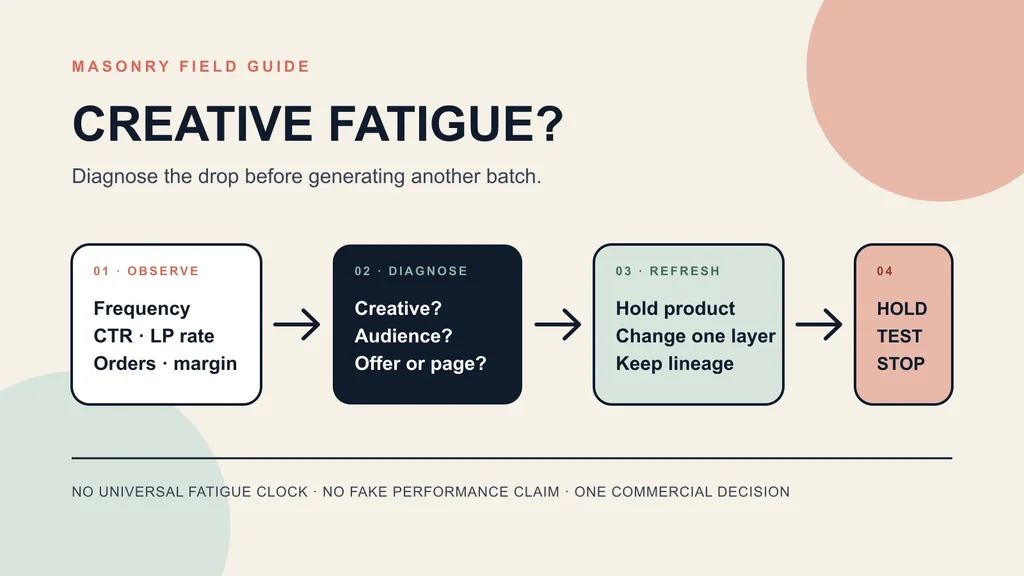
This workflow starts with the commercial question: where did the loss appear? It then changes the smallest useful creative layer, keeps the current ad as a control, and records enough lineage to learn from the result.
Evidence boundary: NORTHLINE is a fictional serum, and the metric rows below are planning examples—not campaign results or benchmarks. The image-generation job, files, prompt, dimensions, and rejection are real. No live ad test was run, so this article does not claim a winner, lift, or ideal fatigue clock.
Diagnose the layer that changed
Use comparable windows: the same account, campaign objective, SKU, market, attribution setup, and enough time to absorb normal weekday effects. Annotate launches, discounts, outages, feed changes, and tracking releases before comparing the numbers.
| Observed pattern | Plausible explanation | Check before generating |
|---|---|---|
| Frequency rises; outbound CTR falls; post-click purchase rate is stable | The execution or message may be losing attention within the reached audience | Audience overlap, placement mix, comments, delivery concentration, and a controlled execution refresh |
| CTR is stable; landing-page purchase rate falls | The ad still earns clicks, but the destination or commerce promise may have weakened | Variant, price, offer, shipping, inventory, page speed, checkout, payment methods, and event integrity |
| Reach falls while CPM or auction conditions change | Delivery or competition may be the constraint | Budget, bids, audience size, placements, seasonality, auction changes, and account status |
| Platform conversions fall but store orders do not | Measurement may have moved | Pixel/CAPI deduplication, consent, event IDs, attribution window, UTMs, timezone, and release history |
| Both CTR and post-click conversion fall | More than one layer may have changed | Reconstruct the full timeline; do not assume one new image can isolate the cause |
The first row is consistent with creative attention decay; it does not prove it. Frequency is an account-specific diagnostic, not a universal threshold. An ad can remain profitable at high frequency or fail at low frequency when the offer is wrong.
Download the creative-fatigue diagnosis sheet. It contains two fictional examples with arithmetic you can replace: one attention-decay pattern and one destination-page pattern. Every row is marked FICTIONAL_PLANNING_EXAMPLE_NOT_BENCHMARK so it cannot quietly become a performance claim.
For NL_VITC_ROUTINE, the example frequency moves from 50,000 / 30,000 = 1.67 to 52,000 / 22,000 = 2.36; outbound CTR moves from 750 / 50,000 = 1.50% to 520 / 52,000 = 1.00%; landing-page purchase rate remains about 5%. That earns a creative hypothesis. In NL_VITC_PAGECHECK, CTR stays near 1.5% while landing-page purchase rate halves from about 5.1% to 2.6%. That sends the team to the offer, page, checkout, or tracking first.
Refresh one layer, not the whole campaign
This article begins after a creative has delivery history. The one-SKU creative testing matrix is the earlier-stage workflow for choosing among an initial product control, routine context, and product world. A refresh test has a different question: can a new execution recover qualified attention while the commercial contract stays fixed?
Use this hierarchy:
- Execution refresh: keep the buyer idea and copy; change crop, camera, layout, light, pace, or opening frame.
- Message refresh: keep the SKU and offer; change one approved buyer problem, proof point, or objection.
- Offer refresh: change price, bundle, discount, or terms only with an updated authority record and destination.
- Audience or placement test: treat this as a distribution change, not a creative win.
Start at the smallest layer capable of explaining the decline. If an execution refresh restores qualified attention but purchases do not recover, the creative team has learned something useful without pretending the entire funnel is fixed.
First-hand refresh: one attractive failure
The control below came from our initial routine-context matrix. It is not a proven ad winner; it is simply the existing execution whose idea we wanted to preserve.
We asked Masonry to alter composition, camera angle, light direction, and shadow while keeping the product immutable:
masonry image "Using the supplied reference image as the immutable product, create one 4:5 paid-social ecommerce photograph that refreshes the existing morning-routine shelf execution without changing its buyer idea. Place the exact NORTHLINE Vitamin C bottle in the lower-right third on a pale warm-gray limestone bathroom shelf, photographed from a slightly higher three-quarter angle with a stronger diagonal band of soft morning window light. Keep the upper-left 40 percent quiet warm off-white negative space for approved copy added later. Change only composition, camera angle, light direction, and shadow. Preserve exactly the bottle silhouette and proportions, orange liquid and fill line, transparent over-cap, silver pump geometry, white label size and placement, and every character of NORTHLINE, VITAMIN C, 30 ML. One bottle only. No person, hand, fruit, leaves, water, box, claim, icon, headline, price, CTA, watermark, or extra text. Return a review candidate, not a publish-ready claim." \ --model gemini-3.1-flash-image-preview \ --ref ./northline-approved-source.webp \ --aspect 4:5 \ --seed 2026081801
The live job d72d4488-ea23-4557-872b-88c15e971d63 succeeded in 5.092 seconds and returned a 928 × 1152 file. It is visually strong—and rejected.
The visible wording survived, but the physical package did not. That is enough to fail the product gate. Re-rolling until a pretty output passes would obscure the cost of the workflow and could still miss subtle SKU drift.
Source-faithful fallback: preserve the product pixels
When exact geometry matters, stop asking the model to redraw the product. The fallback below uses the approved source image pixels inside a deterministic 4:5 layout. The frame, crop, and negative space change; the bottle itself does not.
This fallback is less cinematic, but it is honest, editable, and fast to version. Add approved copy after the product and layout pass. Export each placement from the same reviewed design record; do not let an auto-crop cut the label or convert the reserved copy zone into a new visual treatment without review.
A genuinely different buyer idea should remain outside this execution cell:
Download the refresh lineage sheet. It records parent asset, changed layer, source path, method, job ID, seed when known, SHA-256, product review, hypothesis review, disposition, and evidence status. NOT_RECORDED is used instead of inventing missing provenance.
Build a test that can answer one question
Keep the old creative live as a control unless there is a safety, compliance, inventory, or brand reason to stop it. Then make the comparison as clean as the platform and budget allow.
| Field | Fixed contract for an execution refresh |
|---|---|
| Commercial object | Same SKU and variant, approved offer, inventory status, price, shipping terms |
| Message | Same approved primary text, headline, CTA, claims, and legal copy |
| Destination | Same final URL and landing-page version |
| Distribution | Same audience logic, optimization event, placements, attribution, and budget treatment |
| Changed variable | One named execution layer: composition, crop, camera, light, or first frame |
| Primary outcome | Adequately measured purchase, contribution, or the real downstream campaign objective |
| Diagnostics | Reach, frequency, outbound CTR, landing-page views, add-to-cart, checkout |
| Guardrails | Returns, product complaints, “not as described,” margin, tracking discrepancies |
Meta currently provides creative tooling that can generate or vary backgrounds, formats, and other treatments, and Ads Manager can create an A/B test. Those are capabilities, not evidence that automated variation will improve your store. Preview every delivered version and preserve the platform settings with the result. See Meta's creative strategy guidance, Advantage+ creative overview, and Ads Manager workflow.
Merchant conversations show why this diagnosis matters. Recent threads ask whether rapid fatigue is really caused by a narrow audience, whether refresh cadence should be weekly or performance-led, and how small teams can sustain production. These are qualitative signals of workflow demand, not benchmark sources: fast creative-fatigue discussion, refresh-cadence discussion, and production-burnout discussion.
Measure cost per accepted decision—not files generated
The useful denominator is not the number of images downloaded. Track:
- generation and design attempts;
- review minutes and rejection reasons;
- accepted, placement-ready variants;
- spend required to reach the declared decision rule;
- downstream purchase or contribution result;
- whether the result changed the next production decision.
In this run, one new model output produced zero approved product creatives. The deterministic source-pixel fallback produced one asset accepted for the next review stage. Neither is an ad winner because neither entered a live campaign. Reporting that boundary is more valuable than calling the generation “successful” because the API returned a file.
If clicks remain healthy but commerce performance falls, inspect the Shopify product-image A/B-test workflow and destination handoff before refreshing again. If the accepted static concept needs motion, the product-page to AI video-ad workflow carries approved product evidence through keyframe, clip, destination, and purchase-oriented measurement. For a broader acquisition-to-retention sequence, use the AI ecommerce workflow map.
Bottom line
Creative fatigue is a diagnosis to test, not a calendar reminder. Locate where the decline appears, rule out audience, auction, offer, page, checkout, and tracking changes, then refresh one creative layer while keeping the current ad as a control. Preserve the sold product, record rejected outputs, and let downstream economics—not novelty, CTR alone, or generation volume—decide what scales.