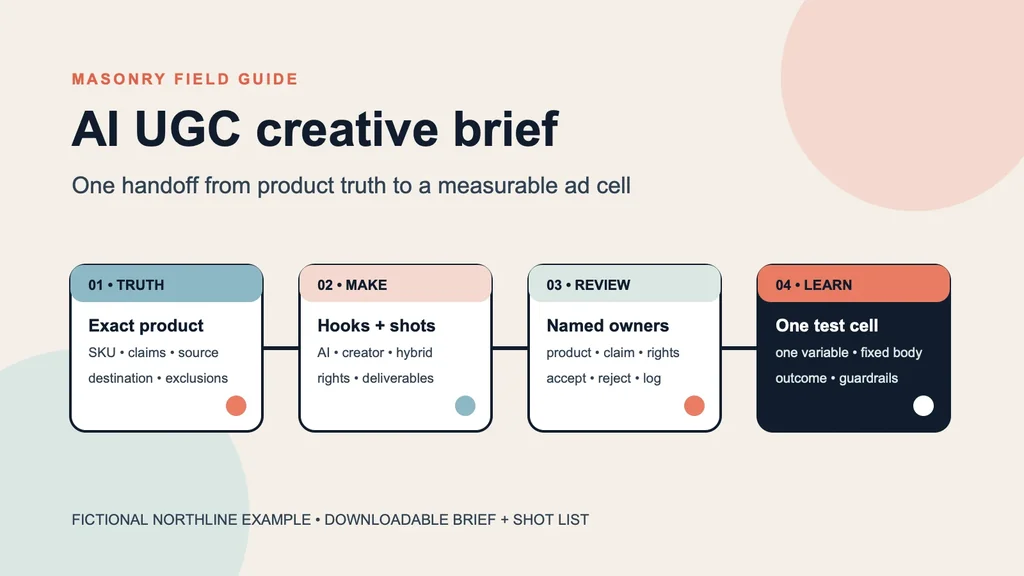
An AI UGC creative brief should let an editor, creator, or model answer five questions before production starts: What product is authoritative? What may the ad communicate? What must be delivered and licensed? Who accepts or rejects it? Which single test cell receives it? If the brief cannot answer those questions, it is a mood board—not a production contract.
This page includes a filled fictional example for NORTHLINE, a six-shot production list, and a route guide for AI-only, real-creator, and hybrid work. Download the filled AI UGC creative brief and download the editable shot list. Replace every sample value with your own approved product, claims, rights, destination, channel, and measurement records.
Evidence boundary: NORTHLINE is fictional. The filled fields, hook lines, product record, acceptance rules, and test plan demonstrate a workflow; they are not customer evidence, legal advice, platform approval, performance benchmarks, or observed Masonry results. Confirm current platform, disclosure, intellectual-property, advertising, employment, privacy, and contract requirements with qualified owners.
Why “make it authentic” is not a brief
Current merchant discussions repeatedly ask for the operational detail hidden behind a UGC order: the actual brief, contract, rights, raw footage, revision rules, and tracking system. One current thread distinguishes receiving the exported video from having paid usage, raw clips, creator-handle advertising permission, a defined term, revision coverage, and cleared commercial music. That thread is anonymous qualitative evidence, not a legal rule or rate benchmark. Read the merchant rights discussion.
Another practitioner argues that requests such as “keep it authentic” and “make it 30 seconds” leave creators to invent the strategy. Their recommended handoff includes the exact hook, message blocks, references, shots, technical specification, and variants. The post may be promotional, so its performance claims are not used here; the recurring ambiguity is the useful signal. Read the vague-brief discussion.
Official production guidance supports two harder boundaries. TikTok Shop says the product represented in content should match the product detail page, including applicable variations. Google's YouTube production guide puts opening, close product or talent shots, early audio, extra footage, and CTA variants into pre-production. Neither source promises approval or performance. They support writing product consistency and shot variants before filming or generation. See TikTok Shop's product consistency guidance and Google's YouTube ad production guide.
The supplied Search Console export contains adjacent non-brand AI product-video demand but no exact AI UGC creative brief template query. This page therefore expands into externally observed merchant intent. It does not claim an existing ranking.
Where this template fits in the workflow
Do not start a brief by asking a model for hooks. Start with the decision already earned upstream:
- Use the review-mining workflow to turn attributable feedback into a buyer question without converting frequency into a product claim.
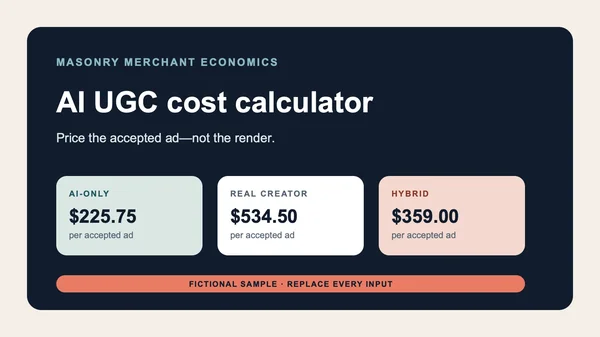
- Use the AI UGC cost calculator to choose AI-only, real-creator, or hybrid production on cost per accepted ad.
- Use this template to define the exact handoff, rights, shots, acceptance gate, and test cell.
- Use the real-product AI UGC workflow when a source-controlled motion candidate is part of the job.
- Use the one-SKU ad testing matrix to isolate the creative variable after approval.
Each page owns a different decision. This one begins after the angle and route are chosen and ends before the asset enters media.
1. Give the brief an ID, decision, and version
Use a stable brief ID, version, status, owner, and named test cell. Write the commercial decision in plain language: for example, “Can a product-clarity opening improve qualified product-page visits versus the control?” Do not use “make three viral ads” as the decision. Viral is neither a production requirement nor a measurable business contract.
The NORTHLINE example permits one variable: the opening visual and first spoken line. The product, variant, offer, audience, destination, CTA, body, duration band, placements, budget rule, optimization event, and attribution treatment stay fixed. A creative change outside that list requires a new version or test cell.
This discipline also makes rejection useful. If a producer cannot deliver the requested interaction without changing the package, the team can change routes instead of quietly changing the brief.
2. Make product authority explicit
Attach or reference the exact approved product record: SKU, variant, color, size, materials, included items, visible label, quantity, sold configuration, and destination-page snapshot. Identify what the media actually reveals and what remains unseen.
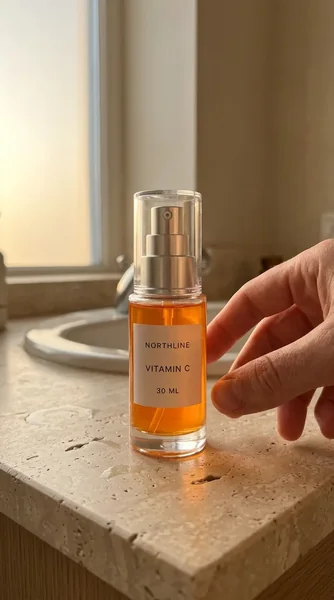
For the fictional NORTHLINE bottle, the authority allows one amber-liquid 30 ML bottle with a silver pump, clear cap, and three visible label lines. It does not authorize an ingredient, result, certification, texture, scent, reverse label, bundle, applicator, before-and-after state, or personal experience. A model should not infer those details from category convention.
Treat the product-page URL as retrieval convenience, not immutable truth. Pages can change and a URL alone may omit the exact variant or historical state used in the campaign. Preserve a reviewed snapshot or manifest with the brief. The Shopify product-page-to-video workflow shows why: two attractive AI returns changed the approved graphite plate, while a deterministic fallback preserved the source pixels.
3. Separate a buyer question from claim authority
A frequent review theme can justify which question to address; it cannot automatically authorize the answer. Give every line one authority type:
- directly visible product fact: inspectable in the approved source;
- approved merchant fact: supported by the current product record;
- substantiated claim: linked to the owner's evidence and permitted scope;
- real testimonial: attributable experience with permission and required disclosure;
- creative hypothesis: a line to test that still cannot invent a product fact;
- prohibited: unsupported, expired, misleading, or outside the brief.
NORTHLINE's hook asks whether the shopper wants the size and dispenser clear before buying. Its answer—30 ML and pump bottle—comes from the approved product record. It does not say customers love the format, that the pump is better, or that the product produces a result.
Add prohibited language, not just approved copy. List unsupported superlatives, medical or efficacy language, rankings, scarcity, savings, personal outcomes, consensus claims, and any category-specific risk. This gives the producer a boundary when generating variations.
4. Request hook variants against a fixed body
Three hooks are useful only if each is a separately identifiable hypothesis. A practical pilot can pair three openings with one reviewed body and end card:
| Hook ID | Opening job | Fictional line | What stays fixed |
|---|---|---|---|
| A | Clarify a purchase detail | “Want the size and dispenser clear before you buy?” | body, product, CTA, destination |
| B | Show the package up close | “Here is the 30 ML pump bottle up close.” | body, product, CTA, destination |
| C | Invite product inspection | “One product detail worth checking before checkout.” | body, product, CTA, destination |
Do not combine the strongest-looking frames from every variant after results arrive and call the compilation a winner. Preserve the exact released files, IDs, exposures, and outcomes. A hook winner is evidence about that test cell—not a universal message rule.
5. Turn the concept into a shot list
The downloadable TSV gives every shot an ID, duration, job, required source, action, framing, audio, deterministic overlay, product-truth gate, claim authority, rights gate, route, and acceptance rule.
The sequence is intentionally small:
- Hook A: source-controlled close-up with no added person.
- Hook B: separately consented hand plate, with no use or result implication.
- Product reveal: bounded motion around the approved front view.
- Factual proof: hold on the pump and 30 ML mark.
- Clarification: return to the full package and reviewed destination.
- End card: add the approved CTA outside generation.
Shots do not need cinematic prose. They need enough specificity to know whether the return passes. “Beautiful lifestyle shot” is subjective. “Exactly one approved SKU, no invented reverse panel, one slow camera move, no application or result” is reviewable.
6. Write deliverables and rights as separate fields
An exported edit, raw clip, project file, caption file, transcript, and source manifest are different deliverables. List each. Then list the rights for each human, likeness, voice, song, stock asset, location, product source, and edit.
At minimum, the responsible owner should resolve:
- ownership or license basis;
- organic and paid usage;
- approved platforms and accounts;
- territory and term;
- raw-footage and edit rights;
- creator-handle advertising or whitelisting;
- exclusivity, renewal, modification, and revision scope;
- synthetic media, sponsorship, testimonial, or other disclosure review.
Do not copy the fictional NORTHLINE wording into a real contract. File delivery is not a substitute for a written rights record, and this template is not legal advice. Requirements depend on the people, assets, jurisdictions, platform, product category, and use.
7. Change route-specific instructions, not the truth contract
AI-only
Use AI-only for a bounded, inspectable visual job that does not depend on a person's claimed experience. Identify the exact source, permitted motion, invisible surfaces, and drift conditions. Keep typeset copy, offer, price, CTA, disclosure, and final assembly deterministic. Reject a polished return if it changes the product.
Real creator
Use a real creator when physical demonstration, accountable likeness, voice, or genuine lived experience is the deliverable. Supply the product, actions, approved and prohibited lines, demonstration boundaries, disclosure decision, technical specification, raw deliverables, revision scope, and written usage record. A real person still does not make an unsupported claim true.
Hybrid
Use hybrid when approved product pixels or real footage remain the truth layer while AI accelerates previsuals, backgrounds, bounded motion, edits, or variants. Identify every component and preserve a source map. Reject an untraceable composite: the reviewer must know which pixels, people, voices, and statements came from which authority.
The AI video model comparison can help choose a candidate route. Its observed returns do not replace a brief-specific product-fidelity test.
8. Name the reviewers and rejection reasons
“Team approval” is not an owner. Assign four accountable checks:
- Product owner: SKU, variant, package, quantity, behavior, and destination match.
- Claims owner: spoken, written, demonstrated, and implied statements.
- Rights owner: people, voice, music, footage, location, paid usage, term, territory, and disclosure record.
- Growth owner: test ID, one-variable rule, CTA, destination, file version, and tracking.
Use explicit dispositions such as REJECTED, SECONDARY_REVIEW, and APPROVED_FOR_NAMED_CELL. Record rejection reasons instead of deleting failed attempts. Product drift, unsupported claims, missing permissions, wrong destinations, unapproved extra variables, unreadable captions, and technical failures all teach the next production decision.
Approval should name the exact file and version. A creator's draft, AI return, caption revision, and final export are not interchangeable.
9. Map the asset to a controlled test
The brief ends at a named creative cell, not a generic campaign folder. Freeze the product, offer, audience, destination, CTA, body, placements, budget treatment, optimization event, and attribution method when testing the opening. Preserve the control and eligibility rules before seeing results.
Choose the primary business outcome before launch. Use attention, view completion, click-through, landing-page view, add-to-cart, and checkout as diagnostics. Monitor wrong-product questions, claim complaints, support contacts, rights incidents, returns, and variant mismatch as guardrails. Report raw counts and denominators when samples are small.
A detailed brief can reduce production ambiguity and make results attributable to a known asset. It cannot guarantee performance. Revenue claims require an adequate design, mature downstream outcomes, and an honest incremental-cost boundary.
Common AI UGC brief failures
- Mood without authority: references describe style but no source defines the exact product.
- One vague deliverable: “three UGC videos” omits hooks, body, raw clips, captions, transcript, formats, and versions.
- Frequency becomes a claim: review themes are turned into product promises without separate evidence.
- Rights are assumed: receipt of a file is treated as perpetual paid usage of every person, voice, song, and clip.
- AI becomes a testimonial: a synthetic person is scripted to imply experience that never happened.
- Model-generated copy: the visual model invents label, price, offer, disclosure, or CTA text.
- No rejection path: failed product details disappear from the record and apparent acceptance is overstated.
- Several variables per cell: hook, offer, audience, body, destination, and budget all change at once.
- No destination match: the ad shows a package, quantity, color, or configuration the linked page does not sell.
- Approval by folder: the team approves a concept but cannot identify the exact released file.
Bottom line
A strong AI UGC creative brief is not long for its own sake. It makes ambiguity expensive before production rather than after launch. Define the exact product, authority for every message, prohibited implications, hook IDs, fixed body, shots, route, people and media rights, deliverables, review owners, rejection reasons, destination, and test cell.
Then produce the smallest useful pilot. Keep product truth and deterministic copy under merchant control. Preserve failed attempts. Approve an exact file for an exact cell. The result is not a guaranteed winning ad; it is a production system that can tell you what was made, why it was accepted, where it ran, and what the next decision should be.