The cheapest way to render a UGC-style clip is not necessarily the cheapest way to produce an ad your ecommerce team can publish. A synthetic product demo can take seconds to generate and hours to correct. A creator quote can look expensive until it includes a usable product interaction, licensed footage, and fewer rejected attempts. A hybrid route can save time—or duplicate the work of both systems.
The useful comparison is cost per accepted ad. Give AI-only, real-creator, and hybrid production the same deliverable, the same acceptance gate, and the same internal labor rate. Then count every attempt, fee, right, review, correction, and publishing task needed to reach that gate.
For a fast decision: use AI-only when the visual job is bounded and does not depend on a claimed experience; use a real creator when physical demonstration, likeness, or trust is the product; test hybrid when AI can accelerate concepts or variations while real footage remains the truth layer. Price the route only after making that decision.
Evidence boundary: the NORTHLINE requirement, prices, acceptance rates, labor times, contribution, sessions, and calculated results on this page are fictional planning inputs. They are not vendor quotes, creator rates, market benchmarks, observed Masonry performance, or ROI. The formulas are reproducible; replace every input with your own paid-pilot records.
Why sticker price gives merchants the wrong answer
AI UGC products commonly sell subscriptions, credits, generations, avatars, or exported minutes. Creators may quote by concept, raw clip, edited ad, package, or usage period. Those units are not comparable and none guarantees an accepted ad.
Current merchant discussions expose the missing costs. One advertiser with an established brand worried about intricate product details, the time required to learn and steer tools, and scenes needing specific physical interaction. A separate merchant with only a few hundred dollars to allocate questioned whether AI UGC subscriptions were worth their price; a reply recommended using AI for research, hooks, scripts, iteration, and editing when a synthetic final harms trust. These are anonymous qualitative signals, not price or performance benchmarks. Read the advertiser discussion and the budget-constrained merchant thread.
Another merchant described using AI to prototype concepts before filming. That supports a hybrid hypothesis, but their self-reported results cannot establish a universal saving. Read the prototyping account.
Google's current video-creative guidance frames the job around Attention, Branding, Connection, and Direction. Its campaign workflow also treats the video, CTA, and destination URL as separate components. That is a useful production boundary: generation can supply a reviewed visual asset, while the merchant controls the message and destination. It does not predict performance. See Google's ABCD guidance and video campaign workflow.
The supplied Search Console export contains adjacent non-brand product-video and AI-tool demand, but no exact AI UGC cost calculator query. This page expands into externally observed merchant intent; it does not claim Masonry already ranks for it.
Define the accepted ad before choosing a route
Use one written acceptance contract across all three routes. For a short-form ecommerce ad, include:
- Product truth: the exact SKU, variant, materials, geometry, labels, quantity, included items, product behavior, and destination-page match.
- Claims and disclosure: every product statement comes from the approved claim record; testimonials describe real experience; required sponsorship or synthetic-media disclosures are present and readable.
- Rights: product, music, creator likeness, voice, location, raw footage, edits, paid usage, territory, duration, and renewal terms are documented.
- Technical delivery: aspect ratio, duration, resolution, safe zones, captions, audio, file format, and platform constraints pass.
- Channel role: the approved hook, audience, offer, CTA, destination, and test cell are declared even when those elements are added outside generation.
- Approval: named owners for product, legal or claims, brand, and growth accept the exact version.
An attractive clip that changes the package or demonstrates a feature the product does not have is rejected. A creator clip without paid usage rights is rejected. A technically valid AI render that implies first-hand experience is rejected. Rejections stay in the numerator because they consumed money and time.
For the source-controlled production gate, use the real-product AI UGC workflow. It shows a real keyframe and motion return, with product truth and claims kept separate from the hook.
Choose the route before pricing the batch
AI-only pilot
Use an AI-only pilot for a simple visible product, a bounded scene, no claimed personal experience, and motion that can be checked directly against approved media. Product showcases, environmental variations, and fast hook previsuals fit better than intricate demonstrations.
The constraint is product truth. If the model must infer the back of an object, articulate complicated hardware, render tiny regulatory copy, or show the product contacting skin or food, the acceptance rate may collapse. The Shopify product-page-to-AI-video workflow demonstrates a safer no-creator route and preserves rejected generative returns instead of hiding them.
Real-creator pilot
Use a real creator when the ad depends on lived experience, credible delivery, detailed physical demonstration, a recognizable person, or a rights-controlled likeness. The brief should specify the exact product, actions, prohibited claims, deliverables, raw footage, revisions, paid usage, territory, term, renewal, and disclosure.
Real footage does not automatically make a claim true or an ad effective. It simply gives the team a better production route for jobs where real interaction and accountable consent are part of the deliverable.
Hybrid pilot
Use hybrid production when AI can create briefs, scripts, hook variants, previsuals, backgrounds, edits, or additional reviewed shots while a creator supplies the trustworthy interaction. Keep approved footage and product pixels authoritative; vary only the declared component.
Hybrid becomes wasteful if the team pays for a full creator package and then regenerates every scene without a testing hypothesis. Use the one-SKU ad testing matrix to assign one visual variable per cell before commissioning or generating a batch.
The AI UGC cost formula
Download the editable input table and the checked sample results. Both are tab-separated, so they can be opened in spreadsheet software or reviewed in version control.
For every route, enter the same required accepted-ad count and then record:
- paid or pilot acceptance rate under the shared contract;
- fixed external production, including creator, studio, samples, and shipping where applicable;
- usage-rights, disclosure, and legal-review budget;
- software or variable cost per attempt;
- prep minutes per accepted concept;
- production and review minutes per attempt;
- correction and publishing minutes per accepted ad;
- burdened internal hourly rate.
Then calculate:
planned attempts = ROUNDUP(required accepted ads / acceptance rate) labor hours = ( prep minutes per accepted concept * required accepted ads + production minutes per attempt * planned attempts + review minutes per attempt * planned attempts + correction minutes per accepted ad * required accepted ads + publishing minutes per accepted ad * required accepted ads ) / 60 total production cost = fixed external production + rights/disclosure/legal-review budget + software cost per attempt * planned attempts + labor hours * burdened internal hourly rate cost per accepted ad = total production cost / required accepted ads
Do not round the required attempts down. If eight accepted ads at a 35% pilot acceptance rate require 23 planned attempts, all 23 carry variable production and review cost.
Worked fictional example: eight accepted ads
NORTHLINE needs eight accepted 9:16 ads. Each route receives the same product and claims record, hook allocation, duration range, caption requirement, CTA, destination, review owners, and acceptance gate. The sample uses $60 per internal hour, $45 contribution per incremental order, and 25,000 eligible sessions.
| Route | Fictional acceptance | Planned attempts | Labor | Total production cost | Cost / accepted ad | Gross break-even orders | Required absolute lift |
|---|---|---|---|---|---|---|---|
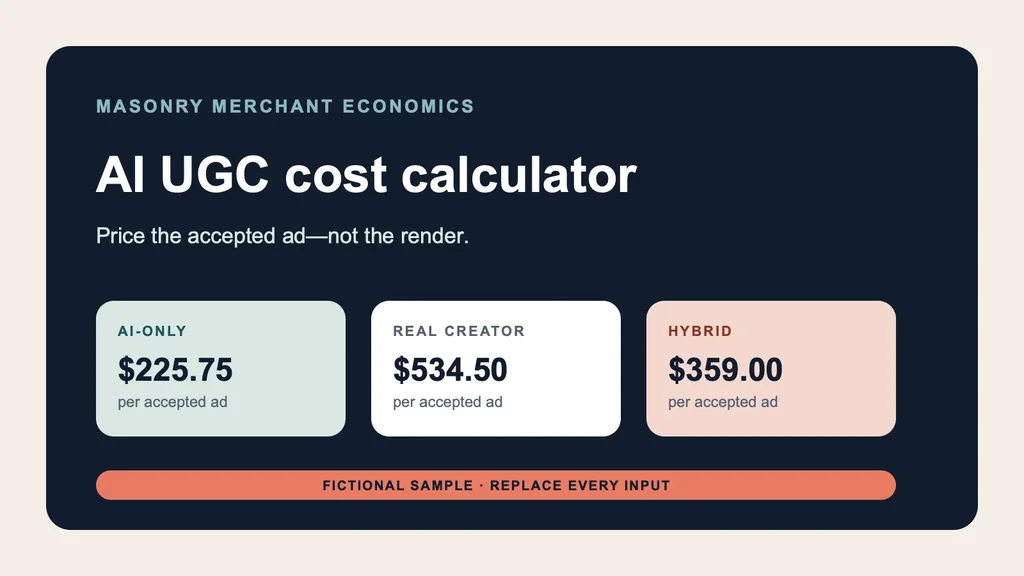
| AI-only | 35% | 23 | 19.67 h | $1,806 | $225.75 | 41 | 0.164% |
| Real creator | 80% | 10 | 29.93 h | $4,276 | $534.50 | 96 | 0.384% |
| Hybrid | 65% | 13 | 21.35 h | $2,872 | $359.00 | 64 | 0.256% |
The AI-only route is cheapest in this fictional example, but that conclusion comes from the inputs—not from a universal AI advantage. Its low 35% acceptance requires 23 attempts and almost 20 internal hours. A regulated product, exact mechanical demonstration, or high correction burden could reverse the ranking. A simple product with approved source media could improve it.
The creator route has higher fictional external and rights costs, but also the strongest assumed acceptance. The hybrid route sits between them because it pays for real production and AI variation. No row estimates media cost, revenue, conversion, or customer response.
Run sensitivity cases before choosing. Reduce acceptance, increase correction time, and add one unexpected revision round. If the winning route changes under a modest adjustment, buy a smaller pilot rather than a large package.
Break-even orders are a threshold, not ROI
Use contribution per incremental order—not revenue—to translate production cost into a conservative gross threshold:
gross break-even orders = ROUNDUP(total production cost / contribution per incremental order) gross break-even absolute conversion lift = gross break-even orders / eligible sessions
At the fictional $45 contribution and 25,000 eligible sessions, AI-only needs 41 incremental orders, equal to 0.164 percentage points of absolute conversion lift, to cover the full $1,806 production cost. Hybrid needs 64 orders or 0.256 points. Real creator needs 96 orders or 0.384 points.
These are deliberately conservative gross project-cost thresholds. If a new route replaces planned production, compare the incremental cost difference between routes. Never describe the threshold as predicted lift, expected revenue, or proven ROI.
Observed ROI requires a valid test or comparable rollout:
observed ROI = (observed incremental contribution - incremental production cost) / incremental production cost
Join the exact creative version to eligible exposure and downstream orders. Keep the offer, destination, audience, optimization event, budget rule, and attribution treatment stable. Wait for relevant cancellations, refunds, and returns. If the design cannot isolate creative impact, report production efficiency and assisted progression separately.
A pilot that produces useful evidence
- Define two to four accepted ads, not a large monthly output target.
- Give every route the same product truth, hook allocation, length, channel, and review contract.
- Record each attempt, elapsed time, paid cost, internal minutes, rejection reason, and final disposition.
- Calculate acceptance and cost per accepted ad without removing failed attempts.
- Release only approved assets into named creative cells.
- Treat attention, click, landing-page, and checkout metrics as diagnostics; use adequately measured incremental contribution for the commercial decision.
- Preserve product complaints, variant mismatch, rights issues, and returns as guardrails.
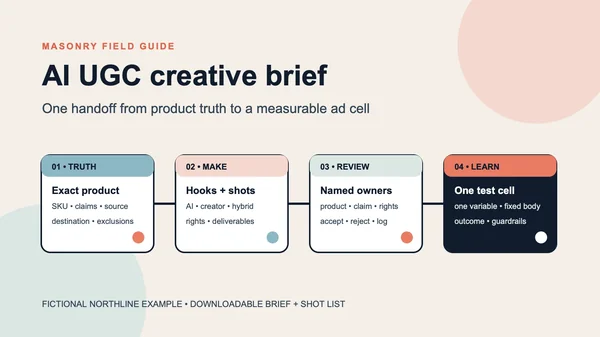
After choosing the route, use the AI UGC creative brief template to turn the shared acceptance contract into hook IDs, shots, deliverables, rights, named reviewers, rejection reasons, and one controlled test cell.
This is where production economics and ad testing meet. A cheaper accepted ad improves creative throughput; it does not automatically improve acquisition economics. Conversely, a more expensive creator asset can still be rational if it provides evidence or interaction the AI route cannot safely produce.
Common failure modes
- Comparing unlike ads: an AI product pan versus a creator demonstration with voice, edits, and paid usage.
- Free internal labor: excluding briefing, prompt work, file handling, review, correction, captioning, disclosure, and publishing.
- Ignoring rights: treating a creator fee as perpetual paid usage or assuming a synthetic likeness has no approval obligations.
- Optimistic acceptance: borrowing a vendor gallery or another brand's results instead of measuring a paid pilot.
- Fabricated experience: asking a synthetic person to make a testimonial or first-hand claim that did not happen.
- Hidden product drift: accepting the hook because it looks polished before comparing every frame with the approved SKU.
- Mixing production and media: claiming ROI from a cost model without a controlled downstream outcome.
- Scaling too early: buying annual software or a large creator package before the acceptance rate and correction burden are known.
Bottom line
Choose AI-only, real-creator, or hybrid UGC by the truth and interaction the ad requires. Then price every route on the same accepted-ad denominator. Count rejected attempts, creators, samples, shipping, rights, software, labor, review, correction, disclosure, and publishing. Convert the total into a break-even threshold, and earn any ROI claim with observed incremental contribution after returns mature.
The calculator is not a verdict that AI wins. It is a way to stop buying incomparable output units and fund the smallest pilot that can reveal the right production system.