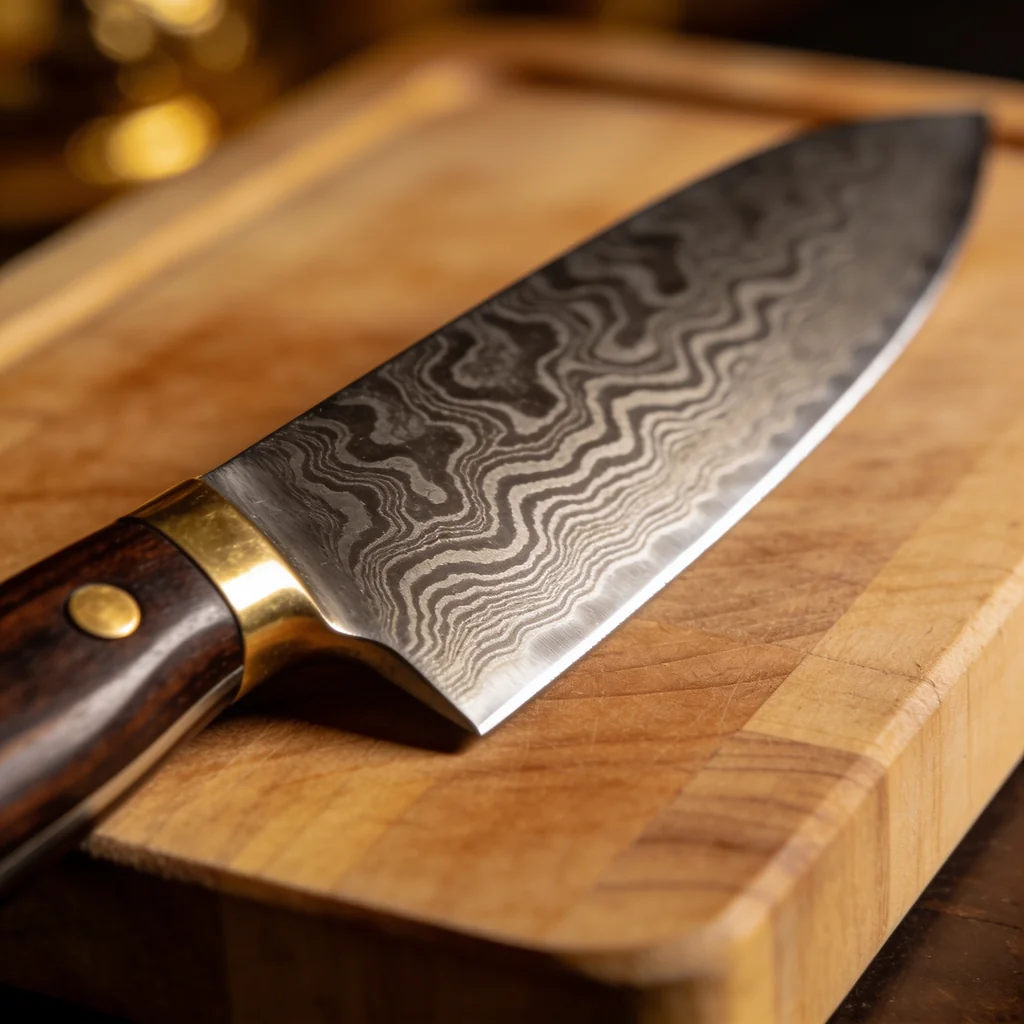
A damascus-style knife image combines reflective metal, a layered pattern, a sharp edge, and detailed handle construction. An image model can make that combination look convincing without representing a real blade.
This first-hand test asked four routes to render the same fictional chef's-knife brief. Every displayed result contained a plausible patterned blade. Every result also invented its own pattern, geometry, handle, and scene because the prompt supplied no product reference.
Evidence boundary: this is one text prompt, one displayed output per model, and one reviewer's visual assessment—not a multi-seed benchmark, metallurgical validation, safety review, or reference-fidelity test. The recorded credit figures can change. Because the knife is fictional, the test cannot prove that a model will preserve a real blade's visible pattern or construction.
Quick answer
- Preferred blade-focused hero in this run: Seedream 4.5. Its displayed pattern had the clearest layered wave and the macro emphasized blade material.
- Preferred complete lifestyle scene in this run: Nano Banana 2. It staged a coherent rustic environment around another invented knife.
- Other plausible interpretations: GPT Image 2 and FLUX.2 Pro both returned patterned blades with different geometry and material treatment.
- Shared limitation: none of the images represents a sellable SKU. A category prompt generated four plausible but different knives.
Those observations describe four candidates, not reliability rates. Cost per accepted asset requires multiple seeds and a real approved source.
The controlled brief
Each route received the same core instruction:
Brand-free 8-inch chef's knife with a damascus-style layered steel blade, full-tang walnut handle, one brass bolster, and three aligned brass rivets. Blade-forward three-quarter product hero on a walnut cutting board, soft raking window light that reveals the pattern without blown glare, coherent edge and contact shadow, photoreal. No logo, text, food, hand, sheath, second knife, chips, blood, or damage.
The requirements are observable, but the phrase “damascus-style” still describes a category rather than an exact blade. A real SKU test needs source images and construction details.
Four outputs from the same brief
Seedream 4.5 produced the preferred macro according to the reviewer. Alternating light and dark waves remain visible across the reflective blade, while the edge and wood-and-brass handle look coherent at article size. The result is useful as a material and lighting concept. It is not evidence that the pattern, grind, edge, or handle matches a manufactured knife.
Nano Banana 2 produced the preferred full lifestyle composition in this run. Its blade pattern is more turbulent, and the knife sits naturally within a rustic kitchen scene. The complete composition can make it easier to overlook changes in tip, heel, handle, rivets, and product scale, so the SKU comparison must come before scene approval.
GPT Image 2 returned another plausible knife with a flowing pattern on a darker reflective blade. The handle and brass details read cleanly, but the higher recorded cost of this one generation does not establish higher acceptance rates. There is no exact source in the test against which to score product fidelity.
FLUX.2 Pro produced a softer interpretation with a recognizable layered-wave effect. It works as another blade-forward concept at the lowest recorded cost in this set. “Recognizable damascus” is not the same acceptance criterion as exact pattern, steel, grind, edge, and construction.
Side-by-side result
| Model | Pattern assessment in this output | Blade presentation | Handle presentation | Product identity | Recorded credits |
|---|---|---|---|---|---|
| Seedream 4.5 | Reviewer's preferred defined wave | Macro, reflective | Detailed wood and brass | Invented | ~4.8 |
| Nano Banana 2 | Coherent turbulent pattern | Lifestyle | Plausible wood and brass | Invented | ~9.3 |
| GPT Image 2 | Coherent flowing pattern | Darker hero | Clean wood and brass | Invented | ~26.4 |
| FLUX.2 Pro | Coherent softer wave | Blade-forward | Plausible wood and brass | Invented | ~3.6 |
The table records what is visible in four outputs. It does not establish which route preserves an actual knife best because the test supplied no actual knife.
Product fidelity checks for a real knife
“The blade looks good” is too broad. Compare:
- overall length, blade length, height, profile, belly, heel, and tip;
- spine thickness and taper, grind type, bevel, edge line, and choil;
- visible layered pattern, etch contrast, finish, polish, and reflections;
- tang construction, bolster shape, handle profile, scales, liners, rivets, grain, and finish;
- logos, maker's marks, steel designation, model text, and country markings;
- included sheath, guard, packaging, or accessories;
- surface contact, blade straightness, shadow, reflection, scale, and perspective;
- safe staging that does not imply unsupported use or include accidental extra blades.
If the knife is sold on a specific steel, grind, construction, or pattern, a plausible substitute is a product misrepresentation.
A reference-first cutlery workflow
- Lock the approved source. Use high-resolution product photographs or renders of both blade faces, spine, edge, tip, heel, and handle.
- List the invariants. Pattern, geometry, grind, finish, handle construction, hardware, markings, and included parts cannot change.
- Generate the environment. Specify surface, props, crop, light direction, reflection control, negative space, and camera placement.
- Review geometry before style. Compare the blade and handle at full size before approving the scene.
- Composite when needed. Preserve a useful generated kitchen or lighting plate and place the untouched approved knife into it if the edit drifts.
- Verify grounding and safety. Check contact, reflection, edge orientation, scale, and whether props or placement imply an unsafe or unsupported use.
- Record approval. Keep the source, prompt, model ID, size, seed when available, candidate, composite, and sign-off.
Current Masonry CLI examples
For a fictional material-and-lighting concept:
masonry image "Brand-free chef's knife with a damascus-style layered blade and walnut handle on a cutting board. Soft raking window light reveals the pattern without blown glare. Coherent edge and contact shadow. No logo, text, food, hand, sheath, second knife, or damage." \ --model seedream-4-5 \ --aspect 1:1 \ --output damascus-concept.png
For a reference-first scene candidate with the current executable Nano Banana 2 model ID:
masonry image "Place this exact knife on a sunlit walnut board. Keep its visible pattern, blade profile, grind, edge, tip, heel, spine, tang, bolster, handle, rivets, grain, finish, markings, and proportions unchanged. Add no food, hand, sheath, second knife, logo, or text." \ --model gemini-3.1-flash-image-preview \ --ref ./approved-knife.png \ --aspect 1:1 \ --output knife-scene-candidate.png
“Unchanged” is an instruction, not a product lock. Compare the candidate with every approved view and composite when it drifts.
Knife acceptance sheet
| Area | Reject the asset when… |
|---|---|
| Blade geometry | length, profile, tip, heel, spine, grind, bevel, edge, or choil differs from the source |
| Pattern and steel | visible layered pattern, etch, finish, reflection, polish, or steel marking changes |
| Handle construction | tang, bolster, scales, liners, rivets, grain, finish, or proportions differ |
| Identity and contents | maker's mark, model text, country marking, sheath, packaging, or included part is wrong |
| Scene and safety | scale, contact, reflection, edge orientation, prop, or use is misleading or unsafe |
| Delivery | crop hides defining detail or compositing adds halos, warped edges, or contradictory reflections |
The bottom line
All four displayed candidates produced plausible patterned knives. That is a narrower and more defensible finding than “damascus is solved.” Each route can create a useful material or lighting concept, while none of these outputs proves fidelity to a real blade.
For catalog work, start from approved knife imagery, define the pattern and construction invariants, inspect geometry before scene quality, and composite when a generative edit changes the product. The product-photography model guide covers broader selection, and the cookware product test examines another reflective-metal category.