Reflective cookware compresses product geometry and environment fidelity into one object. A polished pan can show a believable kitchen while changing the diameter, depth, rim, lining, handle, rivets, base, finish, lid, marks, or reflected room that define the asset.
This test sent one fictional polished copper-saucepan brief through Seedream 4.5, Nano Banana 2, GPT Image 2, and FLUX.2 Pro. The four original outputs below show useful differences in visible metal, room-like reflections, lining, handle treatment, contact, and counter reflection. No real pan, dimensions, construction, materials, finish standard, handle/rivet specification, lid, packaging, reflection plate, compatibility data, safety data, or product record was supplied.
Evidence boundary: this is one text prompt and one displayed output per model. The observations describe visible fictional saucepans—not optical correctness, material composition, thermal behavior, construction, compatibility, safety, model reliability, price/value, studio replacement, or preservation of a real cookware SKU.
Quick answer
- Most detailed displayed room-like reflection: Seedream 4.5 in this run.
- Warmest displayed balanced pan concept: Nano Banana 2 in this run.
- Brightest displayed pan-on-counter reflection: GPT Image 2 in this run.
- Softest displayed metal and reflection detail: FLUX.2 Pro in this run.
- What all four establish: each route made one plausible fictional copper-saucepan concept.
- What none establish: the correct pan, material, lining, gauge, dimensions, handle, rivets, base, lid, reflected environment, compatibility, safety, configuration, or repeated reliability.
One output per route does not establish a universal winner. A reflection that looks continuous at article scale is not necessarily physically correct: the model can invent the object, room, lights, and mapping together.
The controlled concept brief
The original article did not publish the exact prompt. A bounded version matching the displayed subject is:
Fictional brand-free polished copper-look saucepan with straight sides, rounded lower transition, bright silver-look interior lining, long riveted silver-look handle, centered on pale stone beside a window, warm camera-left light, visible room-like reflection on the curved exterior, one contact shadow, square cookware product photograph. No lid, food, steam, utensils, logo, words, measurement, material claim, compatibility claim, safety claim, price, person, watermark, or extra pan.
This prompt can test composition and visible reflective-metal cues. It cannot preserve a SKU because the model invents the diameter, depth, wall, rim, lining, base, handle, attachment, rivets, finish, reflection environment, materials, and hidden surfaces.
Four first-hand outputs
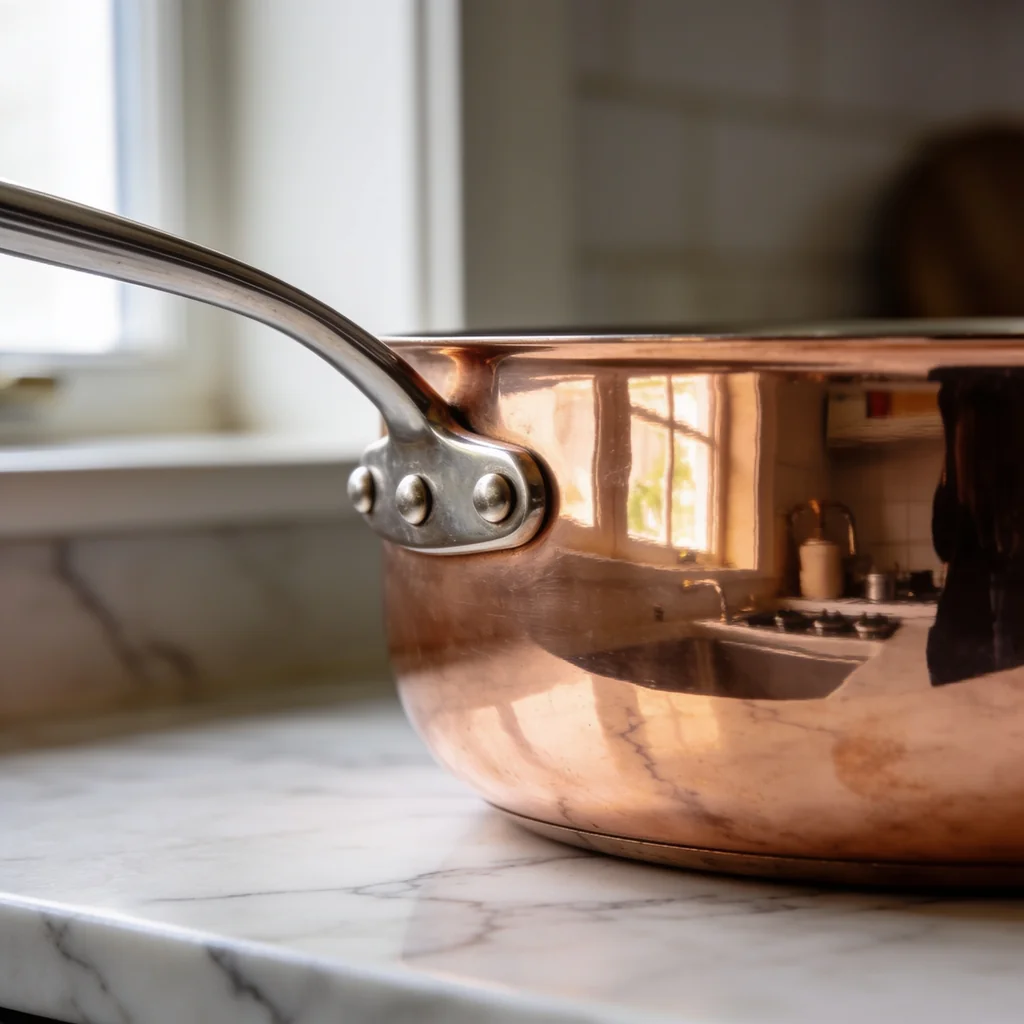
Seedream 4.5 produced the most detailed displayed kitchen-like reflection, a warm copper-colored exterior, bright interior, long handle, and visible attachment points. That supports an art-direction observation about this rendering. It does not establish a coherent real camera/light solution, approved curvature, material, wall/lining construction, handle geometry, rivet count, or environment match.
Nano Banana 2 made a warm, clean pan concept with a visible bright lining, long handle, attachment detail, and room-like reflection. It reads as a finished hero at thumbnail size, which makes it a useful review trap: polish can hide the wrong diameter, depth, rim, base, handle, attachment, material, and sold configuration.
GPT Image 2 produced a bright pan and kitchen treatment with a strong reflection on the polished counter beneath it. That visible relationship is useful for art direction. It is not proof of physical correctness: no pan geometry, surface specification, camera, light position, counter material, or reflection plate was supplied.
FLUX.2 Pro made a plausible overall saucepan concept with a warm exterior, bright interior, long handle, room-like reflection, and counter contact. The reflection also contains a dark human-like form near the center of the pan. It cannot be identified from this image, but it demonstrates why a generated reflection still needs the same crew, equipment, privacy, and environment review as a photographed one. Its finer reflection and attachment detail is less inspectable at article scale.
What this comparison supports
| Question | What the four images show | What remains untested |
|---|---|---|
| Can the routes make a reflective-pan concept? | Yes, once each for this fictional brief. | Reliability across seeds, cookware, finishes, rooms, crops, references, prompts, and current routes. |
| Do visible metal and reflection treatments differ? | Yes; warmth, highlight shape, room detail, distortion, contrast, and counter reflection vary. | Approved material, finish, curvature, camera, lights, room correspondence, occlusion, reflection map, and physical optics. |
| Do body and handle cues differ? | Yes; proportions, rims, interiors, handles, attachments, and visible rivets vary. | Exact dimensions, gauge, lining, ply, base, attachment method, fasteners, balance, lid fit, tolerances, and construction. |
| Is a real cookware SKU preserved? | No evidence; no product source was supplied. | Body, rim, lining, base, handle, helper handle, lid, knob, marks, packaging, accessories, dimensions, and defects. |
| Are performance or safety facts established? | No. | Material, coating, capacity, heat response, compatibility, temperature, care, food-contact, safety, origin, certification, warranty, and every marketed claim. |
The old article called the reflections correctly warped and declared reflective metal solved. The defensible conclusion is narrower: four routes made attractive fictional copper-look saucepans once, and their displayed metal and reflection treatments differ.
Cookware product fidelity checklist
Build the rejection sheet from approved product photography, drawings, measurements, construction specifications, finish standards, reflection references, packaging files, test data, and current product data:
- Body geometry: diameter, depth, capacity-facing dimensions, profile, wall, taper, shoulder/lower transition, rim, rolled/pour edge, spout, base diameter, flatness, curvature, and tolerances.
- Interior and layers: lining appearance, interior finish, exposed edges, clad/ply boundaries, disc base, core visibility, coating boundaries, texture, graduation marks, and intentionally visible wear.
- Handle and attachment: length, width, cross-section, angle, curvature, material-facing cues, finish, heat break, helper handle, guards, weld, rivet count/shape/spacing, screws, brackets, and transitions.
- Lid and controls: included lid, diameter, rim fit, dome/profile, vent, knob/handle, attachment, orientation, material-facing cues, finish, and approved open/closed state.
- Marks and variants: brand, product line, size, capacity, base stamp, material/compatibility symbols, origin, measurement marks, serial/SKU, color, finish, handle, lid, and sold variant.
- Reflection and scene: visible room correspondence, camera/light logic, curve mapping, highlight continuity, occlusion, crew/equipment, window, counter, contact, shadow, counter reflection, color management, and approved retouching.
- Packaging and contents: carton, sleeve, insert, bag, manual, care card, lid, utensils, protectors, spare parts, accessories, and sold configuration.
- Product facts: materials, ply/gauge, coating, capacity, weight, heat response, induction/gas/electric/oven compatibility, temperature, dishwasher/care, food-contact, safety, origin, certification, warranty, and performance remain in approved data and tests.
If the metal and reflection look premium but the body, lining, handle, attachment, base, lid, variant, packaging, or claims differ, it is the wrong cookware asset.
A source-first cookware workflow
1. Capture authoritative sources
Photograph straight side, both handle sides, top, interior, underside/base, rim, pouring edge, handle and attachment macro, marks, lid on/off, packaging, contents, defects, and scale. Add drawings and dimensions, construction/material specifications, finish standards, reflection/room targets, compatibility, care, safety, and current product data.
2. Build the kitchen and reflections deliberately
Generate or photograph an empty counter, stove, shelf, ingredient, lifestyle, or editorial plate at the final crop. Composite approved pan photography, then construct contact, shadow, highlights, reflected environment, and counter reflection deliberately. This keeps the pan deterministic and makes the reflected room reviewable.
3. Test a constrained reference edit
masonry image "Change only the environment to pale stone beside a warm kitchen window. Keep the supplied saucepan unchanged: diameter and depth cues, body profile, rim, pouring edge, interior lining, base, handle length and angle, attachment, rivet count and spacing, finish boundaries, marks, lid and sold configuration. Reflect only the approved kitchen plate in the exterior and add one natural contact shadow. Add no food, steam, utensil, text, claim, person, or extra pan." \ --model gemini-3.1-flash-image-preview \ --ref ./approved-saucepan-three-quarter.png \ --ref ./approved-kitchen-reflection-plate.png \ --aspect 1:1 \ --output cookware-scene-candidate.png
The instruction is not a product or reflection lock. Compare the candidate against every approved product and environment source; composite the approved pan and construct the reflection when exactness matters.
For a fictional concept:
masonry image "Fictional brand-free polished copper-look saucepan with bright silver-look interior, long riveted handle, pale stone counter, warm window light, room-like exterior reflection, one contact shadow, no lid, food, steam, utensil, logo, words, material claim, compatibility claim, person, or extra pan" \ --model seedream-4-5 \ --aspect 1:1 \ --output cookware-concept.png
Cookware acceptance sheet
| Area | Pass condition |
|---|---|
| Source match | Candidate is compared with approved sides, top, interior, base, rim, handle, attachment, marks, lid, packaging, contents, scale, drawings, dimensions, construction, finish, reflection plate, and product data. |
| Body and construction | Diameter, depth, profile, wall, rim, pouring edge, base, flatness, lining, layers, coating/finish boundaries, marks, defects, and tolerances match. |
| Handle, lid, and configuration | Handle/helper handle, angle, section, attachment, rivets/screws/welds, heat breaks, lid, vent, knob, variant, accessories, packaging, and sold contents match. |
| Reflection and delivery | Approved room, camera/light logic, mapping, highlights, occlusion, contact, shadow, counter reflection, crop, dimensions, responsive variants, color, retouching, and format are approved. |
| Claims and rights | No material, ply, gauge, coating, capacity, weight, heat, compatibility, temperature, care, food-contact, safety, origin, certification, performance, warranty, affiliation, or design-clearance claim is inferred from appearance. |
Bottom line
These four outputs are useful as a reflective-metal art-direction comparison. They are not evidence that mirror metal is solved, the reflections are physically correct, a fictional pan is ready to list, or one route is always the best value.
Use fictional concepts to choose the kitchen and highlight language. Use the approved pan, construction, finish, reflection plate, lid/configuration, packaging, and product data to decide whether an asset can ship. Compare the broader AI product photography model review, build a controlled scene in Masonry’s product photography tool, or automate candidates with the Masonry CLI.