The useful way to reduce ecommerce returns with product images is verified return records → normalized reasons → owner routing → approved product facts → one source-preserving PDP correction → purchase and mature-return measurement. It is not “send every return comment to AI and rewrite the listing.”
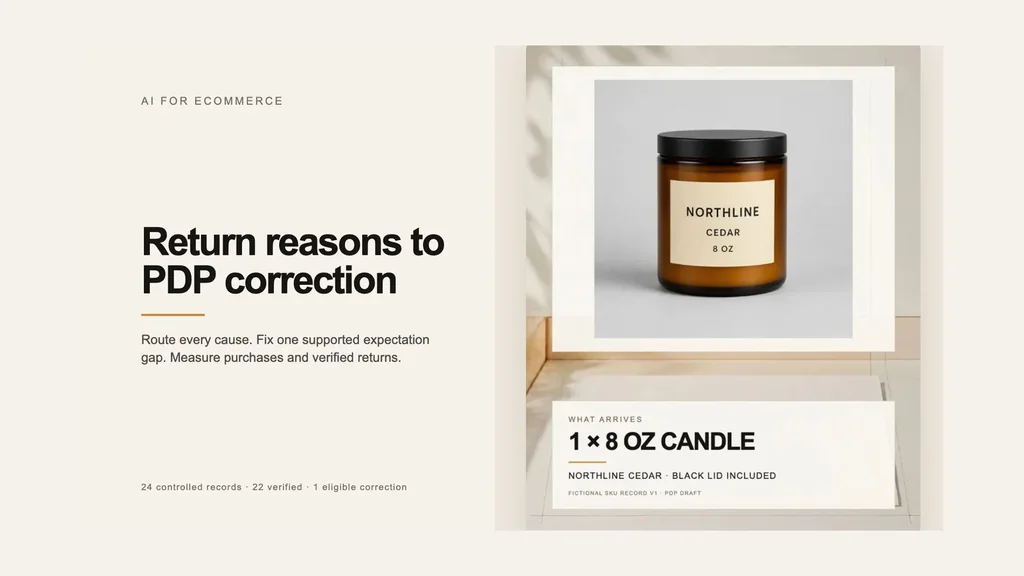
We ran that workflow on 24 fictional NORTHLINE Cedar candle return records. Two open, unverified records were excluded, leaving 22 completed verified rows. Five described a quantity expectation: the buyer thought the listing included more than one candle. That theme supported one narrow secondary image because the fictional approved SKU record says exactly what ships: one 8 oz candle and one black lid.
Five size-expectation records did not survive the authority gate because 8 OZ is weight, not height or diameter. Damage, wrong-item, and delivery records went to operations. Scent preference and changed-mind records remained visible but did not become visual claims.
Evidence boundary: NORTHLINE, its SKU record, and all 24 return records are fictional controls. They do not establish a real return rate, customer problem, causal effect, or conversion opportunity. The dataset, filtering, reason routing, generated style board, live Masonry background job, exact source-photo composite, deterministic fact layer, and manifest are real. Nothing was published to a store and no return reduction was measured.
Why this is a distinct merchant job
Shopify now offers category-specific return reasons across admin, POS, self-serve returns, and the Shop app. Its changelog says the goal is richer, more consistent information for addressing product issues and making inventory or product decisions. Read Shopify's enhanced return-reason update.
Shopify's current ShopifyQL returns schema captures item-level return records and explicitly supports grouping returned_quantity by return_line_item_reason. It also exposes status, order, line-item, SKU-at-sale, product-at-sale, app, and staff context. Read the current ShopifyQL returns schema.
Merchant intent is visible too. One ecommerce seller described repeated requests for clarification despite six or seven product photos and returns where the item looked different than expected. Replies discussed scale, color, configuration, video, and 360-degree views. A reply's claimed 40% return reduction is unverified anecdote and is not used as a benchmark here. Read the qualitative merchant discussion.
This job begins after a return exists and asks whether one normalized reason maps to a supported PDP correction. The AI product-photo trust test explains the general risk and measurement boundary. This article supplies the missing operating artifact: row-level returns, verification status, cause routing, a fact-authority gate, and one auditable secondary image.
The supplied three-month Search Console export contains no exact non-brand return reason product image, reduce ecommerce returns with images, PDP return analysis, or equivalent query row. This is adjacent revenue-intent expansion, not proof that Masonry already ranks for the exact job.
Step 1: define a return record before asking AI to classify it
Download the 24-record controlled return dataset. Each row records:
- return ID, SKU, analysis window, and completed or open status;
- normalized reason code plus the original controlled note;
- synthetic and PII flags;
- possible owner, possible PDP action, fact authority, disposition, and rejection reason.
Real exports need additional controls: market, language, sold variant, quantity returned, category taxonomy, return app or staff path, return initiation and completion dates, verification state, refund relationship, duplicates, fraud or abuse review, deletion status, and access policy.
Do not send names, emails, addresses, order numbers, payment details, medical information, free-form support history, or deletion-requested content to a model when a minimized reason code will do. Keep the order-level lookup outside the analysis view unless an authorized reviewer genuinely needs it.
Step 2: exclude unfinished records and preserve the denominator
The controlled corpus contains 24 records, but two are open_unverified. This analysis uses 22 completed verified rows:
| Reason | Verified rows | Share of 22 | Possible owner | Visual disposition |
|---|---|---|---|---|
| quantity expectation | 5 | 22.7% | merchandising | eligible after SKU-authority check |
| size expectation | 5 | 22.7% | merchandising | blocked: no verified dimensions |
| shipping damage | 3 | 13.6% | packaging / fulfillment | route to operations |
| scent preference | 3 | 13.6% | product and merchandising | review variant copy; no intensity claim |
| delivery delay | 2 | 9.1% | logistics | route to logistics |
| changed mind | 2 | 9.1% | customer choice | no visual action |
| wrong item | 2 | 9.1% | picking / fulfillment | route to operations |
These percentages describe only a fictional 22-row denominator. They are not a store benchmark, a causal model, or a decision threshold. The two excluded rows stay in the download so another analyst can reproduce the filter rather than trusting a polished chart.
Shopify's documented query shape is a useful starting point:
FROM returns SHOW returned_quantity GROUP BY return_line_item_reason WITH TOTALS SINCE -90d UNTIL today ORDER BY returned_quantity DESC LIMIT 25
Then join only the context required for the decision: product and variant at time of sale, return status, time window, and operational owner. A return count without units sold cannot produce a product return rate; a reason count without status can mix finished and unfinished workflows.
Step 3: route causes before designing anything
The top reason is not automatically a creative task.
| Signal | What it might mean | Required evidence before action |
|---|---|---|
| expected a set | sold quantity or included items were unclear | current SKU and package record |
| expected larger | dimensions or scale context were unclear | verified height, width, diameter, and source |
| arrived damaged | pack-out, carrier, material, or handling failed | inspection, packaging, warehouse, carrier data |
| wrong item | pick, barcode, variant, or fulfillment mapping failed | order, pick, pack, and inventory records |
| scent not preferred | variant naming, merchandising, or individual preference | approved scent taxonomy; no invented intensity |
| arrived late | promise, cutoff, carrier, or fulfillment timing failed | promise shown and actual transit timestamps |
| changed mind | no correctable expectation gap is established | no automatic action |
Do not “fix” damage with a prettier packaging image or a picking error with bolder variant copy. That hides an operational cause and creates false confidence.
Step 4: write the correction brief from approved facts
The fictional SKU authority is intentionally small:
| Field | Approved value | What it does not establish |
|---|---|---|
| SKU | NL-CEDAR-8 | inventory, price, or channel status |
| product | NORTHLINE Cedar candle | scent intensity or preference |
| sold quantity | one candle | bundle, gift set, or multipack |
| net weight | 8 OZ | jar height, diameter, or burn time |
| included item | one black lid | box, matches, tray, or other accessory |
| source photo | approved 1254 × 1254 packshot | hidden sides or shipped carton |
That produces one correction brief:
Buyer expectation: some verified returns expected multiple candles. Visual job: show exactly one approved candle and state what arrives. Copy authority: 1 × 8 OZ CANDLE; NORTHLINE CEDAR; BLACK LID INCLUDED. Product rule: preserve the approved source pixels; do not redraw the jar. Prohibited: return-reduction claim, price defense, burn time, dimensions, scent intensity, shipping promise, testimonial, rating, bundle, or accessory. Placement: secondary PDP image, after the factual primary packshot. Status: draft until SKU, mobile PDP, channel, and measurement review pass.
Download the completed reason-to-PDP manifest. It connects every reason count, authority record, rejected path, image input, live job, deterministic copy layer, release state, and measurement plan.
Step 5: generate the background, not the product truth
The built-in image workflow created a product-free style board:
One live Nano Banana 2 job then turned that reference into an empty background plate. The prompt prohibited every factual object and word:
masonry image "Create one 4:5 textless ecommerce PDP secondary-image background plate from the style reference. Preserve only warm ivory paper, pale gray, translucent amber glass, hairline grid marks, and soft side light. Keep the photo and fact zones empty. No product, package, box, person, text, letters, numbers, symbols, arrows, icons, ratings, review, return claim, logo, watermark, screenshot, or interface." \ --model gemini-3.1-flash-image-preview \ --aspect 4:5 \ --seed 2608157 \ --ref ./return-aware-pdp-style-board.webp
Job d09360b7-9b17-4687-b44d-7c964c301ed4 succeeded in 10.128 seconds and returned a 928 × 1152 file:
Step 6: preserve the approved product pixels
The final draft places that exact source file inside the photo panel and renders the approved SKU fields as deterministic HTML typography:
This correction does not claim that the original PDP caused five returns or that the new image will prevent them. It says only what arrives.
If the selected reason were size expectation, stop here until verified dimensions exist. An 8 OZ label cannot authorize a height arrow, and a generated hand, shelf, mug, or credit card is not a trustworthy scale reference unless the actual product geometry and reference relationship are controlled.
Step 7: place and review it on the real Shopify PDP
Shopify's current help center says return reasons vary by product category and can be viewed in analytics to identify trends. Read Shopify's current return workflow.
For this draft:
- Keep the untouched factual primary image first.
- Place the “what arrives” asset early enough to answer the quantity question, but do not replace useful alternate angles.
- Verify the selected SKU, variant, image gallery, cart, checkout, bundle app, subscription state, and order line all say one candle.
- Review the actual desktop and mobile crop, zoom, alt text, page speed, theme behavior, and app-generated media.
- Block publication if the shipped configuration, net weight, lid, variant, or asset version differs.
The Shopify variant-image workflow covers selected-image and cart consistency. The product-listing infographic workflow is the next step when verified dimensions or included-item diagrams are available. Start from the supplier-photo image-set workflow when the whole PDP media set—not one correction—is missing.
Step 8: measure purchases now and verified returns later
Create a declared control and treatment for one SKU. Hold price, offer, inventory, traffic treatment, page template, shipping promise, return policy, fulfillment process, and analysis window fixed where possible.
Use purchase or contribution as the near-term primary business event. Track add-to-cart, checkout, support questions about quantity, bundle selection, page speed, and other operational reasons as diagnostics.
Return outcomes mature later. Record:
eligible orders exposed → purchases → return window matured → completed verified returns → quantity-expectation returns → other return reasons and operational guardrails
Do not divide today's returns by today's orders when the products were purchased weeks earlier. Cohort by purchase date or another defensible eligibility window, wait for comparable maturation, and distinguish requested, approved, shipped-back, received, verified, refunded, canceled, and exchanged states.
A lower quantity-expectation count can coexist with lower purchase volume, more changed-mind returns, a bundle-app change, inventory shifts, or operational errors. Read the complete funnel and keep causality language conservative.
If the correction is ready for a randomized PDP decision, continue to the Shopify product-image A/B-test workflow. It preserves the original purchase cohort, distinguishes assignment from rendered exposure, and leaves the final trust decision open until comparable return windows mature.
The review-mining to creative-brief workflow helps choose a buyer question before purchase. This workflow begins after a return and asks whether one verified reason maps back to a supported PDP fact. Together they form a useful loop: authorized feedback chooses questions; verified returns reveal expectation gaps; product authority controls the correction; downstream evidence decides whether it stays.
For recurring products, the AI subscription ad creative workflow extends that expectation check across the ad, selected purchase option, cart, checkout, confirmation, and customer-management path without treating a recurring-term mismatch as a photography problem.
When the unresolved buyer question is visible motion—such as how one approved part folds, opens, or adjusts—continue to the source-accurate PDP product-demo video workflow. Keep the operation bounded by product evidence, inspect temporal drift, and do not let a generated demonstration become proof of hidden mechanics or performance.