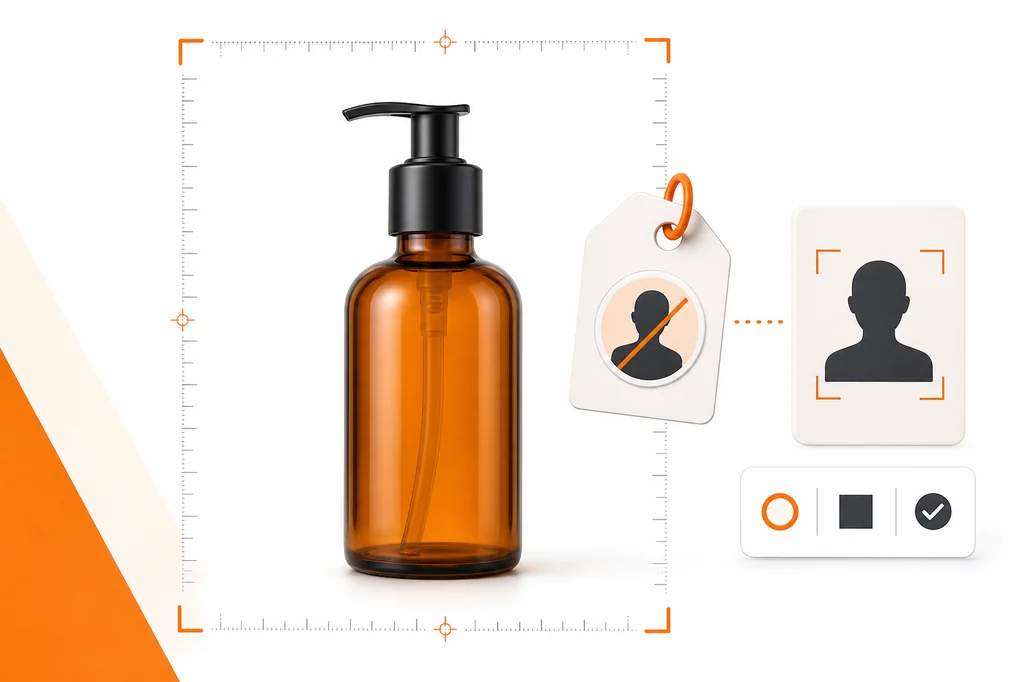
If you sell on Amazon and you have been putting off reading the AI image policy, here is the short version: Amazon documents a disclosure mechanism for a specific kind of synthetic-person image, while its ordinary product-image requirements apply across listings.
Separately, Amazon's ordinary main-image requirements can lead to a listing being suppressed, whether or not AI was involved in making the image.
Everything below was checked against Amazon's Product image guide in Seller Central and Amazon's public seller announcement about tagging AI-generated people on 3 August 2026. The guide states it applies to selling in the United States. Marketplace rules change, so confirm the current version before making a decision that matters.
Quick answer: what Amazon actually requires
- Amazon's AI-specific rule covers photorealistic AI-generated people, not products. The guide says "if your image includes photorealistic AI-generated people, you must tag that image with the appropriate metadata before uploading it to Amazon." There is no equivalent AI disclosure tag for a generated image of a product, but ordinary accuracy and main-image requirements still apply.
- The disclosure is a metadata keyword, not a checkbox. Amazon says to "use an IPTC-compatible metadata editor to add the keyword
contains-synthetic-performerto the dc:subject (XMP) field of your image file." Most guides describe a tickbox. That is not what the guide says. - Amazon explicitly lists when NOT to tag: images that only feature real people "even if they have been altered with AI-powered tools", images featuring characters from movies or video games, images that "do not feature any people", and images where "the people in your image aren't photorealistic."
- Images without people are excluded from this specific tag. Amazon's guide says not to add the metadata when an image does not feature any people. That does not exempt the image from Amazon's other product-image and accuracy requirements.
- The ordinary main-image spec carries a suppression consequence. Amazon states that "if there is no main image that meets the requirements, we may suppress the product listing from search until a compliant main image is provided." Pure white background, product at about 85% of the image, no text or logos.
If you only remember one thing: check the synthetic-person disclosure rule and the ordinary product-image requirements separately. Passing one does not establish compliance with the other.
The AI rule, quoted in full
Amazon's guide introduces it like this:
"Some jurisdictions may require disclosure when product images contain photorealistic AI-generated people. If your image includes photorealistic AI-generated people, you must tag that image with the appropriate metadata before uploading it to Amazon."
Note the framing. This is Amazon responding to disclosure law about synthetic people, not Amazon taking a position on whether AI belongs in product photography.
The mechanism is IPTC metadata
This is the part most coverage gets wrong. Amazon's instruction:
"Use an IPTC-compatible metadata editor to add the keyword
contains-synthetic-performerto the dc:subject (XMP) field of your image file. If you include this metadata, Amazon will add a disclosure to inform audiences that the image includes AI-generated people, where applicable."
So compliance is an operation on the image file itself, using an XMP metadata field, before upload. If you are running a catalog at any scale, that is a step in your export pipeline rather than something you click. Any IPTC-capable tool can write the field, and it needs to survive whatever processing sits between your generator and your upload, which is worth testing once rather than assuming.
When to tag, and the longer list of when not to
Amazon says to provide the tag "if your image features people who were entirely generated by AI (not based on a real person)."
Then it gives four situations where you should not:
- "Your image only features real people (even if they have been altered with AI-powered tools)"
- "Your image only features characters from movies, video games, or other expressive works"
- "Your image does not feature any people"
- "The people in your image aren't photorealistic"
The first and third exclusions matter for common ecommerce workflows. Under the version of the guide checked for this article, an AI-retouched photograph containing only real people does not get this metadata, and neither does an image without people. Both remain subject to the rest of Amazon's image and selling requirements.
The rule that can suppress a listing
Here is the thing worth internalising. Amazon's guide contains a set of restrictions that are far more likely to bite:
"Images that fail to meet technical requirements cannot be uploaded to our system." "Images that fail to meet product image requirements or violate our Selling policies and seller code of conduct may be removed." "If there is no main image that meets the requirements, we may suppress the product listing from search until a compliant main image is provided."
A suppressed listing is removed from search until a compliant main image is provided. The consequence follows the ordinary image requirements regardless of whether the image was photographed, rendered, or AI-assisted.
The main image requirements
From the guide, the main image must:
- "Accurately represent the product as a realistic, professional-quality image", reflecting "the real scale, quantity, and color of the product"
- "Have a pure white background (RGB color values: 255, 255, 255)"
- "Show the product as 85% of the image"
- Carry "no text, logos, borders, color blocks, watermarks, or other graphics covering the product or in the background"
- "Show the entire product within the frame of the image, not cutting off any part"
- Not "show accessories or any props that aren't included with the product"
- "Only show the product once in the image, for example, front only, and not both the front and the back in the same image"
Amazon also notes that "only a limited number of product types are allowed to have a lifestyle image as a main image."
The technical requirements
- Format: JPEG (.jpg or .jpeg) recommended. TIFF, PNG, and non-animated GIF are accepted.
- Size: "Minimum 500 pixels and maximum 10,000 pixels on the longest side." Both bounds are required.
- Resolution: "Clear, non-pixelated, no jagged edges."
- File naming: product identifier plus variant code plus extension, for example
B000123456.MAIN.jpg. Amazon warns the three components are separated by a period and that "spaces, dashes, or additional characters will prevent your image from uploading."
That naming rule quietly breaks a lot of automated pipelines, because generated files usually arrive with descriptive names full of dashes.
What three models produced from the same product photo
We tested the same reference bottle, the same prompt, and the same 1024 by 1024 output size with Nano Banana 2, Seedream 5 Pro, and GPT Image 2. All three removed the loose capsules and produced a single centered bottle. None produced a file we would upload without another QA step.
The failures split in useful ways: framing, exact background colour, and packaging fidelity. The reliable workflow is to generate the composition, measure the frame fill, replace the background with literal RGB 255, 255, 255, and composite the real label or packaging artwork back onto the result.
What this means if you generate images with AI
The honest read is that Amazon publishes no blanket AI-image ban, while still enforcing the same accuracy and presentation constraints a studio photographer has always worked to. That distinction matters: silence on the production tool does not excuse an image that illustrates a plausible product instead of accurately representing the real one.
Three practical consequences:
Pure white is a specification, not a vibe. RGB 255, 255, 255 means pure white, and generated backgrounds frequently come back as very light grey, or white with a subtle gradient or shadow falloff. It looks white on a screen and fails the spec. Check the actual pixel values on your corners before you upload.
Frame fill is a composition instruction you have to give. Models do not naturally frame a product at 85% of the image. If you do not direct the crop, you will get a product floating in a lot of empty space, which is both non-compliant and weaker on a search results page.
Fidelity is still the whole game. The main image has to accurately represent real scale, quantity, and colour. This is where generating a product from a text prompt rather than starting from a photograph of your actual item becomes a genuine risk, because a plausible product is not your product. If you sell on Etsy as well, note that Etsy goes considerably further and requires original photos rather than renderings, which we covered in the Etsy rules post. eBay and Shopify are more permissive again, and all four are compared in AI product photo rules by platform.
We make a multi-model AI product photography tool, so to be plain about where that fits: the reference-image workflow, where you photograph the real product and the models restyle the scene around it, is the one that survives Amazon's accuracy requirement. Across thirty first-hand category tests, the models differed sharply in how faithfully they held a product, and which one wins depends on the material. If you want the detail, that is in our product photography model roundup.
Main-image compliance is only one Amazon visual job. To plan the listing gallery itself, use the six-slot Amazon listing-image workflow to assign each image one buyer question, one authority source, and one acceptance test. For secondary brand modules, the source-preserving Amazon A+ Content workflow shows how to generate an empty scene, composite the approved SKU, render facts deterministically, export separate Basic and Premium sizes, and carry the result into Amazon review and Manage Your Experiments.
Once an eligible ASIN is stable and the merchant needs a commercial decision rather than another opinion, use the Amazon product-image A/B testing workflow to pre-register one image hypothesis, preserve the exact SKU, let Amazon randomize the comparison, and apply contribution and delayed-return guardrails before publishing a winner.
If a specific ASIN is already rejected or removed from search, switch from policy reading to the Amazon main-image suppression recovery workflow. It captures the exact failure, preserves the known-good source, separates pixel defects from contribution conflicts, and verifies submission, selection, publication, and search restoration independently.
The bottom line
Amazon's AI image rule is real but narrow. It applies to photorealistic people who were entirely generated by AI, it is satisfied with an IPTC contains-synthetic-performer keyword in the dc:subject field rather than a checkbox, and Amazon explicitly excludes AI-altered real people, non-photorealistic people, and images with no people at all.
If your product images contain no people, which is most of them, you can stop worrying about that rule and spend the attention on the main-image spec instead, because that is the one that can take your listing out of search results. Selling the same SKU on another marketplace requires a separate release contract; the Walmart Marketplace primary-to-secondary image workflow shows how to keep the factual white-background asset distinct from an AI-assisted lifestyle image.
You can try the reference-based workflow here. Policies quoted were verified on 3 August 2026 against Amazon's Product image guide in Seller Central, its public AI-generated people disclosure announcement, and Amazon's public main-image requirements summary. These rules change, so re-check before relying on any of it.