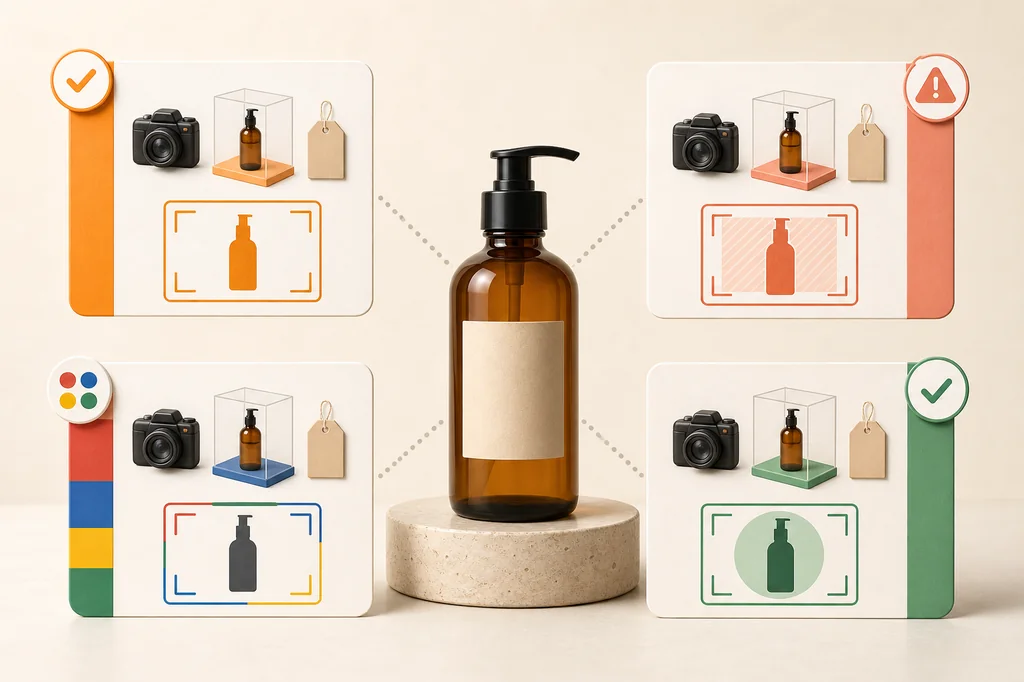
There is no single answer to "can I use AI product photos," because the four platforms most sellers use have arrived at four genuinely different positions. One requires the seller's own photographs rather than renderings. One regulates synthetic people through image metadata while applying strict ordinary main-image rules. One has no AI-specific image ban but explicitly leaves responsibility for generative-AI listing content with the seller. One publishes no general product-image content policy whatsoever.
This post puts them side by side. Every claim is grounded in the platform's own documentation, re-checked on 3 August 2026, with a link to the deeper post on each. These policies are moving, so verify before you make a decision that matters.
Quick answer: the four positions
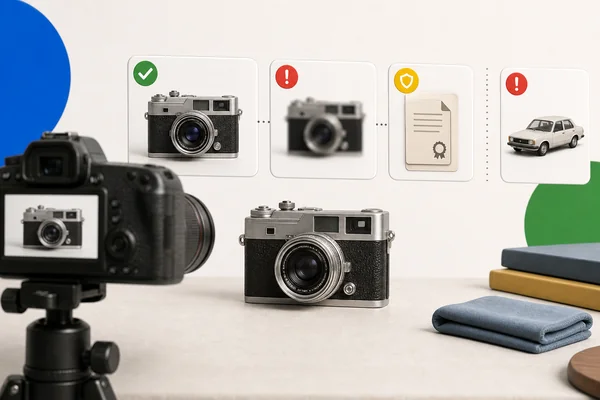
- Etsy is the strictest, and not because of an AI-photo rule. Its current Seller Policy requires the seller's own photographs rather than stock photos or artistic renderings, while its Listing Image Requirements require original photos of the actual product. A generated product render is in tension with both regardless of disclosure.
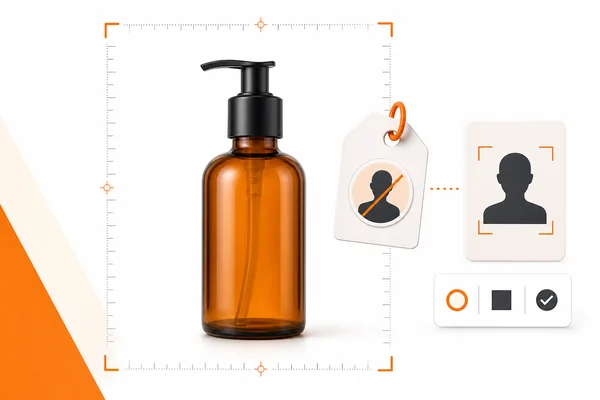
- Amazon regulates AI people rather than AI products. Amazon publishes no blanket AI-product-image ban, but its ordinary main-image rules still require a realistic, professional-quality image that accurately represents the actual product. Photorealistic people who were "entirely generated by AI" require an IPTC metadata keyword.
- eBay has no AI-specific image ban, but it does mention generative AI. Its image policy requires truthful, accurate, rights-safe content. Its User Agreement explicitly makes sellers responsible for listing content created with generative AI tools.
- Shopify has no general product-image content policy, because your store is not a marketplace. Its Acceptable Use Policy makes you responsible for "the rules of your platform, your partners, and the law."
- Only Etsy and Amazon have any disclosure requirement, and neither covers AI-generated product photos. Etsy's applies to AI-created items; Amazon's applies to AI-generated people.
If you only remember one thing: the rules differ in kind, not in degree, so if you sell on more than one platform, build your images to the strictest standard in your mix.
The comparison
| Etsy | Amazon | eBay | Shopify | |
|---|---|---|---|---|
| Rule against AI-generated product images | Effectively yes, via the original-photo rule | No blanket AI ban; normal main-image rules apply | No AI-specific image ban | No general image policy |
| AI disclosure required | For AI-created items, not photos | For AI-generated people only | No | No |
| Disclosure mechanism | Listing field | IPTC contains-synthetic-performer in dc:subject | n/a | n/a |
| Must images show the actual item | Yes, with narrow exceptions | Must accurately represent it | Seller owns accuracy; "should" take your own | No general image rule |
| Documented enforcement | May remove listings; fees non-refundable | May suppress listing from search | Moderation rejection, incl. poor quality | Graduated; account action last resort |
| Strictness | Strictest | Specific but narrow | Permissive | No policy |
Etsy: the original-photo rule is the one that matters
Etsy has two separate rules, and almost every guide conflates them. The Seller Policy says "If an item is created through the use of artificial intelligence, you must disclose this in your relevant listings," which governs the thing you are selling. Separately, the Listing Image Requirements govern your photos:
"we require sellers to use original photos of the actual product buyers will receive, not renderings or stock photos, except in the situations outlined below"
Ticking a disclosure box does not satisfy the image rule, because they are different rules. The exceptions are narrow: for personalized items the first image must be a finished customized item and a placeholder mockup as the main image is prohibited, and stock mockups are allowed when a production partner prints your design onto a base item.
One honest caveat: neither policy uses the exact phrase "AI-generated product photo," so this is not a purpose-written AI-image ban. But the current Seller Policy renews the same photos-versus-renderings distinction in 2026, so the conclusion does not rest only on an older help page. Full detail in the Etsy post.
Amazon: the AI rule is narrow, the image spec is not
Amazon's product image guide publishes no blanket AI-product-image ban. Its AI-specific provision is about people:
"If your image includes photorealistic AI-generated people, you must tag that image with the appropriate metadata before uploading it to Amazon."
The mechanism is not a checkbox. Amazon asks you to "use an IPTC-compatible metadata editor to add the keyword contains-synthetic-performer to the dc:subject (XMP) field of your image file." And the scope is narrower than most coverage suggests: it applies only to people "entirely generated by AI (not based on a real person)," and Amazon explicitly says not to tag images featuring real people "even if they have been altered with AI-powered tools," images with no people, or people who are not photorealistic.
The rule that actually costs sellers money is the ordinary main-image spec: pure white at RGB 255, 255, 255, the product shown "as 85% of the image," no text or logos or watermarks, and a longest side between 500 and 10,000 pixels. Amazon states that "if there is no main image that meets the requirements, we may suppress the product listing from search until a compliant main image is provided." Full detail in the Amazon post.
eBay: no AI image ban, but the seller stays responsible
eBay's Images, videos and text policy contains no AI-specific ban. It opens with an expectation rather than a requirement, "You should take your own images and videos and write your own descriptions," and permits content "as long as your use of that content is truthful, accurate, and does not infringe third-party rights."
Its broader User Agreement does mention the production method. Sellers assume responsibility for listing accuracy and content, including content made with "generative artificial intelligence tools." That creates no disclosure requirement, but it makes clear that responsibility for an invented detail stays with the seller rather than the tool.
Two things still catch generated images. The accuracy standard, because models invent plausible details that the buyer will not receive. And moderation, which rejects images for "poor quality," defined as "blurry, undefined or distorted," a fair description of how weak generations look at full size.
eBay does carve out vehicles: pre-owned listings must show the actual vehicle, and new vehicles may use stock images only if the listing discloses they are not of the actual vehicle. That pairing of non-actual imagery with disclosure is the shape a future AI rule would most likely take. Full detail in the eBay post.
Shopify: no policy, which is not the same as no constraint
Shopify publishes no product image content policy and no AI disclosure rule, because your store is your own. Its Acceptable Use Policy is principles-based and states the main rule plainly: "you're responsible for following the rules of your platform, your partners, and the law."
Its image documentation sets technical limits only: up to 5000 x 5000 px or 25 megapixels, files under 20 MB, PNG preferred followed by JPEG, and 2048 x 2048 as usually best for square images.
The constraints on a Shopify store come from elsewhere: consumer protection law where you sell, the rules of any sales channel you syndicate to, and your return rate. Full detail in the Shopify post.
If that Shopify catalog is sold through TikTok Shop, use the TikTok Shop AI creative release workflow. It separates listing images, seller posts, affiliate videos, and paid ads so product evidence, claims, rights, commercial disclosure, AIGC disclosure, and the destination SKU do not collapse into one generic “AI allowed” decision.
The practical rule: build to the strictest
Because these differ in kind, a workflow that is completely fine on Shopify can sit badly against Etsy's image rule. In theory you maintain a different image set per channel. In practice almost nobody does, and the sets drift.
The workable answer is to build one image set to the strictest standard in your mix. For most multi-channel sellers that means Etsy, which resolves to a specific instruction: the product in your listing photo should be a photograph of the item you will actually ship.
That single constraint satisfies all four at once. It meets Etsy's original-photo requirement. It meets Amazon's accuracy requirement and leaves you free to hit the white-background spec. It meets eBay's truthful-and-accurate standard. And it is more than Shopify asks for.
What you can still do freely is everything around the product: the background, the surface, the lighting, the season, the mood. That is where AI earns its place in this workflow. The one-product-to-complete-image-set test shows how to separate those channel jobs while preserving an approved factual primary image.
For a Shopify catalog sent specifically to Google, the Merchant Center image-feed workflow adds the operational layer this policy comparison does not cover: exact variant IDs, main and additional image roles, delivered AI metadata, crawlability, processing, destination agreement, and rollback.
For Google's specific image-too-small diagnostic, the Merchant Center AI-upscaling release test separates minimum dimensions, apparent sharpness, reconstructed product detail, and product-owner approval.
For organic discovery on the storefront itself, use the Shopify product-image SEO audit. It checks rendered HTML, public asset access, alt text and page context, Product schema, sitemap coverage, exact-variant resolution, responsive delivery, and non-brand image-search measurement without confusing a technical failure with an image-generation job.
If the same catalog is distributed to Pinterest, use the source-locked Pinterest Product Pin image workflow. It separates the approved product, AI-assisted scene, image_link or additional_image_link assignment, versioned asset URL, Product Pin state, campaign delivery, and purchase outcome instead of treating one attractive 2:3 file as proof that the catalog or ad worked.
For a Shopify catalog moving into Reddit Dynamic Product Ads, the Reddit catalog-image QA workflow continues from general channel policy into exact catalog-to-Pixel or Conversions API product-ID matching, current delivery-format checks, separate feed and conversation previews, destination continuity, and product-level economics.
We build a multi-model AI product photography tool around exactly that reference-image approach, so it is worth being direct about the limitation: for Etsy in particular, the fully-generated product shot is the wrong use of a tool like ours. Across thirty first-hand category tests, the models varied sharply in how faithfully they preserved a real product when given a reference, which is detailed in our product photography model roundup.
The bottom line
Nobody uses a simple blanket sentence banning AI product photography. Etsy comes closest through current rules requiring the seller's own photographs rather than renderings. Amazon regulates AI people while applying ordinary accuracy rules to product images. eBay has no AI-specific image ban but expressly assigns responsibility for generative-AI listing content to the seller. Shopify publishes no general product-image content policy.
The practical answer for a seller on more than one platform is not to track four policies. It is to keep a photograph of the real item at the centre of every listing image and generate the world around it, which satisfies all of them and happens to be the version that keeps returns low.
You can try that workflow here. Claims were re-verified on 3 August 2026 against Etsy's Seller Policy and Listing Image Requirements, Amazon's AI disclosure announcement and Product image guide, eBay's image policy and User Agreement, and Shopify's Acceptable Use Policy and product media documentation. These rules change, so re-check before relying on any of them.