eBay is one of the more permissive big marketplaces on AI product photography. Its Images, videos and text policy contains no AI-specific image ban or disclosure requirement. But eBay has not ignored generative tools completely: its User Agreement explicitly makes sellers responsible for listing content created with generative AI.
That does not mean anything goes. There are two standards in the policy that catch generated images without ever naming them, and one category where the rules are unusually strict.
Everything below was checked against both documents on 3 August 2026. Policies change, so confirm the current versions before relying on this.
Quick answer: what eBay actually requires
- eBay's images policy contains no AI-specific ban or disclosure rule. There is no tag to apply, and generated images are not singled out in that policy.
- The User Agreement does name generative AI. It says sellers assume full responsibility for listing accuracy and content, including content created with generative AI tools.
- The governing standard is truth and accuracy. The policy allows content "as long as your use of that content is truthful, accurate, and does not infringe third-party rights."
- eBay says you should take your own images, not that you must. The policy opens with "You should take your own images and videos and write your own descriptions." That "should" is materially softer than Etsy's requirement to use original photos rather than renderings.
- Poor quality is a documented rejection reason. eBay lists images being "blurry, undefined or distorted" among the most common reasons content is rejected in moderation, which is exactly how bad generations fail.
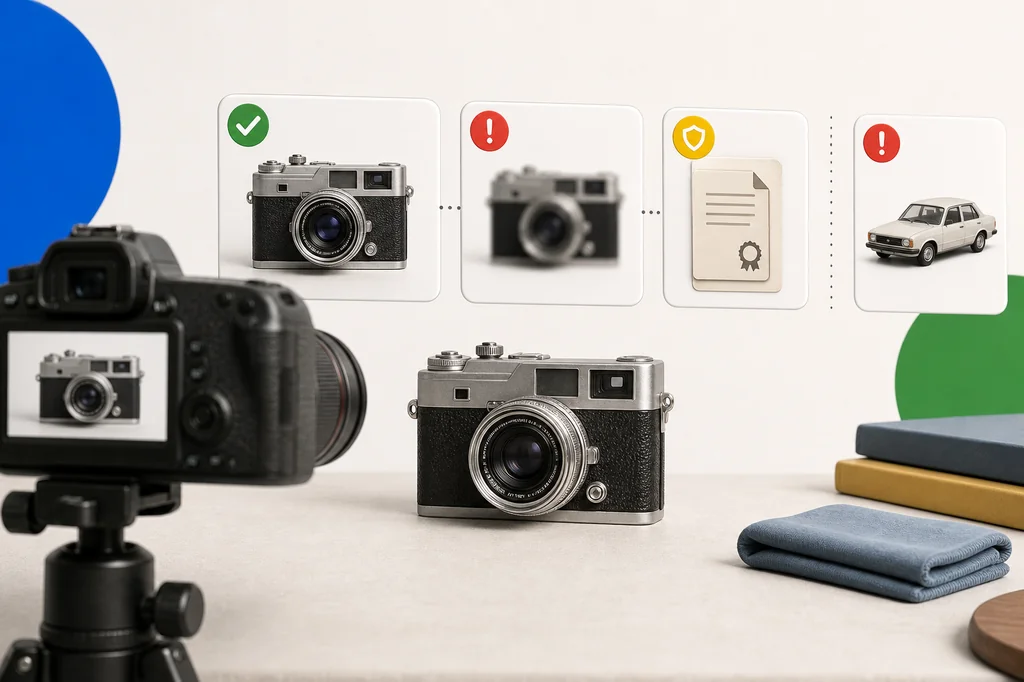
- Vehicles are the strict exception. For pre-owned vehicles "images must be of the actual vehicle offered for sale." For new vehicles, stock images are permitted with supplier permission only if "the listing discloses that photos are not of the actual vehicle offered for sale."
If you only remember one thing: eBay does not publish a separate rule for AI product photos, but it explicitly leaves responsibility for AI-assisted listing content with the seller.
The policy, quoted
eBay opens the article with the expectation rather than a prohibition:
"You should take your own images and videos and write your own descriptions."
Then it sets out what is permitted:
"You may use images, videos or text on eBay as long as your use of that content is truthful, accurate, and does not infringe third-party rights and the content follows our Offensive materials policy."
And it grants one explicit reuse right:
"You may also use the images and product details from the eBay product catalog. This content is provided by eBay customers and third parties, and can be used by all sellers for additional product information."
Read together, this is a policy about provenance and honesty, not about production method. A generated image is not inherently disallowed. An inaccurate one is, whatever made it.
The User Agreement does mention generative AI
The image policy is silent on AI, but the broader User Agreement is not. Under Listing Conditions, it says:
"You assume full responsibility for the item offered and the accuracy and content of the listing, including listing content created using tools offered by eBay or third parties such as translation, image editing, and generative artificial intelligence tools."
That is not an AI-image ban and it creates no disclosure field. It does close an important loophole in the interpretation, though: using eBay's tools or a third-party generator does not transfer responsibility for an invented product detail back to the tool provider. The seller remains accountable for the result.
The two standards that actually apply to generated images
Truthful and accurate
This is the one that matters. If your image shows a product in a colour, finish, condition, or configuration that the buyer will not receive, it fails the standard regardless of whether a camera or a model produced it. Generated product images fail here in a specific way: models invent plausible details. A slightly different handle, an invented logo, a finish that reads as glossier than the real thing. Each of those is an accuracy problem sitting inside a technically permitted image.
Poor quality gets rejected in moderation
eBay lists the common reasons uploaded images and videos get rejected. Alongside size limits, infringement, offensive content and off-eBay links, it names:
"Poor quality – A video that is blurry, undefined or distorted is considered poor quality and not allowed"
That is a useful thing for anyone generating images to know, because the characteristic failures of image models are exactly this: soft or smeared regions, warped edges, garbled small text on a label. An image can look fine at thumbnail size and be visibly distorted at full size, which is the size moderation and buyers see it at.
The vehicle rule is the interesting precedent
Buried in the FAQ is the one place eBay does draw a hard line about whether an image shows the real item:
"Note for Pre-owned vehicle sales, images must be of the actual vehicle offered for sale. For new vehicles, stock images may be used with permission from the supplier provided the listing discloses that photos are not of the actual vehicle offered for sale."
Two things stand out. First, eBay clearly knows how to write an actual-item requirement when it wants one, and has chosen to apply it to a single high-value category rather than to listings generally. Second, where it permits non-actual imagery, it pairs that with disclosure. That is the shape a future AI rule would most likely take if eBay writes one, and it is worth being ready for.
One thing sellers get wrong that is riskier than AI
The policy is blunt about manufacturer images:
"No, you can't use images or videos from a manufacturer's website, even if it is publicly available. Copying content from other websites or internet searches may be considered copyright infringement."
This matters because pulling a supplier photo is the shortcut most sellers reach for before they consider generating anything. On eBay's own terms, photographing your product and generating a scene around it sits on safer ground than lifting the manufacturer's shot, because the first is your content and the second is someone else's.
How eBay compares
Across the four platforms we have checked against their own documentation, eBay sits at the permissive end but not alone there.
- Etsy is strictest. Its Listing Image Requirements require original photos of the actual product buyers will receive, "not renderings or stock photos," which is a genuine constraint on generated product images. Covered in the Etsy post.
- Amazon is narrow but specific. It publishes no blanket AI-product-image ban, but a metadata tag is required for entirely AI-generated photorealistic people, and the main-image spec is strict enough to suppress a listing. Covered in the Amazon post.
- Shopify has no general product-image content policy, because your store is not a marketplace. Covered in the Shopify post.
- eBay has no AI-specific image clause, but its User Agreement assigns responsibility for generative-AI listing content to the seller. Its image policy still uses a "should" rather than a "must" on taking your own photos.
If you sell across several of these, build to the strictest one. The full side-by-side is in AI product photo rules by platform. Maintaining separate image sets per channel is work almost nobody sustains.
What to do about it
The practical answer on eBay is the same one that survives every other platform's rules: photograph the actual item, then use AI for the scene around it. That keeps the product in the frame truthful and accurate, keeps the content yours rather than the manufacturer's, and avoids the invented-detail problem that turns a permitted image into an inaccurate one.
We build a multi-model AI product photography tool around that reference-image workflow. Across thirty first-hand category tests the models differed sharply in how faithfully they held a real product, and the ones that drift invent exactly the kind of detail that breaks an accuracy standard. The detail is in our product photography model roundup.
The bottom line
eBay's images policy does not ban or require disclosure for generated product photos. Its User Agreement nevertheless names generative AI and makes the seller responsible for listing accuracy and content. The image still has to be truthful, accurate, non-infringing and good enough to pass moderation, with vehicles the one carved-out actual-item exception.
The risk on eBay is therefore not a compliance rule you might trip. It is quieter: an image that quietly misrepresents the item, or one that is visibly distorted at full size. You can try the reference-based workflow here.
Verified on 3 August 2026 against eBay's Images, videos and text policy and User Agreement. These rules move, so re-check the current versions.