If you have been looking for Shopify's policy on AI-generated product images, the reason you cannot find it is that it does not exist.
That is not an oversight. Shopify is not a marketplace. Your store is your store, and Shopify does not review your listings the way Amazon or Etsy review theirs. So the interesting question is not "what does Shopify allow," it is "if Shopify is not the constraint, what is."
Claims here were re-checked against Shopify's Acceptable Use Policy, product media documentation, and AI media-generation documentation on 3 August 2026. These change, so confirm before relying on them.
Quick answer: what Shopify actually says
- Shopify publishes no product image content policy and no AI disclosure rule. There is no field to declare AI use and no requirement to. This is the permissive end of the marketplace spectrum.
- The Acceptable Use Policy pushes responsibility back to you. Its stated main rule is that "you're responsible for following the rules of your platform, your partners, and the law." That sentence is doing a lot of work: Shopify is pointing at everyone else who does regulate you.
- The AUP never mentions images, accuracy, or representation. It covers illegality, the social contract of commerce, following Shopify's agreements, payment and channel terms, and acting in good faith. Its closest relevant line is that Shopify does not "tolerate anyone defrauding Shopify, other merchants, or buyers."
- Shopify's image requirements are technical, not editorial. Up to 5000 x 5000 px or 25 megapixels, under 20 MB, PNG preferred then JPEG, and 2048 x 2048 px for square images "usually displays best."
- Connected sales channels bring their own rules with them. If you push products to Google Shopping, Meta, or the Shop channel, you inherit those requirements, and Shopify's AUP explicitly notes that the Shop channel "comes with its own merchant guidelines and product eligibility criteria."
If you only remember one thing: Shopify does not regulate your product images, so the binding constraints are the law where you sell, the channels you syndicate to, and your own return rate.
What the Acceptable Use Policy actually says
It is worth reading Shopify's Acceptable Use Policy directly, because it explains the whole posture:
"The main rule for using Shopify is: you're responsible for following the rules of your platform, your partners, and the law."
The policy then sets out principles: you cannot do anything illegal where you do business, you cannot breach "the social contract of commerce," you must follow Shopify's agreements, payment and add-on terms may apply, channel rules may apply, and you are expected to act in good faith.
On enforcement, Shopify describes a graduated approach:
"we will give you notice, grant you opportunities to self-remediate conflicts, default to enforcement at the product level, and take account-level action as a last resort when appropriate."
Nothing in there is about photography. There is no truthful-representation clause, no image standard, no AI provision. If you have read elsewhere that Shopify's AUP contains a truthfulness requirement mirroring the FTC's deception standard, that is not in the policy. The FTC standard is real and it applies to you as a US seller, but it comes from the FTC, not from Shopify.
The image specs, which are limits rather than rules
Shopify's product media documentation sets out what the platform will accept:
- File types: "The best file type for most product images is PNG, followed by JPEG." PSD, TIFF, BMP, GIF, SVG, HEIC and WebP are also accepted.
- Dimensions: "Your product and collection images can be any size up to 5000 x 5000 px, or 25 megapixels."
- File size: images "need to have a file size smaller than 20 MB to be added to Shopify."
- Recommended: "For square product images, a size of 2048 x 2048 px usually displays best."
- Consistency: Shopify notes that images displayed side by side on collection pages need a consistent aspect ratio to appear the same size.
That last point is the one most worth acting on if you generate images. Models return different aspect ratios depending on the prompt and the model, and a collection page built from mixed ratios looks visibly amateur. Pick one ratio and hold it across the catalog.
So where do the real constraints come from
Three places, none of them Shopify.
The law where you sell. In the US that includes the FTC's truth-in-advertising requirements. If your image implies the buyer receives something they do not, that is an advertising problem regardless of what tool made it. This is the actual source of the "truthful representation" idea that gets misattributed to Shopify.
Your connected channels. The moment you syndicate products to Google Shopping, Meta, Amazon, or the Shop channel, that channel's rules apply to those listings. Shopify's own AUP flags this, and it means a store selling across channels effectively inherits the strictest rule in the set. If Etsy is one of them, note that Etsy requires original photos of the actual product rather than renderings, which we covered in the Etsy rules post. eBay is closer to Shopify in permissiveness, and the full side-by-side is in AI product photo rules by platform. Amazon's requirements are different again, mostly about the main image spec, covered in the Amazon post.
Returns and chargebacks. This is the one that actually costs money on a Shopify store, and it is not a policy at all. An image that oversells the product converts once and comes back as a return, with the shipping both ways and often a lost customer. On your own store nobody suppresses your listing, so the feedback arrives as margin damage instead, which is slower to notice and harder to attribute.
What this means practically
Shopify being permissive is genuinely useful. You can use AI for scenes, backgrounds, seasonal refreshes, and lifestyle context without a compliance step, and for a store selling only through its own site there is no disclosure to manage.
The trap is assuming permissive means consequence-free. Two rules of thumb hold up:
Write for the strictest channel you sell on, not for Shopify. If any of your products also appear on Etsy or Amazon, the constraint is theirs. Maintaining two image sets is real work, and most merchants will not do it, so the practical answer is to build to the strictest standard once.
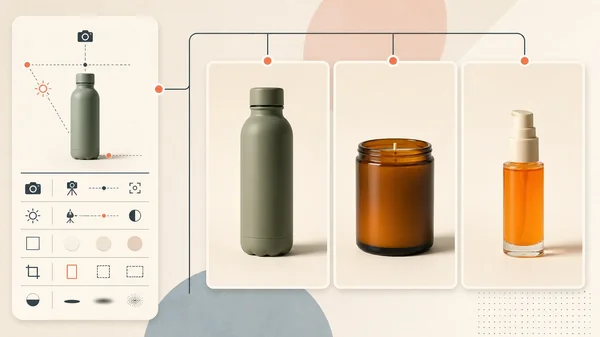
Keep the product itself honest even when nothing forces you to. Generate the scene, not the product. The reference-image workflow, where you photograph the real item and let models restyle the world around it, is the version that keeps returns low, and it is the one that survives contact with every other platform's rules. We build a multi-model AI product photography tool around exactly that workflow, and across thirty first-hand category tests the models varied sharply in how faithfully they held a real product, which is detailed in our product photography model roundup.
Product truth is only the first gate when a listing has variants. Use the Shopify variant-image assignment workflow to verify that the accepted image remains attached to the exact selected SKU through the product page, gallery, cart, and checkout. Shopify's permissive image policy does not protect a merchant from a wrong-color or wrong-material handoff.
The bottom line
Shopify has no AI image policy, no disclosure requirement, and no image content rules. Its Acceptable Use Policy is principles-based and explicitly makes you responsible for the rules of your platform, your partners, and the law. Its image documentation sets technical limits only: up to 5000 x 5000 px, under 20 MB, PNG preferred, 2048 x 2048 best for square.
That makes Shopify the permissive case in this series, and it means the real questions are which other channels you sell on and whether your images set expectations your product can meet. You can try the reference-based workflow here.
Verified on 3 August 2026 against Shopify's Acceptable Use Policy, product media documentation, and AI media-generation documentation. Platform rules move, so re-check the current versions.