If you sell on Etsy and you have started using AI for product photos, almost every guide gives you the same answer: tick the AI disclosure box and you are fine. That answer is confidently wrong, because it addresses the wrong policy.
Etsy has two separate rules here, and only one of them is about AI. Ticking the disclosure box satisfies that one. The other rule, the one that actually governs what your listing photos can be, says something quite different, and no checkbox exempts you from it.
This post quotes both from Etsy's own policy pages. Policy claims here were re-checked against Etsy's current Seller Policy and Listing Image Requirements on 17 August 2026. These rules move, so verify before you make a decision that matters.
Quick answer: what Etsy actually requires
- Etsy requires your own photos of the actual product, not renderings. The current Seller Policy requires "your own photographs or video content — not stock photos, artistic renderings, or photos used by other sellers or sites." The Listing Image Requirements add that sellers must use original photos of the actual product buyers will receive, with narrow exceptions.
- The AI disclosure rule is about the ITEM, not the photo. Etsy's Seller Policy says "If an item is created through the use of artificial intelligence, you must disclose this in your relevant listings." That covers AI-created products, such as AI art. It does not grant permission for AI-generated listing images.
- Keep the photographed product itself unchanged. Background cleanup or replacement is lower risk when it leaves the item untouched, but Etsy does not expressly promise that every AI edit is permitted. Compare the output with the real inventory and confirm whether an exception applies.
- Generating the product itself is where you run into the rule. A product image produced from a text prompt is a rendering of a plausible item, not a photo of the one in your inventory, and that is precisely the distinction the policy draws.
- Mockups are allowed, but only in specific slots. For personalized items the first image must show a finished customized item, and a blank product or placeholder mockup as the main image is prohibited. Computer-generated mockups are permitted in additional images.
If you only remember one thing: on Etsy the question is not "did I disclose the AI," it is "is my listing photo a photograph of the actual item I am shipping."
Rule one: the AI disclosure rule, and what it actually covers
Etsy's Seller Policy, under what can be sold, lists the information you must provide for each item. Item five reads:
"If an item is created through the use of artificial intelligence, you must disclose this in your relevant listings."
Read that carefully. It says an item created through the use of AI. This is aimed at the thing you are selling. If you generate digital art with an image model and sell it as a print, that item was created using AI and must be disclosed.
It is not a permission slip for listing photography. Nothing in this clause says your product images may be AI-generated as long as you tell people. That question is answered somewhere else entirely.
Rule two: the listing image rule, which is the one that matters
The current Seller Policy first requires:
"Your own photographs or video content — not stock photos, artistic renderings, or photos used by other sellers or sites."
Etsy's separate Listing Image Requirements then make the actual-item standard explicit:
"The Etsy marketplace is built on trust and transparency. That's why we require sellers to use original photos of the actual product buyers will receive, not renderings or stock photos, except in the situations outlined below."
And on what counts as an original photo:
"When creating your listings, you must use your own photos, either photos you took yourself or had someone take for you. These photos should showcase the actual finished product that you made, designed, handpicked, or sourced."
Two phrases carry the weight. "Original photos of the actual product buyers will receive" sets the standard. "Not renderings" names the failure mode, and a fully AI-generated product image is, in plain reading, a rendering. It depicts a plausible version of your product rather than the specific item that will go in the box.
One honest caveat still matters. Neither image rule says "AI-generated product photo" explicitly, so this is not a purpose-written AI-image ban. The Listing Image Requirements page predates the current wave of generative product photography. But Etsy's current Seller Policy, effective in 2026, renews the same distinction by requiring the seller's own photographs and excluding artistic renderings. The conclusion therefore does not rest only on an old help page: a fully generated product render remains in direct tension with Etsy's current seller requirements.
The exceptions, and they are narrow
Etsy sets out two situations where you can depart from original photos.
Personalized or customized items. Your first image must feature a finished, customized item similar to what buyers will receive. Etsy is explicit about the prohibition:
"It is prohibited to use a photo of the blank product or a mockup with placeholder text (e.g. "Your Text Here") as the main image."
Computer-generated mockups may be used in additional listing images to show customization options, provided the first image is real.
Items made with production partners. Here it splits by what the partner does. If a partner manufactures a unique item you designed, such as furniture, clothing, or a book, you must use a real photo of the physical end product. If a partner prints an original design of yours onto a base item like a t-shirt or a mug, you may use a stock photo mockup.
Notice what both exceptions have in common: they exist because photographing the exact item is genuinely impossible or meaningless, not because rendering is acceptable when convenient.
So what can you actually do
The line that follows from the policy is about what is in the frame, not what software touched the file.
Lower-risk editing: photograph the real item, keep its pixels and appearance intact, and restrict edits to non-product areas such as background cleanup. Etsy's policy does not expressly classify every AI-assisted edit, so this is a conservative reading rather than a guarantee of compliance.
Squarely outside it: generating the product from a text prompt and using that as your listing image. Even an excellent render of a candle is not a photo of your candle.
Genuinely grey, and worth being conservative about: heavy AI edits that change the product's appearance, colour, finish, or details. The further the output drifts from the item in your inventory, the harder it is to argue you used an original photo of the actual product. A buyer receiving something that does not match is also the fastest route to a complaint, which is the practical risk underneath the policy one.
A trust-first Etsy image release workflow
Current seller discussion makes the commercial issue clearer than the policy wording alone. In a May 2026 Etsy seller thread about AI versus real product photos, buyers and sellers repeatedly described AI-looking images as a reason to distrust a listing, while some sellers said they use AI only around a photographed product. That is qualitative evidence from one self-selected discussion, not a conversion study, but it exposes the buyer question your release process must answer: will the item in the box match the image?
Use an image sequence in which every slot has one job:
- Anchor the listing in reality. Use your own photograph of the actual finished item as the first image unless a documented Etsy exception applies. Do not let a polished scene replace the factual control.
- Separate product pixels from scene pixels. If you test AI assistance, begin with the approved source and ask the model to change only background, surface, lighting, and composition. Reject changes to shape, colour, material, finish, text, quantity, or included parts.
- Answer buyer questions with real evidence. Add real close-ups for texture and finish, a scale view, the sold quantity, and packaging or personalization where those details affect expectations.
- Review at full resolution. Compare the candidate beside the inventory or approved source. A thumbnail can hide a changed clasp, engraving, seam, label, or surface treatment.
- Record the basis for exceptions. If a personalized item or production-partner rule permits a mockup, note the exact exception and keep the mockup in an allowed image position.
- Measure the full outcome. Track listing visits and orders, but also watch message rate, return reasons, reviews mentioning mismatch, and cases. A higher click-through rate is not a win if the image creates the wrong expectation.
Download the Etsy AI product-photo release checklist. It is a blank operating template, not a compliance certificate.
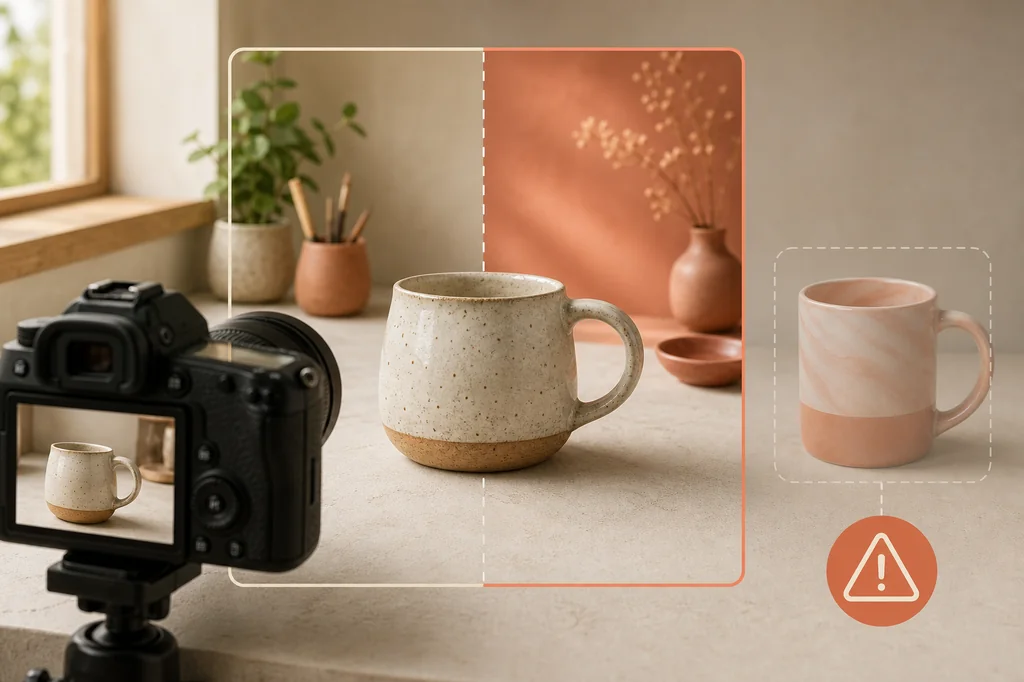
The visual below shows the distinction using Masonry's fictional NORTHLINE test product. It is not an Etsy listing and neither file proves compliance; the pair simply makes source-versus-scene review concrete.
Why this matters more on Etsy than elsewhere
Etsy is unusual. Its marketplace proposition is that items are made, designed, handpicked, or sourced by a person, and its policies are built to protect that. The image rule is not an arbitrary technicality, it is load-bearing for the whole marketplace.
That means the answer genuinely differs by platform. Amazon's product image guide is concerned with a pure white background, the product shown at about 85% of the image, and no text or logos, and it says nothing equivalent about Etsy's own-photo requirement. eBay has no AI-specific image ban but explicitly leaves responsibility for generative-AI listing content with the seller. We put all four side by side in AI product photo rules by platform. Shopify is your own store, where the binding constraint is truthful representation rather than a marketplace image rule. Etsy is the strictest of the three on this specific point, and a workflow that is completely fine on your own Shopify store can sit badly against Etsy's listing image policy.
We build a multi-model AI product photography tool, so the boundary matters to us. For Etsy, a fully generated product shot conflicts with the requirement for an original photo of the actual item unless a stated exception applies. In our thirty-category model test, supplying a real reference reduced unconstrained invention compared with text-only generation, but some outputs still changed product details. A reference image is useful evidence for visual fidelity; it is not proof that Etsy will treat the finished listing image as compliant.
The bottom line
Etsy sellers keep being told that AI product photos are fine as long as you disclose. The disclosure rule is real, but it is about AI-created items, not about photography. The rule that governs your listing images asks for original photos of the actual product buyers will receive, not renderings, and it has only narrow exceptions for personalization and production partners.
The practical takeaway is conservative. Use your own photograph of the finished item, preserve the product itself, and treat AI edits to its surroundings as something to review rather than automatic permission. If you want to compare reference-based outputs on your own products, you can try it here, or read which models held a product most faithfully in our product photography model roundup.
Policies quoted here were verified on 17 August 2026 against Etsy's current Seller Policy and Listing Image Requirements. Marketplace AI rules are changing quickly, so check the current versions before relying on any of this.