The useful AI review-mining workflow is authorized feedback → privacy filter → transparent theme coding → claim-authority check → one creative brief → one controlled test. It is not “paste positive reviews into a chatbot and ask for winning ads.”
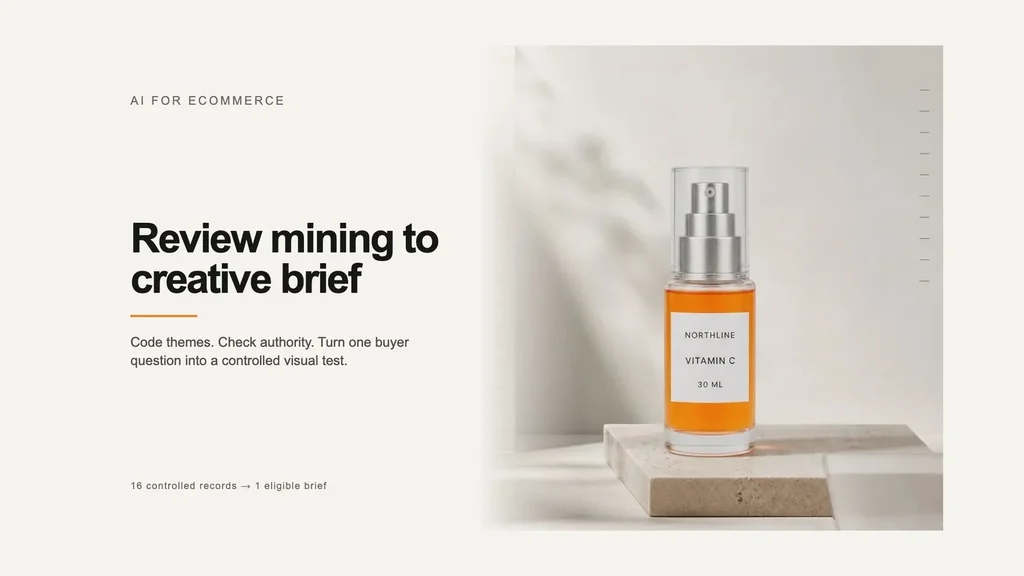
We ran the full workflow on 16 fictional NORTHLINE feedback records. The records intentionally contain repeated buyer questions plus tempting result, routine, texture, travel, and sentiment language. Only one direction survived review: make the visible 30 ML quantity, front label, and pump package inspectable before the click.
That brief uses facts visible in the approved fictional product image. It does not turn a synthetic experience into a testimonial, infer a benefit from repetition, or claim that this angle will convert. We then created a textless style board, ran one real two-reference Nano Banana 2 generation in Masonry, and added factual copy as a deterministic layer.
Evidence boundary: NORTHLINE and all 16 feedback records are fictional controls. They are not customer reviews, testimonials, market research, or evidence about a real product. The coding table, downloadable data, generated style board, live Masonry job, visual inspection, deterministic copy layer, and manifest are real. No ad was launched and no revenue effect was measured.
Why this is a distinct ecommerce job
A current ecommerce-marketing post describes reading 1,400 reviews, finding a repeated authenticity concern, and changing the creative direction. That is useful intent evidence, but the post's 20%+ rule is an anecdotal heuristic—not a universal decision threshold or a validated benchmark. Read the current qualitative example.
The job sits upstream of image generation: merchants need to choose which buyer question deserves a creative cell before producing more assets. The supplied three-month Search Console export contains no exact non-brand review mining, voice of customer creative brief, or customer review ad creative query row. This is adjacent revenue-intent expansion from Masonry's existing ad-creative and product-truth cluster, not evidence that the site already ranks for the exact query.
The risk is equally concrete. The FTC's current guidance says consumer reviews featured in a business's advertising or marketing become testimonials; the exemption for merely hosting reviews no longer applies. It also warns that businesses and agencies can face liability for creating or selling fake or false reviews or testimonials. Read the FTC's Consumer Reviews and Testimonials Rule Q&A.
So the output of mining is a question and evidence record, not automatically a quote, claim, or ad.
Step 1: control the corpus before asking AI to code it
Download the 16-record controlled feedback corpus. Every row records its source type, source status, synthetic flag, PII status, theme, controlled text, paraphrase, candidate claim, authority, disposition, and rejection reason.
For a real corpus, add at least:
- source URL or system, product and variant, market, language, collection timestamp, and permission basis;
- reviewer or ticket identifiers only where operationally required, stored outside the analysis view;
- incentive, employee, influencer, moderation, authenticity, duplicate, and deletion status;
- analysis window, inclusion and exclusion rules, and the number of missing or removed records.
Do not paste unrestricted support tickets, names, emails, addresses, order numbers, medical details, or deletion-requested content into an image or language model. Minimize first, then analyze.
Step 2: code themes without hiding the denominator
The controlled corpus produces this audit table:
| Theme | Records | Share of this corpus | Authority | Disposition |
|---|---|---|---|---|
| package clarity | 5 | 31.25% | approved product image | select as a visual question |
| routine fit | 3 | 18.75% | none | reject usage claims |
| pump mechanics | 2 | 12.5% | mixed: package visible, dose not | show package; reject dosing |
| texture / results | 3 | 18.75% | none | reject sensory, efficacy, and safety claims |
| travel fit | 2 | 12.5% | none | reject travel and leak claims |
| general sentiment | 1 | 6.25% | none | reject nonspecific social-proof language |
These percentages describe only 16 synthetic rows. They do not establish prevalence among customers, statistical confidence, or a winning message. A transparent small corpus is more useful than invented certainty: another analyst can see every row and reproduce the count.
When AI helps with coding, give it a fixed codebook, allow unclear and multiple-theme labels, preserve the original row, and review disagreements. Run a second human pass on high-risk themes such as health, safety, performance, compatibility, price, and regulated use.
Step 3: separate frequency from claim authority
A feedback theme answers: what are people discussing in this corpus? It does not answer: what may the business say about the product?
| Candidate message | Repeated feedback? | Independent authority? | Decision |
|---|---|---|---|
show 30 ML clearly | yes | visible in approved source | eligible visual brief |
| show the pump package | yes | visible in approved source | eligible; compare geometry |
| designed for morning use | yes | no approved instructions | reject |
| lightweight texture | yes | synthetic experience only | reject |
| brightens without irritation | yes | no efficacy or safety record | reject |
| travel-friendly and leakproof | yes | no route or performance record | reject |
| customers love it | one vague record | no authentic testimonial | reject |
If a real review contains a useful quote, keep its exact source, product, permission, authenticity, typicality, and disclosure review attached. Do not paraphrase it into a stronger experience. The FTC's endorsement guidance emphasizes that context matters and that endorsements must reflect the endorser's actual experience. Read the FTC Endorsement Guides Q&A.
Step 4: write the brief as a testable buyer question
The selected brief is deliberately narrow:
| Brief field | Controlled value |
|---|---|
| buyer question | can I inspect the quantity, label, and pump package before clicking? |
| evidence | five package-clarity records plus one package-mechanics record |
| product authority | approved fictional source visibly reads NORTHLINE / VITAMIN C / 30 ML |
| visual objective | one bottle, large front label, visible pump and cap, quiet close-inspection scene |
| prohibited messages | testimonial, rating, result, texture, routine, travel, leak, safety, or efficacy |
| deterministic copy | 30 ML, SHOWN CLEARLY / PUMP BOTTLE · ONE PRODUCT |
| release state | draft; product, channel, destination, and measurement review required |
| primary test event | purchase or the downstream event the campaign is genuinely optimized for |
Download the completed analysis and creative manifest. It connects corpus version, theme counts, authority, selected brief, style board, real generation job, copy layer, review status, and blocked release state.
Once the buyer question and authority are fixed, move them into the AI UGC creative brief template to specify hook variants, shots, route-specific rights, named reviewers, rejection reasons, and the exact ad cell that may receive the asset.
Step 5: generate visual direction without smuggling in evidence
The built-in image workflow produced a textless close-inspection style board:
The board is not customer evidence. It can control lighting, material, backdrop, and composition only.
Step 6: run one real visual candidate
The live Nano Banana 2 route received the approved product source as reference 1, the style board as reference 2, a 4:5 request, and seed 2608156:
masonry image "Create one 4:5 ecommerce paid-social product photograph from two references. Reference 1 is immutable product truth. Reference 2 is visual direction only. Preserve exactly the single NORTHLINE Vitamin C 30 ML pump bottle and every visible character NORTHLINE, VITAMIN C, 30 ML. Show one bottle large and centered for close inspection on the pale limestone plinth. No new text, quote, review, testimonial, star rating, person, result, efficacy, texture, routine, travel, price, offer, CTA, extra product, or watermark." \ --model gemini-3.1-flash-image-preview \ --aspect 4:5 \ --seed 2608156 \ --ref ./NL-VITC-30-approved.webp \ --ref ./package-clarity-style-board.webp
Job c786fe9f-4acf-4ef7-93e2-3c3f0afeb79a succeeded in 10.126 seconds and returned a 928 × 1152 file.
The candidate passed the requested content checks:
- exactly one orange-liquid bottle with a transparent cap and silver pump;
- exact visible
NORTHLINE,VITAMIN C, and30 MLlabel text; - large front label and inspectable dispensing format;
- no quote, reviewer, rating, testimonial, offer, result, ingredient, routine, travel, or efficacy language.
It is still not approved packshot truth. Compared with the source, the generated bottle, pump stack, label proportions, and scene are re-rendered. For strict identity work, generate only the background plate and composite the approved product pixels.
Step 7: add factual copy deterministically
This layer does not quote the corpus or imply that customers endorsed the message. If 30 ML or the shipped package changes, the product record—not the feedback count—must update the copy.
Step 8: measure the handoff, not just the click
A current Shopify advertiser described traffic with no add-to-cart or purchase. Replies repeatedly warned that creative might not be the cause: the optimization event, tracking, price, or mismatch between ad and product page could be responsible. Those are qualitative diagnoses, not benchmarks, but they identify the correct measurement boundary. Read the current merchant discussion.
Hold these fixed between the control and package-clarity cell:
- exact product, variant, offer, audience, budget treatment, placements, and destination;
- primary text, CTA, optimization event, attribution settings, and test window;
- product-page quantity, package image, price, shipping information, and checkout behavior.
Use purchases—or the downstream business event the campaign is genuinely optimized for—as the decision metric. Read click-through, landing-page views, add-to-cart, checkout, support contacts, package-confusion tickets, wrong-variant purchases, and returns as diagnostics and guardrails. A higher click rate with no downstream improvement is not proof that review mining worked.
The one-SKU ad creative matrix defines the controlled cell structure. The same-SKU fidelity benchmark shows why correct label text does not prove package geometry. Use the real-product AI UGC workflow if the eligible question moves into motion, and the product-listing infographic workflow when approved dimensions or specifications—not feedback—should control the message.
The deliverable is not a folder of “customer-inspired” ads. It is an auditable corpus, a reproducible theme count, an authority-backed buyer question, one reviewable asset, and a test that can distinguish creative from the rest of the funnel.
After orders mature, the return-reasons to PDP-image workflow closes the downstream loop by separating verified expectation gaps from damage, delay, wrong-item, preference, and changed-mind causes before changing the product page.