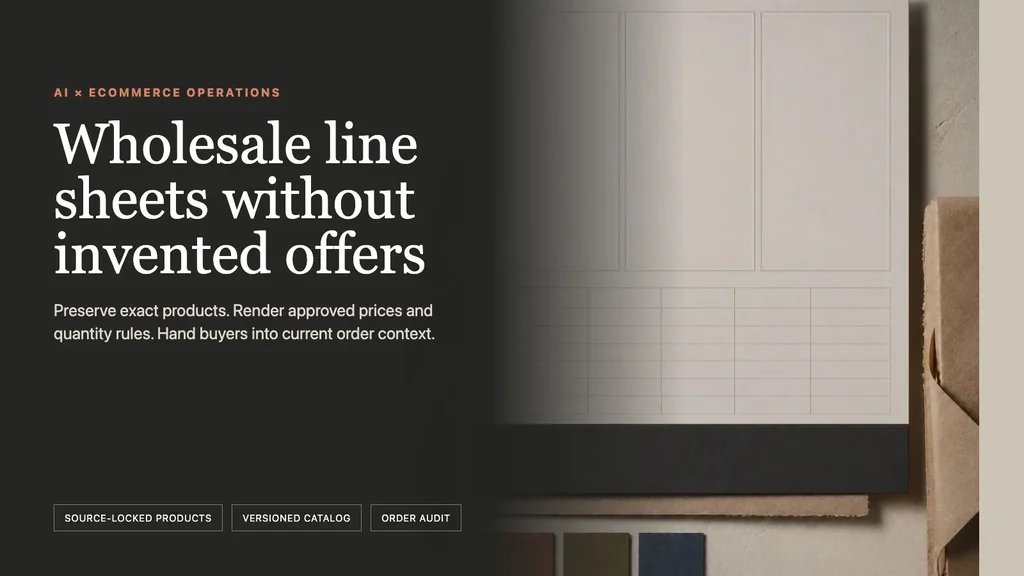
The useful AI wholesale line-sheet workflow is approved product sources → versioned wholesale catalog record → textless visual plate → deterministic products and commercial fields → assigned-buyer catalog or inquiry handoff → accepted-order audit → fulfilled contribution. AI can accelerate art direction. It should not invent the offer or become a second catalog.
This worked example uses three fictional NORTHLINE candles. The US/USD offer has exact variant SKUs, wholesale unit prices of $12, $13, and $14, six-unit case packs, a $240 opening minimum, a $120 reorder minimum, and a five-business-day lead time that begins only after order acceptance for in-stock units. Nothing here represents a real supplier, buyer, price, inventory position, or promise.
Evidence boundary: the catalog and order arithmetic are fictional controlled records. The generated source sheet and style board, live Masonry background job, deterministic line sheet, order handoff, and release audit are real artifacts. No live Shopify B2B store, buyer, inquiry, order, fulfillment, margin, conversion lift, or legal-compliance result was tested.
Why this is a distinct merchant job
A product-comparison visual helps a retail shopper choose among products. A wholesale line sheet helps a qualified buyer understand a merchant's offer and begin an order under business-specific rules. The two surfaces can share products, but not authority or destination.
Shopify's current B2B documentation says catalogs control which products and prices are available to companies and company locations. Its quantity-rule documentation keeps minimums, maximums, increments, and volume pricing as separate controls. Company-location context can also carry payment terms, checkout behavior, delivery options, and order-review settings. That makes a static PDF or image a communication surface—not the final commercial system. Review Shopify B2B catalogs, quantity rules and volume pricing, and company setup.
Faire's current brand terms describe practical line-sheet fields including product name, variations, case size, wholesale price, retail price, description, and active status, alongside order minimums and lead time. Faire also advises brands to translate their direct-to-consumer voice for wholesale buyers. Those sources support the job and field set; they do not make one marketplace's terms universal. Read Faire's current brand terms and wholesale-language guidance.
Recent merchant discussions ask how to manage B2B pricing, company-specific catalogs, order forms, minimums, and a path that remains simple for buyers. They also expose the recurring failure mode: a polished document becomes stale while store prices, inventory, or buyer terms change. These are qualitative signals, not demand volume or product endorsements. Read a Shopify wholesale implementation discussion, a company-catalog question, and an order-form discussion.
The supplied non-brand Search Console export contains no wholesale line-sheet, MOQ, case-pack, or wholesale-catalog query. This is therefore a revenue-intent expansion for Masonry's ecommerce audience, not a claim that existing search demand has already been proven.
Step 1: establish commercial authority before design
Do not start with a blank canvas. Name who can approve each field and the effective window. Reject the project when the merchant cannot provide:
- exact product and variant identifiers;
- market and currency;
- wholesale unit price and, if used, approved MSRP;
- case pack, quantity increment, and product minimum as separate fields;
- opening and reorder minimums;
- current availability behavior and lead-time scope;
- tax, freight, payment-term, and territory boundaries;
- the approved buyer destination and catalog assignment;
- valid-from and valid-through timestamps.
The approved source image is authority for visible product identity only:
The same-SKU fidelity workflow is the rejection gate if a generative step redraws an approved item. When many source files enter production, use the catalog batch workflow to keep one manifest row and acceptance decision per SKU.
Step 2: build one versioned offer record
Download the fictional wholesale catalog record. It contains one row per sellable variant and repeats shared terms intentionally so each exported row remains auditable.
| Product | Variant SKU | Wholesale | MSRP | Case pack | Case price |
|---|---|---|---|---|---|
| DUSK CEDAR | NL-QH-DUSK-240 | $12.00 | $24.00 | 6 | $72.00 |
| MOSS CYPRESS | NL-QH-MOSS-240 | $13.00 | $26.00 | 6 | $78.00 |
| TIDE MINERAL | NL-QH-TIDE-240 | $14.00 | $28.00 | 6 | $84.00 |
Catalog version NL-WH-US-2026-08-16-v1 applies to the fictional US/USD assigned-company catalog through September 30, 2026. Prices exclude tax and freight. The public sheet grants no payment terms and reserves no inventory. Availability must be checked in the assigned catalog at order time.
That language is deliberately narrower than “ships in five days.” The approved lead time is five business days after order acceptance for in-stock units. If stock, buyer review, customization, or payment changes, the static line sheet cannot resolve the order promise.
Step 3: keep quantity fields separate
Case pack, quantity increment, product minimum, opening minimum, and reorder minimum answer different questions. Store and render them separately even when the current numbers coincide.
The fictional opening order uses valid six-unit increments:
DUSK CEDAR 12 × $12.00 = $144.00 MOSS CYPRESS 12 × $13.00 = $156.00 TIDE MINERAL 6 × $14.00 = $84.00 ---------------------------------- 30 units $384.00 subtotal
Every line is a multiple of six and the $384 subtotal passes the $240 opening minimum. It does not calculate tax, freight, discount, payment timing, or final margin. Those belong to the current buyer and order context.
Step 4: generate only a textless background
The built-in style board establishes a restrained family—warm ivory paper, kraft layers, linen, terracotta, moss, cobalt, three equal product windows, a grid, and a dark order band—without generating products or facts:
We then used the board as visual direction for a live Masonry job:
masonry image "Create one textless portrait 4:5 editorial background plate for a premium wholesale line-sheet workflow. Preserve exactly three equal blank product windows, a blank commercial-data grid, a full-width dark charcoal order band, warm ivory paper and plaster, kraft-stock layers, linen texture, and small terracotta, moss, and cobalt accents. Keep every product and data zone empty. No product, candle, jar, package, person, hand, words, letters, numbers, price, currency symbol, SKU, MOQ, case pack, lead time, availability, terms, logo, UI, order-form text, CTA, claim, or watermark." \ --model gemini-3.1-flash-image-preview \ --aspect 4:5 \ --seed 2608164 \ --ref ./wholesale-line-sheet-style-board.webp
Job b446ac03-2b6e-4fc5-a4b0-a335066844d1 succeeded and returned a 928 × 1152 image.
Step 5: compose products and data deterministically
Place approved product pixels into the empty windows. Render names, SKUs, prices, case details, minimums, validity, lead-time scope, exclusions, catalog version, and order qualifier from the TSV—not from generated text.
The product-listing infographic workflow applies the same separation to buyer-facing facts for one SKU. The product-comparison workflow is the better pattern when the task is consumer choice rather than a wholesale offer.
Step 6: hand the buyer into current order context
Do not publish restricted pricing to an unrestricted URL by accident. Resolve the CTA to the correct assigned-company catalog or an approved inquiry route. Recheck company location, market, currency, product set, prices, minimums, payment terms, delivery settings, and review requirements at the destination.
Shopify documents customer submission, draft-order review, invoices, deposits, and payment terms as separate B2B order concerns. The line sheet can summarize an approved offer; checkout and order operations still determine what is accepted. Review Shopify B2B checkout and orders and payment terms.
Step 7: audit the whole revenue path
Download the ten-surface wholesale order audit. Its fictional pass and fictional expected states are controlled checks, not observations from a real store.
| Surface | Block release when |
|---|---|
| Catalog authority | a displayed field lacks current approval or effective dates |
| Product source | a product differs from the approved source |
| SKU mapping | the image or destination resolves to a sibling/default variant |
| Price and currency | markets, currencies, price types, or dates are mixed |
| Quantity rules | case pack, increment, and order minimum are conflated |
| Shared terms | static copy promises stock, ship date, terms, or reservation |
| Buyer destination | restricted pricing leaks or company context is wrong |
| Worked order | quantities, line totals, subtotal, or minimum status disagree |
| Measurement | a click is called revenue or the order cannot be reconciled |
Step 8: measure fulfilled economics
Use accepted orders and contribution as outcomes. Downloads, CTA clicks, inquiry submissions, catalog visits, item additions, and checkout starts explain the funnel but do not equal revenue.
eligible wholesale visitor → line sheet viewed or downloaded → assigned catalog or inquiry opened → valid quantities submitted → order reviewed and accepted → payment and fulfillment completed → cancellation/return window matured → contribution after discount, freight support, returns, and service cost
Store the source, catalog, line-sheet, destination, company-location, order, and attribution versions together. Guardrail wrong-SKU orders, stale-price incidents, quantity-rule failures, stock conflicts, support contacts, cancellations, returns, margin erosion, and unauthorized pricing exposure. Use a valid holdout or phased rollout before claiming that the line sheet caused incremental revenue.
The valuable output is not “an AI wholesale PDF.” It is one approved multi-SKU offer, one source-preserving visual, one current buyer-context handoff, and one order record that finance and operations can reconcile.