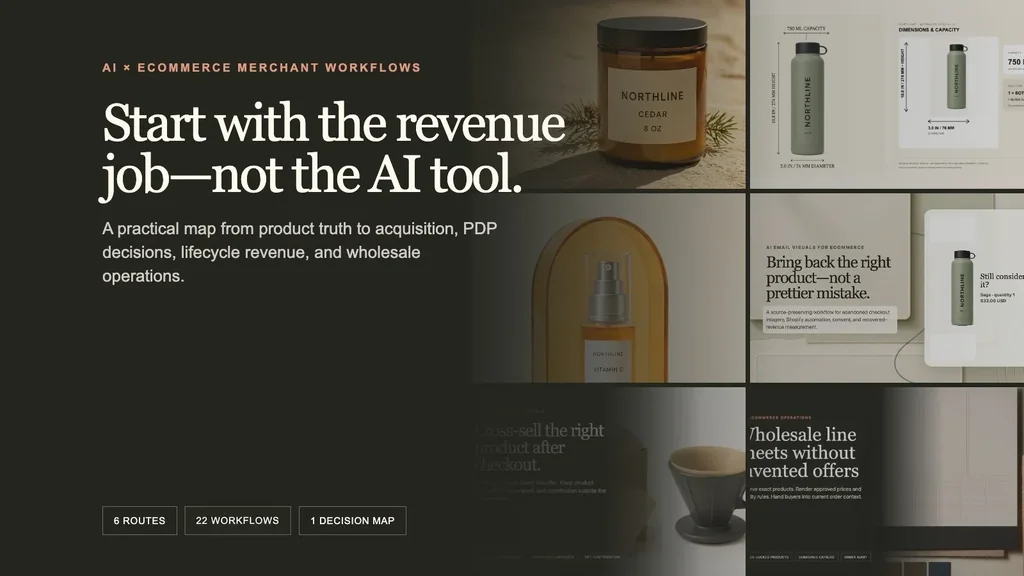
The most useful way to choose AI for ecommerce is to start with the revenue job, not the AI tool. Name the bottleneck, identify the record that is allowed to be true, give AI one bounded task, keep commerce facts deterministic, and decide in advance what business outcome would justify repeating the workflow.
This map routes 22 practical merchant jobs across six stages: catalog foundation, product-page decisions, demand acquisition, customer evidence, lifecycle revenue, and B2B operations. It is not a promise that automating all 22 is better. The goal is to choose the smallest workflow that can remove a real constraint without giving a model authority it does not have.
Evidence boundary: this guide organizes 22 workflows already published by Masonry and combines current platform guidance, the supplied non-brand Search Console export, and qualitative merchant discussions. It does not claim that Masonry ranks for the broad phrase “AI for ecommerce,” that any workflow produced revenue, or that AI should control a merchant's catalog, storefront, advertising, messaging, or orders. Examples in the linked workflows use controlled or fictional records unless stated otherwise.
Choose a route before choosing a model
Recent merchant discussions are consistent on one point: the useful work is usually less glamorous than “let AI run the store.” Merchants describe value in organizing customer objections, comparing ad angles, preparing supplier questions, and reducing repetitive catalog work. They also describe exact-color failures, reflective-product failures, generic copy, and tools that ignore operational edge cases. These threads are qualitative evidence, not market-size or conversion evidence, but they help distinguish a workflow from a feature demo. Read the practical-use discussion, the structured-data workflow discussion, merchant skepticism about generic output, and real image-generation failure reports.
The supplied three-month non-brand Search Console export shows adjacent demand rather than broad ownership. Queries include questions about AI models for transparent or reflective product images and compliant product images or lifestyle mockups for ecommerce listings. Existing Masonry pages about product-photo models, video ads, and product-photography tools already earn non-brand impressions. The missing layer was a merchant-stage router connecting that discovery to the right operational workflow. This hub fills that navigation gap; the specific pages remain the search destinations for their specific jobs.
Download the complete 22-workflow use-case map. Each row names the merchant question, starting condition, minimum authority, bounded AI role, deterministic layer, deliverable, primary decision, guardrails, and any starter artifact.
If you know the symptom but not the stage, download the six-row workflow router.
Where should I start?
Use this sequence:
- Write the problem as an observable condition: “the selected blue variant shows a black image,” not “we need better AI.”
- Find the narrowest current authority: the exact SKU source, a reason-coded return, a paid order, a restock request, or a buyer-specific catalog.
- Decide what AI may change. Usually that is a background, composition, motion candidate, theme cluster, or creative hypothesis—not the underlying product or offer.
- Name the deterministic handoff: variant mapping, price, copy, terms, audience, consent, destination, or order rule.
- Choose one commercial finish line and its guardrails before generating at scale.
If no reliable authority record exists, fix that first. AI can make an incomplete record more polished; it cannot make it more true.
Route 1: build a catalog foundation
Start here when the bottleneck is producing enough accurate, channel-ready product media. The finish line is not render volume. It is accepted assets per exact source or SKU after review, retries, and export work.
| Merchant job | Start when | Minimum authority | Finish line |
|---|---|---|---|
| Turn one supplier photo into an ecommerce image set | One verified source exists, but the listing needs a factual hero and secondary assets | Exact product source, variant, sold configuration, approved claims | Accepted assets per source and cost per accepted asset |
| Benchmark exact-SKU product fidelity | Product preservation matters more than novelty and the model choice is unresolved | One approved SKU image and a visible invariant checklist | Accepted-output rate by model under one rubric |
| Run a bulk product-photography workflow | Many SKUs need the same shot family and review contract | Per-SKU sources, manifest, naming, channel rules | Accepted assets per SKU and total cost per accepted asset |
| Create Shopify variant images | Selectable variants must remain correct through PDP, cart, and checkout | Variant IDs, option values, exact sources, theme behavior | Correct-variant selection through completed-order contribution |
| Show a multi-product bundle accurately | Several exact products are sold together and count or packaging may drift | Component SKUs, quantities, real packaging, sold configuration | Product-, count-, and packaging-truth acceptance |
Choose the supplier-photo workflow for one bad source, the fidelity benchmark when model selection is the risk, and the batch workflow only after one asset contract passes. Variant and bundle workflows introduce additional truth surfaces; do not treat them as simple volume extensions.
If the product source is already approved but the production brief is inconsistent, use the ecommerce product-photography prompt pack as a reusable constraint contract before generating a shot family.
When the problem spans product descriptions, metadata, unsupported claims, feed mismatches, and missing assets across many Shopify products, use the AI Shopify catalog-cleanup workflow to detect and prioritize defects, keep proposed copy separate from approval, publish a canary batch, verify dependent surfaces, and retain field-level rollback. It routes only diagnosed visual gaps into generation.
When an approved Shopify variant leaves the storefront for Google, use the Shopify-to-Merchant-Center image-feed workflow to bind its exact item ID, image URL, delivered metadata, preselected destination, processing state, and rollback path.
If Merchant Center specifically reports an image as too small, use the image-too-small diagnostic and upscaling workflow to distinguish a delivery problem from a source-resolution problem before replacing the main image.
When the destination is an AI shopping channel, use the Shopify Agentic Storefront product-discovery audit to separate channel eligibility, catalog transport, exact-variant representation, checkout behavior, and attributed outcomes before changing product data or generating another asset.
Route 2: help the shopper make the right product-page decision
Start here when traffic reaches the product page but shoppers cannot understand, compare, choose, or set expectations correctly. Judge the change with completed-order contribution and expectation-quality guardrails—not clicks alone.
| Merchant job | Start when | Minimum authority | Finish line |
|---|---|---|---|
| Create a fact-safe product-listing infographic | Dimensions, included items, or use are hard to understand from photos | Exact SKU, verified facts, approved claims, channel rules | Completed-order contribution with expectation guardrails |
| Build source-preserving Amazon A+ Content | One eligible ASIN needs an A+ module that answers one buyer question | Exact ASIN and sold variant, approved source, copy, module | Completed-order contribution from an eligible A+ experiment |
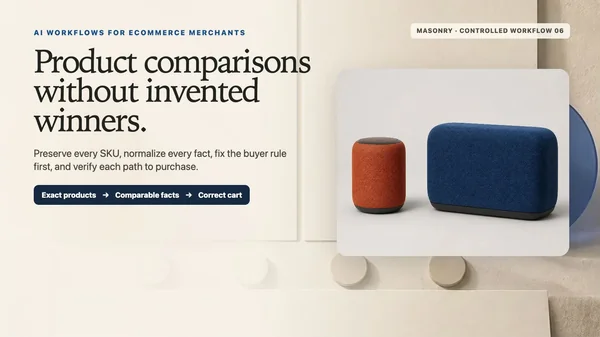
| Build a multi-SKU product comparison | A buyer must choose among merchant-owned SKUs | Normalized definitions, disqualifiers, current prices and URLs | Correct-SKU completed-order contribution |
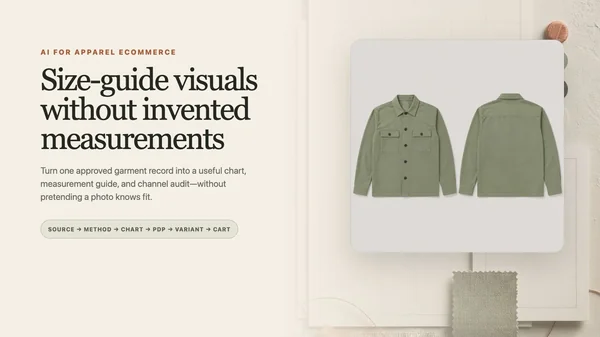
| Publish a product-specific apparel size guide | A garment needs measurements and a clear measurement method | Finished-garment measurements, units, tolerance, method | Size-related returns with conversion and support guardrails |
| Show one operation with a PDP demo video | One visible, documented motion answers a buyer question | Exact SKU, approved endpoints, documented motion, invariants | Completed-order contribution with playback, drift, and page-speed checks |
| Assemble an AI product Reel | One approved product source becomes a controlled 9:16 hook test | Exact SKU, safe-zone preview, audio rights, exact destination | Completed orders after spend, with hold and click diagnostics |
| A/B test one Amazon product image | One eligible ASIN has a stable listing and a named visual bottleneck | Brand role, eligible ASIN, exact source, stable offer, guards | Amazon result translated through contribution and delayed trust outcomes |
| A/B test one Shopify PDP image | One source-approved hero treatment needs a causal commercial decision | Exact SKU, stable offer, eligible traffic, exposure and orders | Purchase and contribution lift with trust and return guardrails |
| Turn return reasons into a PDP visual correction | Matured, reason-coded returns reveal one repeated expectation gap | Return evidence, exact SKU, approved corrective evidence | Incremental contribution after matured returns |
Use an infographic for verified facts, Amazon A+ for a source-preserving marketplace module, a comparison for choice, a size guide for measurement, and video for one visible operation. Use Amazon's native image experiment only after account, role, ASIN, traffic, product-truth, and commercial guardrails clear. Use the Shopify image experiment only after product truth, assignment, exposure, and traffic are adequate for a causal decision. A return-led correction comes later: it needs enough matured evidence to identify an expectation gap without pretending that one visual caused every return.
If an Amazon ASIN is already rejected or absent from search because of its main image, use the source-preserving suppression recovery workflow before building persuasive secondary media. Restore factual eligibility first; do not turn a production incident into an uncontrolled creative test.
Route 3: acquire demand around a locked product and offer
Start here when product and offer truth are already stable but the team needs more testable creative hypotheses. The commercial finish line is contribution after media cost, discounts, returns, and service—not the number of ads generated.
| Merchant job | Start when | Minimum authority | Finish line |
|---|---|---|---|
| Create a one-SKU ad testing matrix | One exact SKU and offer can support distinct hypotheses | Product source, fixed offer, audience, channel, spend and attribution rules | Contribution after spend by assigned creative cell |
| Make real-product AI UGC-style ads | A routine-style story is useful without fabricating a testimonial | Exact media, approved routine, actor and disclosure policy | Contribution after spend with complaint and trust guardrails |
| Localize product creative across markets | One approved source needs controlled language and offer adaptation | Source asset, reviewed translation, local price, terms and URL | Market-level contribution after spend or send cost |
| Refresh seasonal or Black Friday creative | A promotion has approved products, dates, stock and destinations | Exact SKU, offer, effective dates, market and inventory rules | Contribution after discount and media cost |
| Launch preorder creative without implying in-stock status | A future product has reviewed payment and availability terms | Exact SKU, preorder state, allocation, payment timing, estimate, policy | Fulfilled preorder contribution after cancellation and support |
The safest first acquisition workflow is usually the ad matrix because it locks one product and offer while varying named hypotheses. UGC, localization, seasonal, and preorder work add disclosure, market, timing, or availability risks; use them only when those records are controlled.
Before producing UGC-style ads, use the AI UGC cost calculator to compare AI-only, commissioned-creator, and hybrid routes on cost per accepted ad. Then carry the selected route into the AI UGC creative brief template so hooks, shots, rights, reviewers, rejection reasons, and the named test cell stay explicit.
When the creative hypothesis depends on an ordered sequence rather than independent ad cells, use the manual ecommerce carousel workflow to lock the story, product truth, deterministic copy, review gates, and release package slide by slide.
Route 4: turn customer evidence into a testable brief
Start with review mining to a creative brief when the team has a controlled set of customer language but no consistent way to extract objections and hypotheses. The minimum authority is a privacy-minimized review set with source IDs, dates, product mapping, inclusion rules, and claim exclusions. AI can cluster language and draft candidate angles; it cannot turn a handful of selected comments into consensus.
The finish line is a set of accepted, evidence-linked hypotheses that can enter a downstream experiment. Preserve theme counts, dissent, source coverage, quote permissions, and reviewer disposition. Do not publish raw personal data, generate synthetic testimonials, or convert frequency into an efficacy claim.
Route 5: use real lifecycle events to choose the message
Start here when a browse, checkout, inventory, or paid-order event creates a legitimate reason to communicate. Event truth selects the product and eligibility. AI only helps with the bounded visual or message candidate.
| Merchant job | Start when | Minimum authority | Finish line |
|---|---|---|---|
| Build an abandoned-cart email visual | An authorized incomplete checkout has a valid recovery path | Checkout event, exact variant, consent rule, inventory, price, URL | Recovered completed-checkout contribution |
| Create an exact-variant back-in-stock email | A product-specific request and sellable inventory exist together | Request event, variant, permission, stock threshold, destination | Completed-order contribution per eligible notification |
| Keep subscription ad creative consistent | A recurring offer has fixed billing, delivery and cancellation terms | SKU, purchase type, cadence, pricing policy, management path | Mature contribution through comparable billing opportunities |
| Offer a post-purchase cross-sell accurately | A paid order maps to one reviewed, available companion | Purchased and offered SKUs, relationship, order state, inventory, offer | Incremental contribution per eligible original order |
These are four different permissions and destinations. An abandoned checkout is not a paid order. A restock request is not consent for unrelated promotions. A subscription changes the recurring promise. A post-purchase offer needs an exact reviewed relationship and a verified order append. Do not merge them into one “retention automation.”
Route 6: preserve truth in B2B and operations
Use the wholesale line-sheet workflow when a buyer-facing document must summarize several products and commercial terms without drifting from the current catalog. The authority record includes exact SKUs, wholesale prices, case packs, increments, minimums, availability, buyer context, and terms. AI can produce a textless style plate; product crops and commercial fields stay deterministic.
Judge it by accepted-order contribution and order-error guardrails. Downloads and inquiries are diagnostics. A polished line sheet is not authority for price, inventory, credit, freight, tax, fulfillment, or a contract.
Put authority before generation
The five layers should remain joinable by version or job ID:
- Product authority: exact SKU, variant, source pixels, geometry, materials, included items, measurements, and approved claims.
- Customer or event evidence: the minimized review, return, browse, checkout, request, paid order, or buyer context that justifies the job.
- Offer authority: current price, discount, quantity, cadence, dates, eligibility, inventory, market, terms, and destination.
- Visual candidate: prompt, model, sources, generated plate, deterministic copy, disposition, and accepted export.
- Commerce outcome: eligible exposure, selected SKU, paid order, fulfillment, matured return, support, media and service cost, and contribution.
This separation makes review possible. If a model changes the product, reject the visual. If a price changes, re-render the deterministic offer layer. If consent or stock changes, suppress the send. If the accepted asset does not improve the downstream decision after cost, stop scaling it.
Use a commercial scorecard
Do not compare all routes with one vanity metric. Catalog production should answer whether more accepted assets were created per source at a lower total cost. PDP work should answer whether shoppers chose and completed the right order without worse returns or support. Acquisition should answer whether contribution after media spend improved. Lifecycle should answer whether eligible events produced incremental contribution without oversend, complaint, or margin damage. B2B work should reconcile exposure to an accepted and fulfilled order.
For catalog production specifically, the AI product-photography cost calculator compares conventional, AI-assisted, and hybrid routes by accepted asset, SKU, labor, and gross break-even orders instead of headline subscription price.
A credible test also freezes the population, treatment, holdout where feasible, attribution window, cost definition, return-maturity window, and stopping rule. Assisted reader or click attribution can help prioritize; it is not proof that a page, asset, or model caused revenue.
When not to start with AI
Do not start a generation workflow when:
- the exact product, variant, sold configuration, or destination cannot be resolved;
- the business is still deciding the price, offer, positioning, or customer promise;
- the requested image would need to prove fit, safety, efficacy, durability, or another physical fact;
- a merchant lacks permission to use the source media, customer data, review, likeness, or channel;
- a deterministic template, conventional composite, real photograph, CAD render, or corrected feed solves the job more reliably;
- the team cannot review rejects or connect the output to a downstream outcome;
- the only target is “publish more content” or “make more ads.”
The sequence that scales is deliberately small: one route → one authority record → one bounded output → one acceptance gate → one commercial decision window. Expand only when that chain works. The value of AI for ecommerce is not that it can touch every surface; it is that it can reduce a specific production or analysis constraint while product truth and commercial accountability remain inspectable.