

Ideogram V3 Quality
Generate product-ad concepts, launch cards, retail posters, and campaign graphics with integrated typography. See three current-route first returns, copy the exact prompts, and use a character-level release gate before any price, claim, or SKU copy ships.





- 26 Mar 2025
Official release
- Prompt · size · negative · seed
Current route inputs
- 3 first returns
Test returns
- 0 of 3
Release passes
About Ideogram V3 Quality
Ideogram 3.0 launched on March 26, 2025 with an emphasis on prompt alignment, realism, graphic design, and text rendering. The current Masonry Ideogram V3 Quality route is useful when a merchant wants to explore the image and typography together: a product-launch card, offer concept, retail poster, social ad, collection graphic, or campaign direction. That does not make generated copy authoritative. In a controlled August 2026 test, three first returns looked like finished ecommerce creative, yet none reproduced every requested string exactly without adding or changing text. The low-density result kept 2 of 4 strings exact, the medium result kept 1 of 5, and the high-density result kept 4 of 7 while replacing the requested $24 with [PRICE]. These are dispositions from one candidate per prompt, not an accuracy rate. Use the route for concept and composition, review every visible character, and typeset mutable, regulated, or SKU-critical copy in a deterministic design layer.
Prompts behind these Ideogram V3 Quality images
Actual prompts from Ideogram V3 Quality renders by the Masonry community. Copy any prompt, then remix it into your own creation.








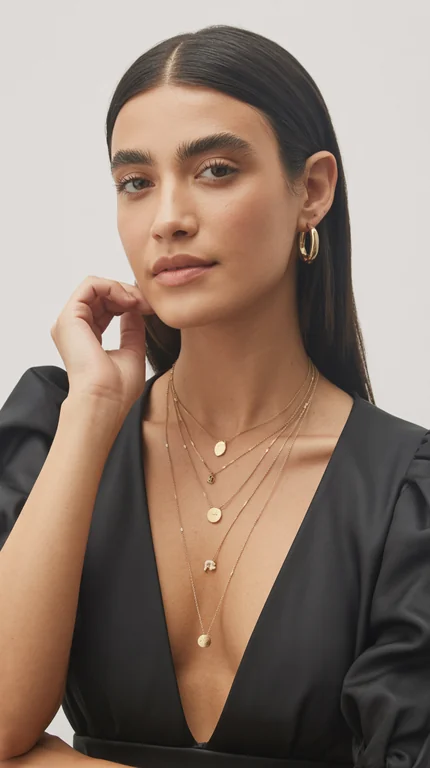

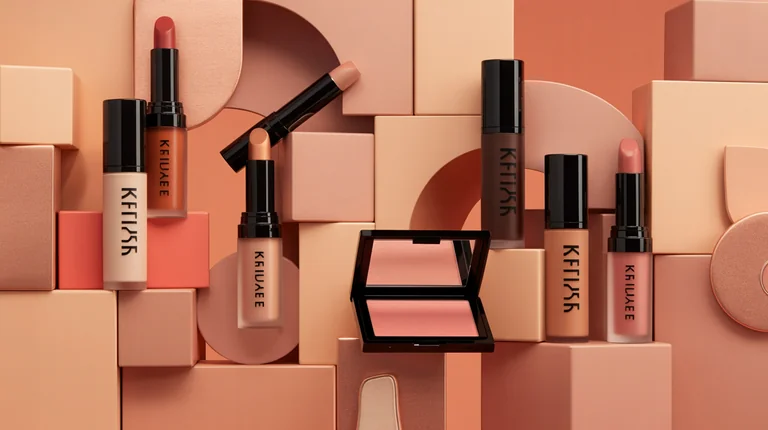





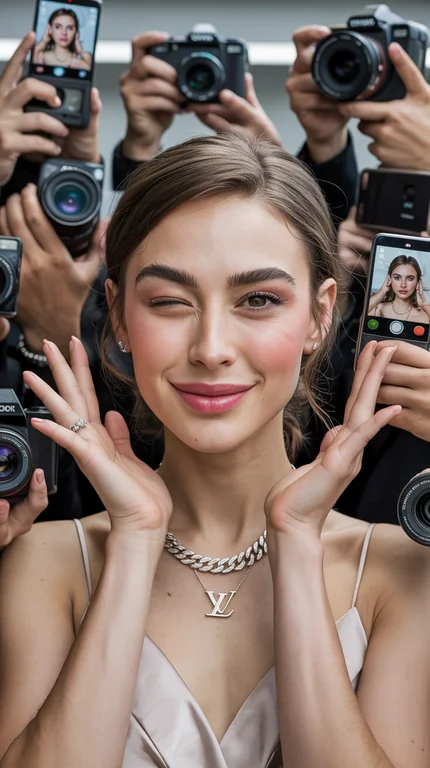
a realistic Vogue magazine cover–style fashion portrait using the uploaded face as the original face reference (100% face identity preservation). A young elegant woman posing confidently, maintaining her original facial features and natural beauty. She is winking with her left eye and making a playful duck-face expression. Both hands are raised, forming a love/heart gesture near her face. She is surrounded by multiple DSLR cameras and smartphones held around her, as if paparazzi and photographers are capturing her from all directions. Some phones show her live image on their screens. Appearance & styling: flawless glowing skin, natural makeup with glossy pink lips, soft blush, subtle highlights. Light brown hair styled in a low, neat updo with a few loose strands. Outfit & accessories: elegant minimalist beige-white strapless evening dress, Louis Vuitton necklace, diamond ring, luxury fashion jewelry. Photography style: close-up to half-body fashion portrait, Vogue editorial aesthetic, cinematic professional studio lighting, soft HDR background, shallow depth of field, realistic skin texture, ultra-detailed, 8K quality. Camera & lens look: professional DSLR look, 85mm lens feel, f/1.8 aperture, crisp focus with smooth background bokeh. Composition: Vogue magazine layout with large bold logo at the top, editorial fashion cover framing, clean and elegant design. Mood & vibe: playful yet luxurious, high-fashion beauty editorial, realistic, not AI-looking, photographed by a professional fashion photographer.











Why teams choose Ideogram V3 Quality
Choose Ideogram V3 Quality when integrated typography is part of the visual idea and the team benefits from seeing headline, composition, product scene, and hierarchy together. Do not choose it because a percentage promises exact text; the official release does not provide a universal accuracy rate, and Masonry's three first returns all failed an exact release gate. The commercially useful workflow is concept first, character-level review second, and deterministic typesetting for every mutable or regulated fact. For pure product fidelity, start from an approved SKU source and use the product-photography model workflow; for a broader text-model comparison, use Masonry's controlled text-rendering benchmark.
What Ideogram V3 Quality can do
The capabilities that set Ideogram V3 Quality apart and earn its place in a brief
Integrated image-and-type concepts
Explore headline, product scene, offer hierarchy, CTA placement, and overall art direction in one generation. This is most useful before a deterministic production layout exists, not after final price or legal copy has been approved.
Character-level review evidence
The retained three-prompt test scores exact requested strings, capitalization, punctuation, substitutions, and unrequested additions. A readable phrase still fails when a character, price, claim, or extra label differs from the brief.
Fifteen current dimension targets
The live Masonry parameter view currently advertises fifteen landscape, square, and portrait dimensions. The test requested 1080x1350 and received Ideogram's native 4:5 output at 896x1120, so inspect the returned file instead of assuming literal dimensions.
Repeatable seed input
The current route accepts a seed, which helps preserve one controlled input while a team changes prompt density or layout language. A matching seed is not a layout, typography, product, or pixel lock.
Negative-prompt control
Use the current negative-prompt field for broad exclusions such as watermarks or crowded backgrounds. Put required copy and hierarchy in the positive prompt; exclusions cannot guarantee the model will avoid invented microtext.
Concept-first production boundary
Preserve the useful scene and composition, then move price, discount, ingredients, claims, legal lines, variant data, and CTA copy into a deterministic design tool when exact release text matters.
Where teams reach for Ideogram V3 Quality
- Paid-social product-ad conceptsExplore product composition, headline hierarchy, offer treatment, and CTA safe area before rebuilding approved copy deterministically.
- Product-launch and restock cardsCreate visual directions for launches, drops, and restocks while keeping inventory, dates, and prices outside the generated layer until verified.
- Collection and campaign graphicsDevelop a coherent seasonal look across collection headers, social cards, and display concepts with a short controlled message.
- Retail posters and point-of-sale conceptsPrototype hierarchy, product staging, and headline scale, then typeset final store, date, price, and legal details in layout software.
- Email hero conceptsExplore one product, one headline, and one visual CTA direction while keeping the live email text and destination editable in the email system.
- Packaging and label directionUse generated packaging only to discuss color, form, material, and typographic direction; apply approved artwork, ingredients, warnings, and claims separately.
- Marketplace secondary-image conceptsDevelop feature-callout layouts for review, then verify channel rules and rebuild product facts from approved authority before upload.
- Creative-test cellsHold the product brief and destination stable while exploring a small number of headline or composition hypotheses for named placements.
What sets Ideogram V3 Quality apart
The strengths teams reach for, shown on real renders.
Readable is not the same as release-ready
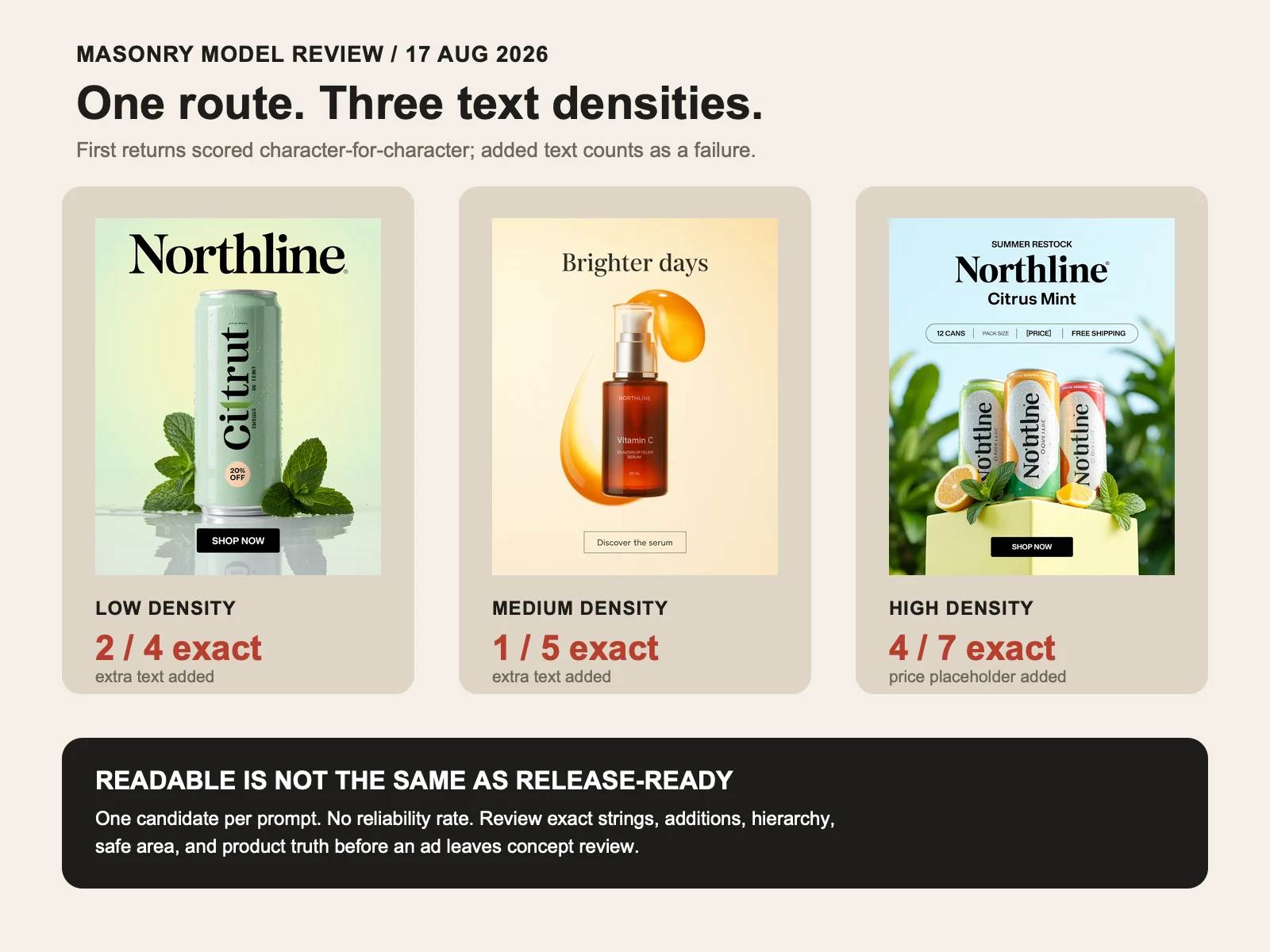
Three current-route first returns at low, medium, and high text density looked polished. Exact-string review found 2 of 4, 1 of 5, and 4 of 7 requested strings unchanged. Every result added, substituted, or reformatted copy, so all three remain concept-only.
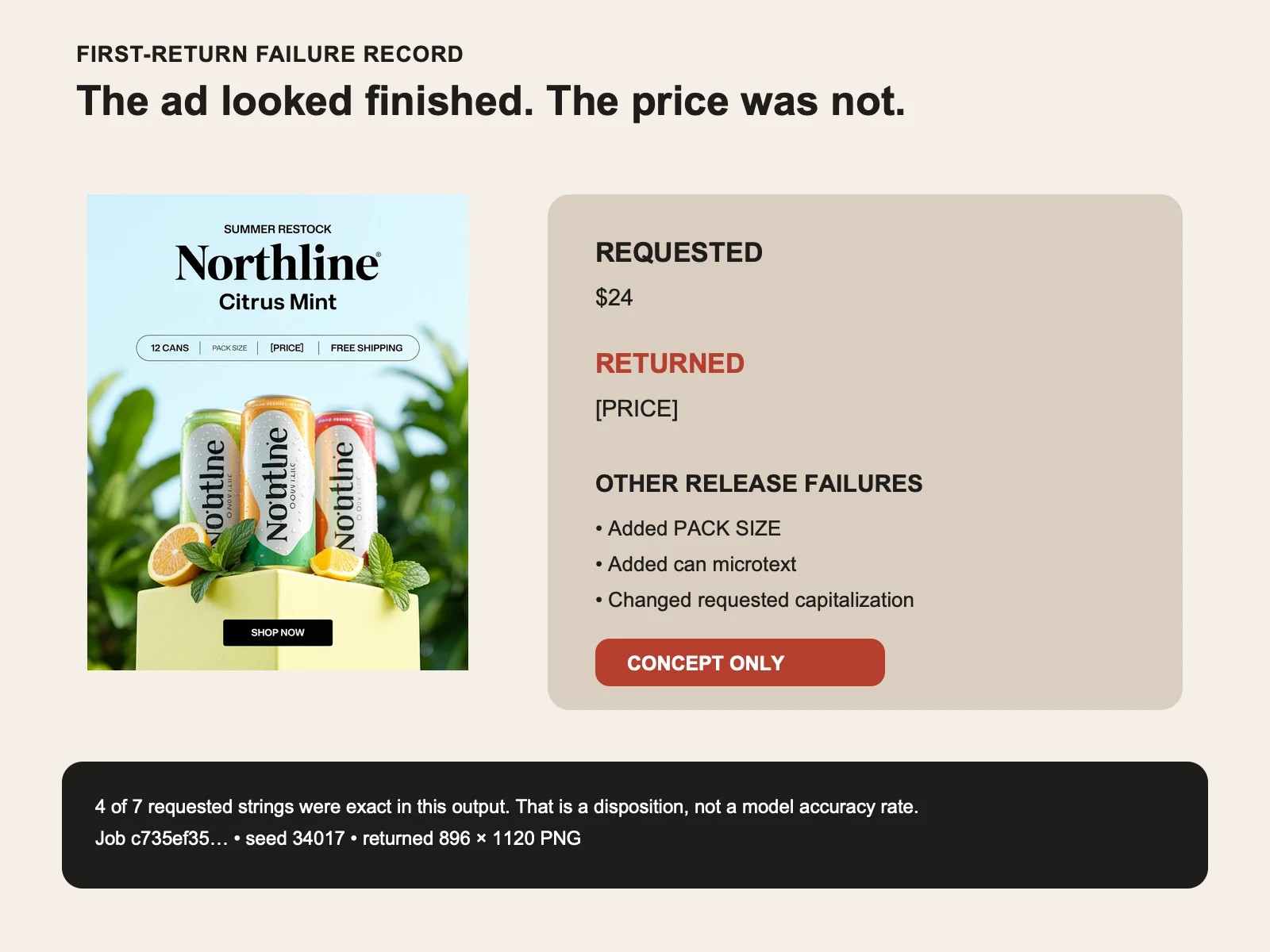
A finished-looking ad can still contain the wrong price
The seven-region restock prompt requested $24. The first return rendered [PRICE], added PACK SIZE and can microtext, and changed capitalization. Four requested strings were exact, but a wrong price is a release failure regardless of visual quality.
Explore related categories
Browse adjacent categories and creative directions teams are exploring
Frequently asked questions
What teams need to know about creating with Ideogram V3 Quality in Masonry
What is Ideogram V3 Quality best used for in ecommerce?
It is most useful for concepting creatives where typography and image composition need to be explored together: paid-social ads, launch cards, retail posters, email heroes, collection graphics, and packaging direction. Final mutable or regulated copy should be typeset from approved data after the visual direction is selected.
Does Ideogram V3 Quality have a proven universal text-accuracy rate?
Do not use that as a universal claim. Ideogram's official 3.0 release reports strong text rendering and comparative human-evaluation performance, but it does not publish one universal character-accuracy percentage that applies across prompts, languages, layouts, or production jobs.
What happened in Masonry's ecommerce text test?
Three first returns were reviewed character for character. The low-density result kept 2 of 4 strings exact, the medium kept 1 of 5, and the high-density result kept 4 of 7 while replacing $24 with [PRICE]. All three added or changed text and were marked concept-only.
Do those results mean high-density prompts work better?
No. There was one first return per prompt, so the counts are three dispositions rather than a reliability estimate or density trend. A useful benchmark would run several seeds per density and score blinded outputs under the same acceptance sheet.
Why does capitalization count as a failure?
Brand names, product names, units, approved claims, and campaign lockups can be case-sensitive. A phrase that remains readable but changes capitalization, punctuation, spacing, or line structure is not the exact approved string.
Can I let the model generate a live price or discount?
Treat generated price and discount copy as concept material only. The retained restock result replaced $24 with [PRICE]. Apply the current authorized value in a deterministic layer and verify the destination, currency, eligibility, dates, and storefront before release.
Can I use it for final packaging labels?
Use it to explore packaging form, color, imagery, and typographic direction. Do not treat generated ingredients, warnings, net contents, certifications, claims, barcodes, or legal text as authority. Apply approved artwork and regulated copy in a production design system.
Which controls does the current Masonry route expose?
The live August 17 parameter view exposes a required prompt plus dimension, negative prompt, and seed. Check `masonry models params ideogram-v3-quality` before automating because the public route can change independently of this page.
Does the Masonry route currently expose Ideogram style references?
No. Ideogram's provider product documents style-reference images, but the current Masonry public parameter view for this route does not expose reference images or style type. Do not put provider-only inputs into a Masonry CLI production script.
Can this Masonry route edit an existing product photo?
The current route is prompt-led and does not expose an image or reference input in its model-specific contract. For exact-SKU work, choose a current reference-conditioned route, start from approved source photography, and review product identity before release.
What output size did the test return?
Each job requested 1080x1350 through the CLI and returned an 896x1120 PNG, Ideogram's documented native 4:5 size. Inspect actual returned dimensions instead of assuming that a requested canvas string is the literal delivered pixel size.
Does using the same seed lock the layout and copy?
No. A seed controls one input to generation and can make a test easier to audit. It does not guarantee identical composition, typography, product geometry, or pixels across different prompts or future route versions.
How should I prompt exact text?
Quote each required string, name its position and hierarchy, state the exact number of text regions, and forbid additional copy. Then use a case-sensitive review sheet. Even a strong prompt is a specification, not an enforcement mechanism.
What should happen after a useful concept is generated?
Preserve the approved concept, rebuild product and copy authority in deterministic layers, verify full-size text, safe areas, product truth, destination, channel rules, and mobile crop, then record the exact released file and approval owner.
Should I use Ideogram V3 Quality or the newer Ideogram V4 route?
Treat them as separate live routes and test the current contract for the job at hand. This page documents the V3 Quality route and its retained outputs; it is not a claim that V3 universally beats V4 or any other current text-rendering model.
What is Ideogram V3 Quality?
Ideogram V3 Quality is an AI image generation model from Ideogram, available inside Masonry, the AI creative agent teams use to produce marketing, product, and brand images.
How does my team use Ideogram V3 Quality in Masonry?
Open a Masonry canvas, pick Ideogram V3 Quality from the model selector, and describe the image you need: a product shot, an ad creative, a social post. Masonry generates it, then you refine, edit, and combine Ideogram V3 Quality with other models in one workspace.
Is Ideogram V3 Quality free to try?
Yes, you can start generating images with Ideogram V3 Quality on Masonry's free tier, then scale up with higher limits and priority processing as your team grows.
How do I write good prompts for Ideogram V3 Quality?
Put each required string in quotation marks, name its region and hierarchy, cap the number of text regions, and explicitly forbid additional copy. Then compare the full-size output with the brief character by character. Keep prices, discounts, ingredient lists, claims, legal copy, and SKU facts in deterministic layers even when the generated concept looks correct. See the prompt gallery on this page for real Ideogram V3 Quality prompts you can copy and adapt.
Who makes Ideogram V3 Quality?
Ideogram V3 Quality is built by Ideogram. Inside Masonry it runs alongside 50+ image and video models, so your team can pick the right one for each brief without switching tools.
Can I see examples made with Ideogram V3 Quality?
Yes, the prompt gallery on this page shows real images teams have generated with Ideogram V3 Quality in Masonry, each paired with the exact prompt you can copy and adapt for your own brand.
Start creating with Ideogram V3 Quality
Generate, edit, and compare across 50+ models in one workspace.
Guides for Ideogram V3 Quality
Prompt walkthroughs and examples from the Masonry blog
Explore more AI models
Compare Ideogram V3 Quality with other models teams run in Masonry