Reddit Dynamic Product Ads can connect a product catalog to prospecting and retargeting delivery. That does not make the catalog image a standalone creative decision. The product ID in the catalog, the product ID emitted by Reddit Pixel or Conversions API, the imported price and availability, the source image, the rendered placement, and the landing page all have to describe the same sold item.
When that chain breaks, generating another image is usually the wrong first move. A beautiful scene cannot repair an event that sends a variant ID while the catalog expects a parent ID. It cannot fix an unavailable product, a stale price, an import diagnostic, or a destination that opens the wrong variant. It can only add another asset to an unresolved system.
This guide gives ecommerce teams a release sequence and a
downloadable 62-field Reddit DPA catalog-image release record.
The four controlled rows cover source authority, one generated candidate, feed placement review,
and conversation placement review. Every unobserved account, event, diagnostic, preview, policy,
delivery, and performance field remains NOT_RUN; every non-source row remains HOLD.
Quick answer
- Prove the product-ID join first. The catalog product ID and the product IDs sent in commerce events need to match exactly enough for Reddit to associate behavior with the right item.
- Resolve catalog readiness before creative production. Check imports, availability, coverage, match rate, and diagnostics before assuming the image is the constraint.
- Separate product truth from creative variation. The catalog record and approved source control identity, price, availability, and destination. Generation may change only an authorized visual layer.
- Review named placements independently. Record feed and conversation surfaces separately rather than calling one source file or screenshot “the ad.”
- Finish at product-level economics. Impressions and clicks diagnose delivery. Purchases, purchase value, costs, contribution, returns, and negative outcomes decide whether the complete route deserves more spend.
Evidence boundary: NORTHLINE, the catalog, IDs, product set, destination, and product record are fictional controlled examples. The source and generated image are real files from this production run; the hashes, dimensions, visual review, release schema, and local checks are real. No Reddit or Shopify account was authenticated. No catalog was imported, no Pixel or Conversions API event was observed, no placement was previewed, and no ad, policy review, impression, click, purchase, revenue, or conversion lift was tested.
The image sits inside a six-part release contract
Reddit's current Dynamic Product Ads setup documentation describes a system built from a catalog, Reddit Pixel or Conversions API commerce events, and matching product IDs. Its current catalog guidance adds import status, diagnostics, DPA readiness, product data, images, and product-level reporting. The useful unit of work is therefore not “one AI image.” It is one releasable product route.
| Layer | Merchant-controlled evidence | Hold condition |
|---|---|---|
| Catalog truth | exact product, variant, title, price, availability, URL, source image | any field is stale, unsupported, or points to another sold item |
| Event identity | event source, event name, emitted product ID, timestamp | the event ID cannot join to the exact catalog product ID |
| Catalog readiness | import status, availability, coverage, match rate, diagnostics | the product is ineligible, missing, unmatched, or unresolved |
| Creative candidate | immutable source hash, allowed change, candidate hash, product review | the candidate changes product truth or introduces unsupported text |
| Placement and click | named preview, rendered product, image, price, destination, policy state | the rendered route disagrees with the approved product promise |
| Commercial decision | spend, purchases, value, contribution inputs, window, rollback owner | the route lacks evidence or misses the merchant's business threshold |
The release record repeats fields across the source, candidate, and placement rows deliberately. When an import, image, event mapping, or destination changes later, the reviewer should be able to reconstruct the intended route without joining several informal documents.
Step 1: state one commercial decision
Start with a question narrow enough for one catalog campaign to answer. For the fictional example:
Can a source-faithful square scene for the exact NORTHLINE Sage 750 ML bottle contribute profitable purchase value from a declared Reddit audience while keeping the product, rendered price, image, destination, and cart route consistent?
That statement fixes the product, visual job, audience role, business outcome, and continuity check. It does not assume Reddit will outperform another channel, that a new scene will improve response, or that every eligible product belongs in the same set.
If the real decision is still “which creative idea should we test?”, use the one-SKU ad creative-testing matrix first. A DPA product set should receive an approved hypothesis, not become a container for several unlabeled ideas.
Write the release rule before launch. A practical rule might say:
- hold when the catalog-to-event ID join fails for an intended product;
- hold when the candidate changes the visible product, quantity, label, or variant;
- hold when either named placement shows the wrong product, image, price, or destination;
- hold when the clicked variant or cart disagrees with the rendered product; and
- scale only after the declared window clears the store's contribution threshold and negative- outcome guardrails.
Step 2: freeze the eligible catalog product set
Do not start with “all products” as an unexamined creative brief. Start with the exact products that can support one truthful visual promise. Export or record two field groups:
- Product identity:
catalog_id,product_id,item_group_id,retailer_sku,variant, andproduct_title. - Merchandising and offer state:
price,sale_price,currency,availability,landing_url, andproduct_set.
The item-group and product IDs serve different jobs. A group may connect variants for merchandising, while delivery and event matching still need the identifier expected for the exact item. Preserve the raw values; do not normalize punctuation, prefixes, case, or parent-versus-variant scope from memory.
Reddit's current DPA product page describes a Shopify integration that can sync catalog images, pricing, and inventory. Treat that as a transport, not an accuracy certificate. After any integration runs, inspect the imported item rows, timestamps, images, titles, prices, availability, and URLs. A successful sync can still carry a stale or poorly mapped merchant record.
Keep one rollback source for every approved replacement. If a new image is rejected or a mapping breaks, the owner should know which prior catalog asset and product record to restore.
Step 3: prove catalog-to-event product-ID parity
This is the highest-leverage check in the workflow. Reddit's setup documentation says the product ID in the catalog must match the product ID sent by Reddit Pixel or Conversions API. Commerce events such as product views, add-to-cart actions, and purchases need product identifiers that Reddit can associate with the catalog; purchase events also need the commercial fields required by the current event contract.
Build a small join table from actual observed payloads:
| Catalog product ID | Event name | Event product ID | Match | Decision |
|---|---|---|---|---|
EXAMPLE:NL-BOTTLE-SAGE-750ML | ViewContent | NOT_RUN | — | hold until event observed |
EXAMPLE:NL-BOTTLE-SAGE-750ML | AddToCart | NOT_RUN | — | hold until event observed |
EXAMPLE:NL-BOTTLE-SAGE-750ML | Purchase | NOT_RUN | — | hold until event observed |
The example does not fabricate a passing event. In a real account, capture the event name, raw product ID, timestamp, source, value and currency when relevant, and the exact catalog row it should join.
A common structural failure is parent-versus-variant mismatch: the catalog imports one platform's composite item ID while the storefront event sends only a numeric variant ID. Another is environmental drift: a development storefront sends a prefix or test product that does not exist in the production catalog. Do not patch these differences in a reporting spreadsheet. Correct the authorized catalog or event implementation, then observe the payload again.
Step 4: clear catalog readiness and diagnostics
Reddit's catalog documentation currently exposes DPA-readiness concepts including availability, coverage, match rate, and diagnostics. Record those states with an observation timestamp. Do not copy a help-center requirement into a field called “observed.”
Work in dependency order:
- Import: Did the current feed or integration finish, and which version produced the row?
- Availability: Is the exact item eligible and in a state that can be promoted?
- Coverage: Are enough intended products represented for the declared set?
- Match rate: Do observed commerce-event IDs associate with those product rows?
- Diagnostics: Which errors or warnings still affect the intended products?
Resolve the product-level issue, rerun or resync through the merchant's authorized process, and keep the before-and-after evidence. Do not create a new image to hide a diagnostic. A missing item remains missing; an unmatched event remains unmatched.
Step 5: separate the source image from the creative candidate
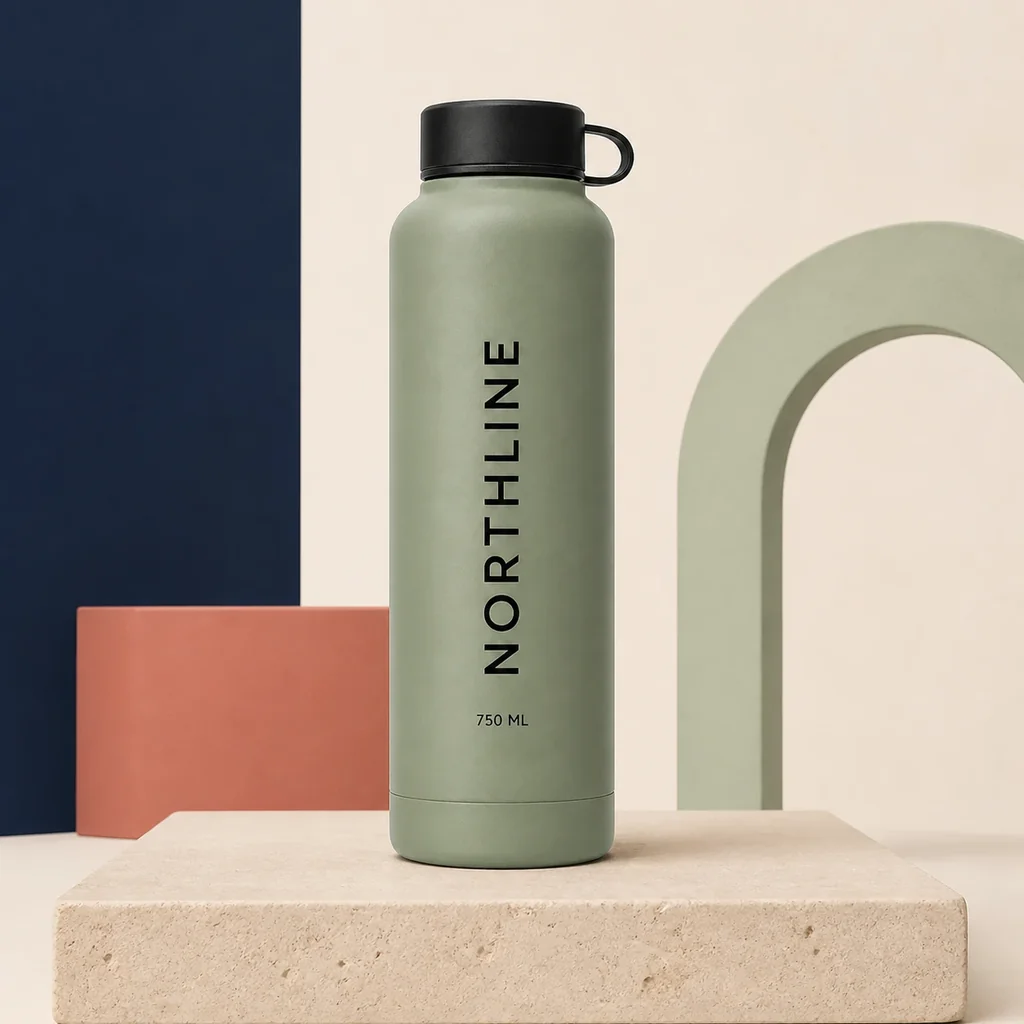
The catalog image begins with product authority. For the controlled example, the approved source is
one fictional matte sage bottle with one black cap, one camera-right loop, a bottom seam, vertical
NORTHLINE, and 750 ML. It does not authorize a price, promotion, durability claim, lifestyle use,
material claim, or real-world performance statement.
The source was passed to the built-in ImageGen path with one authorized change scope: background, surface, lighting, composition, and non-product geometric props. The prompt preserved the exact bottle count, silhouette, proportions, shoulder, base, cap, loop, color, finish, front orientation, vertical wordmark, and capacity text. It prohibited a person, hand, second product, claim, price, badge, logo, platform UI, and extra text.
Format gate: Reddit's catalog guidance, checked August 27, 2026, asks for images at least
500 × 500 pixels and image URLs that resolve to JPG or PNG; it recommends a white background. Both
files shown here are WebP evidence assets, so neither is the catalog delivery file. The release record
adds a lossless 1254 × 1254 PNG derivative of the held candidate at
/images/blog/reddit-dynamic-product-ads-catalog-image-workflow/northline-square-candidate.png, with
SHA-256 d0be7f73…a711e. That clears the documented dimension and file-type checks—not product-truth,
account, placement, policy, destination, or performance review. Recheck the derivative at full
resolution and point the authorized feed at its final reviewed delivery URL only after release.
The image looks coherent and belongs to the same editorial family as Masonry's adjacent merchant workflows. That is not enough to promote it to factual-primary media. Compare the original-resolution files for:
- exact object count, variant color, silhouette, shoulder, base seam, cap, and loop;
- label or wordmark spelling, order, placement, size, and legibility;
- crop safety, product-to-frame scale, contact shadow, and background separation; and
- any invented texture, edge, highlight, opening, accessory, or product feature.
The release sheet records PASS_VISIBLE_REVIEW_REMAINS_REGENERATED, not “exact match.” For a real SKU
whose geometry or labeling cannot tolerate a redraw, generate the empty environment and composite the
approved product pixels instead. The same-SKU product-fidelity test
shows how attractive candidates can drift, while the
supplier-photo image-set workflow separates
factual-primary, detail, social, and lifestyle roles.
Step 6: review feed and conversation placements separately
Reddit currently describes DPA delivery across feed and conversation placements, with single-image and carousel formats documented in the setup flow. The source image does not prove any of those renders. Create one placement row per surface the campaign can actually use and record:
- Delivery surface:
placementandpreview timestamp. - Rendered promise:
rendered product ID,rendered image ID,rendered price,rendered text, anddestination URL. - Review result:
revieweranddecision.
Open each named preview from the authorized account. Confirm that the visible product, image crop, price, availability language, text, and destination remain consistent. A square source can still be cropped, scaled, paired, or presented differently by surface. A correct product image can still sit beside a stale price or click to a parent collection when the promise concerns an exact variant.
If the preview is unavailable, write NOT_RUN. If it is observed but fails, retain the evidence and
write HOLD; do not replace the failed screenshot with a source-file thumbnail. The controlled TSV
keeps separate feed and conversation rows for exactly this reason.
Step 7: verify click-to-product continuity
After the preview passes, open the actual destination through the test path available to the merchant. Verify:
- the same product and variant are selected;
- title, image, price, sale price, currency, and availability agree;
- the landing page does not silently substitute a sibling product or generic collection;
- add to cart preserves the selected configuration and quantity; and
- checkout preserves the item, price, discount, shipping promise, and other approved commercial facts.
Record the landed product ID and destination result rather than only checking that the page returned HTTP 200. A technically working URL can still break the merchant promise.
When variant continuity is already weak inside Shopify, correct it upstream with the Shopify variant-image workflow. Acquisition should not amplify a storefront join the merchant cannot verify.
Step 8: launch from a reversible hold
The release record should have a named owner, observation timestamp, rollback asset, and explicit decision before spend starts. The minimum launch packet contains:
- the resolved product set and catalog import version;
- observed event-ID matches for the intended products;
- cleared diagnostics or an approved, documented exception;
- immutable source and candidate hashes;
- named placement and destination reviews;
- the decision window and commercial threshold; and
- the prior catalog image or configuration to restore.
Platform recommendations about product counts, audience construction, budget, bidding, or learning periods can change and may not fit the merchant's economics. Recheck the current Reddit-owned setup guidance on launch day and treat it as platform guidance—not as a guaranteed result or a substitute for an authorized media plan.
The commercial-use release checklist provides the upstream source, terms, mark, claim, and provenance checks when a generated candidate may enter paid distribution.
Step 9: decide from product-level outcomes
Reddit's current catalog documentation describes product-level reporting that includes delivery and sales fields. Use that grain to diagnose which items receive impressions and clicks and which complete the intended commercial route. Keep the denominator and time window explicit.
Do not call an image a winner because it has the highest click-through rate. A high-click product can
lose contribution through media cost, discounting, fulfillment, returns, or a mismatch after the click.
A simple merchant contribution view is contribution after attributable cost = purchase value −
discounts − cost of goods − fulfillment and payment costs − media cost −
creative production cost − matured return and support cost.
This is a decision framework, not a universal accounting definition. Use the store's approved finance logic, attribution window, return-maturity window, and incrementality standard. The AI UGC cost calculator helps carry production and acceptance cost into the decision, but it does not turn platform-reported sales into causal incremental revenue.
Keep three conclusions separate:
- Catalog and event correctness: did the product route work as designed?
- Creative acceptance: did the source and rendered image preserve the approved product promise?
- Business value: did the complete route produce enough incremental contribution to justify continued spend?
A route can pass the first two and fail the third. It can also appear profitable while the wrong variant, price, or destination is being measured. The release record exists to keep those states from collapsing into one dashboard number.
The reusable merchant checklist
Before a Reddit DPA catalog image moves from candidate to release, require every answer below:
- Is the exact product and variant eligible, current, and represented by an authorized source?
- Does the raw catalog product ID match the raw Pixel or Conversions API product ID?
- Have import status, availability, coverage, match rate, and diagnostics been observed?
- Does the candidate change only the authorized visual layer?
- Are source and candidate files versioned, hashed, and connected to a rollback asset?
- Have feed and conversation surfaces been reviewed separately where applicable?
- Do rendered product, price, image, and destination remain consistent?
- Does cart and checkout preserve the sold configuration?
- Are policy and approval states observed rather than inferred?
- Are spend, purchases, value, contribution inputs, and negative outcomes read over a declared window?
- Is the final decision
RELEASE,HOLD, orROLLBACKwith an accountable owner?
If any account-only field has not been checked, keep it NOT_RUN. If a required join or review fails,
keep the row HOLD. The purpose is not to make the spreadsheet look complete. It is to prevent a
source-faithful image from being mistaken for a releasable acquisition system.
For the broader operating sequence, return to the AI ecommerce use-case workflow map. Use the catalog record to control product truth, Masonry to create only the authorized visual layer, Reddit's named surfaces to verify the delivered route, and product-level economics to decide whether the route deserves another dollar.