


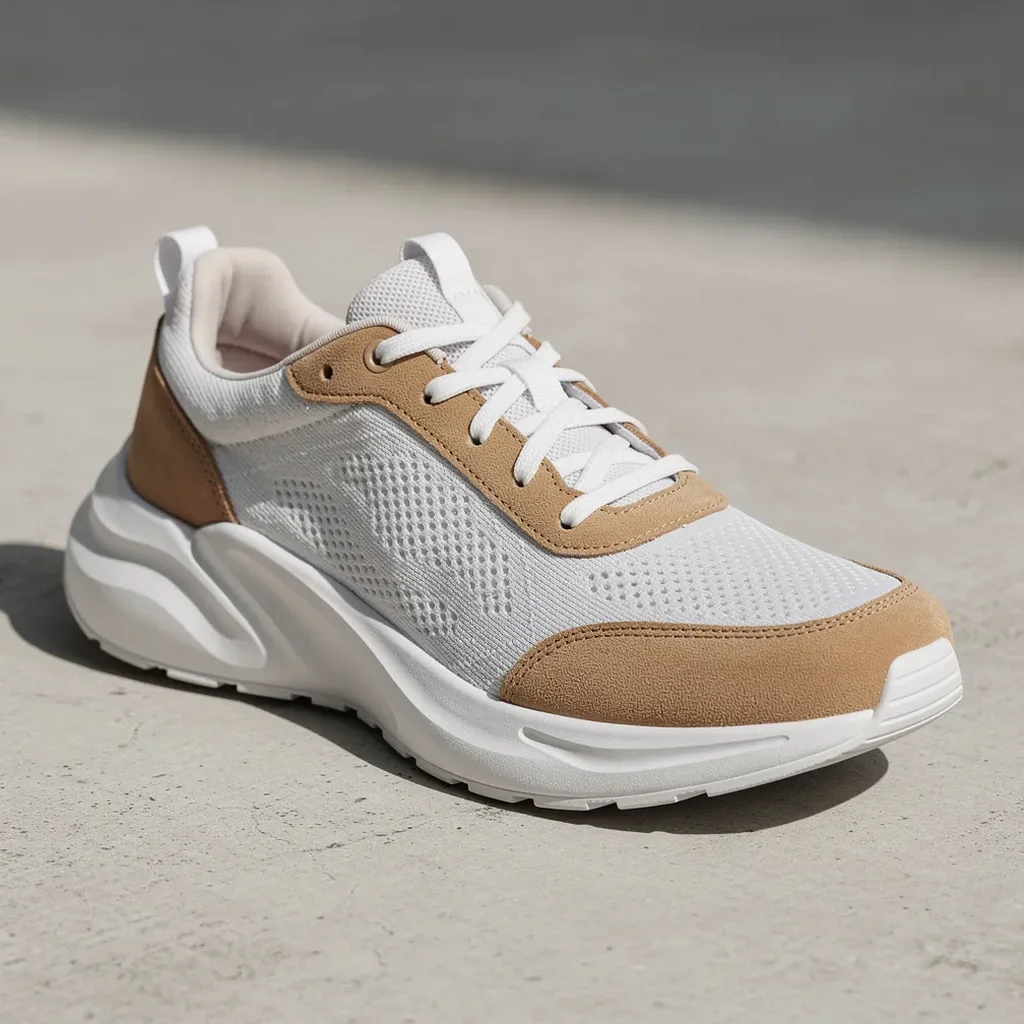
Footwear product photography has to preserve more than a silhouette. The last, toe spring, heel counter, upper panel map, stitching, lace path, midsole, outsole tread, color blocking, and every mark all identify the SKU.
This test sent one fictional white-mesh and tan-overlay running-shoe brief through FLUX.2 Pro, Nano Banana 2, GPT Image 2, and SeedDream 4.5. The four original outputs below show useful differences in materials, construction, grading, and unrequested marks. No real shoe reference was supplied.
Evidence boundary: this is one prompt and one displayed output per model. The shoe was fictional, no approved product reference or specification sheet was supplied, and no fit, sizing, material-composition, traction, safety, legal, or repeated-reliability test was possible. The observations describe these four images; they are not model pass rates or proof that a candidate is commercially cleared.
Quick answer
- Strongest displayed material study: FLUX.2 Pro made the clearest separation between mesh, suede-like overlays, and rubber-like sole in this run.
- Most important failure: the Seedream candidate added conspicuous side stripes and lettering despite a no-marks requirement.
- What all four prove: each route made one visually plausible fictional sneaker concept.
- What none prove: preservation of a real shoe, construction, size, materials, marks, colorway, or performance.
- Safer listing path: generate the set and light, then composite approved footwear photography.
The controlled brief
The original article summarized the prompt. A reproducible version matching the tested subject is:
Fictional brand-free low-top running sneaker, white engineered-mesh upper, tan suede-like eyestay and heel overlays, white woven laces, padded tongue and collar, sculpted white foam-like midsole, pale gum-rubber outsole, three-quarter lateral view on smooth concrete, soft camera-left studio light, natural contact shadow, square product photograph. No text, logos, stripes, symbols, badges, people, socks, box, extra shoes, or watermarks.
This text-only brief can test art direction and visible material separation. Without a real source, each panel, seam, and sole is invented.
Four first-hand outputs
FLUX.2 Pro separated the requested surfaces most clearly at article scale. The upper reads as mesh, the tan panels read as a different nap, and the sole carries broader highlights. That is a visual observation, not verification of fiber, leather, rubber, foam, thickness, stitch construction, or performance.
Nano Banana 2 returned a conventional centered product composition. Mesh, overlays, eyelets, laces, and sole remain readable. The panel boundaries and sole geometry look plausible, but plausibility cannot establish that the seams connect, the lacing functions, or the outsole matches a sold product.
GPT Image 2 used a warmer grade and another invented construction. The major material regions separate cleanly. For a real colorway, compare every upper panel, lace, midsole, outsole, and mark against a controlled target; warm light can make the wrong tan look attractive.
Seedream 4.5 made a polished hero, but it added side stripes and lettering that the brief prohibited. That observable failure is enough to reject the candidate. There is no need to guess which brand the mark evokes before removing it from a commercial workflow; questions about trademark, trade dress, or clearance require qualified review.
What the comparison actually supports
| Question | What these four images show | What remains untested |
|---|---|---|
| Can the routes make a sneaker concept? | Yes, once each for this brief. | Reliability across seeds, shoes, crops, and prompts. |
| Do the materials read separately? | Each candidate shows recognizable mesh, overlay, lace, and sole cues. | Real composition, thickness, construction, color, feel, and durability. |
| Can unrequested marks appear? | Yes, in one displayed candidate. | Frequency, cause, legal significance, and behavior across other briefs. |
| Is a real SKU preserved? | No evidence; no source shoe was supplied. | Every construction line, dimension, material, colorway, label, and mark. |
| Are fit or performance claims supported? | No. | Sizing, fit, cushioning, drop, traction, stability, waterproofing, safety, and athletic performance. |
The earlier version described material rendering as solved and made a categorical real-brand conclusion from one image. The defensible finding is narrower: four models made attractive fictional sneakers once, and one candidate visibly violated the no-marks instruction.
Product fidelity checks for a real shoe
Build the rejection sheet from approved packshots, technical drawings, color standards, artwork, and specifications:
- Last and silhouette: toe shape and spring, forefoot width, waist, arch, heel height, heel counter, collar opening, and overall proportions.
- Upper construction: panel map, mesh or knit pattern, overlays, underlays, stitching paths and counts where visible, bonding, perforations, reinforcement, tongue, collar, pull tabs, and lining.
- Lacing: lace material and color, eyelets, loops, path, crossings, knot, tongue centering, and left-right consistency.
- Midsole and outsole: sidewall geometry, stack profile, segmentation, flex grooves, tread blocks, rubber zones, cutouts, plates, windows, and ground contact.
- Materials and colorway: approved material names, texture, grain or nap, gloss, transparency, reflective zones, color blocking, edge paint, and color target.
- Artwork and marks: logos, stripes, symbols, model name, size label, tongue and sockliner artwork, heel marks, outsole marks, legal and certification copy, and every visible character.
- Pair and sold configuration: left-right asymmetry, size, included laces, insoles, tags, packaging, and accessories must match what the customer receives.
- Product facts: fit, width, weight, cushioning, stack, drop, stability, traction, durability, waterproofing, breathability, materials, sustainability, safety, and performance remain in approved data and test records.
If the shoe looks plausible but its panel map, lace path, tread, or label differs, it is the wrong SKU.
A reference-first footwear workflow
1. Prepare authoritative sources
Use lateral, medial, front, rear, top, outsole, tongue-label, sockliner, and material-detail views plus drawings, artwork, a color target, and the current specification sheet. Name each source's role.
2. Generate the environment separately
Create an empty concrete studio, track, locker room, trail, or lifestyle plate with the final crop and light. Composite approved shoe photography, then construct contact shadow, reflection, and surface interaction deliberately.
3. Test a reference-conditioned scene
masonry image "Change only the environment to smooth concrete with soft camera-left studio light. Keep the supplied shoe unchanged: last, silhouette, toe, heel, panel map, mesh, overlays, stitches, tongue, collar, laces, eyelets, midsole, outsole tread, colorway, labels, logos, and every visible character. Add one natural contact shadow. Add no new stripes, symbols, text, people, box, or extra shoes." \ --model gemini-3.1-flash-image-preview \ --ref ./approved-shoe-lateral.png \ --aspect 1:1 \ --output footwear-scene-candidate.png
The instruction is not a footwear lock. Compare the candidate with every approved view and composite the source shoe when exact construction or markings matter.
For a fictional concept:
masonry image "Fictional brand-free low-top running sneaker, white engineered-mesh upper, tan suede-like overlays, white laces, sculpted white midsole, pale gum outsole, three-quarter lateral view on concrete, soft camera-left light, no text, logos, stripes or symbols, square product photograph." \ --model flux-2-pro \ --aspect 1:1 \ --output footwear-concept.png
Footwear acceptance sheet
| Area | Pass condition |
|---|---|
| Source match | Candidate is compared with approved lateral, medial, front, rear, top, outsole, labels, artwork, and material details. |
| Last and upper | Silhouette, toe, heel, panel map, mesh, overlays, stitches, tongue, collar, tabs, lining, and perforations match. |
| Lacing and pair | Laces, eyelets, path, tongue position, left-right asymmetry, scale, and sold configuration match. |
| Sole | Midsole profile, stack cues, segmentation, flex grooves, tread, rubber zones, cutouts, and contact match. |
| Materials and color | Texture, grain, gloss, transparency, reflective zones, color blocking, and target color pass controlled review. |
| Artwork and marks | Every approved mark and character matches; no invented stripe, symbol, word, label, or background text appears. |
| Product facts | No sizing, fit, cushioning, traction, durability, material, sustainability, safety, or performance fact is inferred from the image. |
Bottom line
The four visuals belong here because they show useful material and art-direction differences—and because one polished candidate visibly ignored the no-marks requirement. Their value is the controlled comparison, not a claim that generic footwear generation is production-ready.
Use the images to choose a scene direction. Use approved construction sources, specifications, color targets, and qualified review to decide whether an asset can ship. Compare other controlled tests in the AI product photography model review, or build a reference-first workflow in Masonry's product photography tool and automate candidates with the Masonry CLI.


