


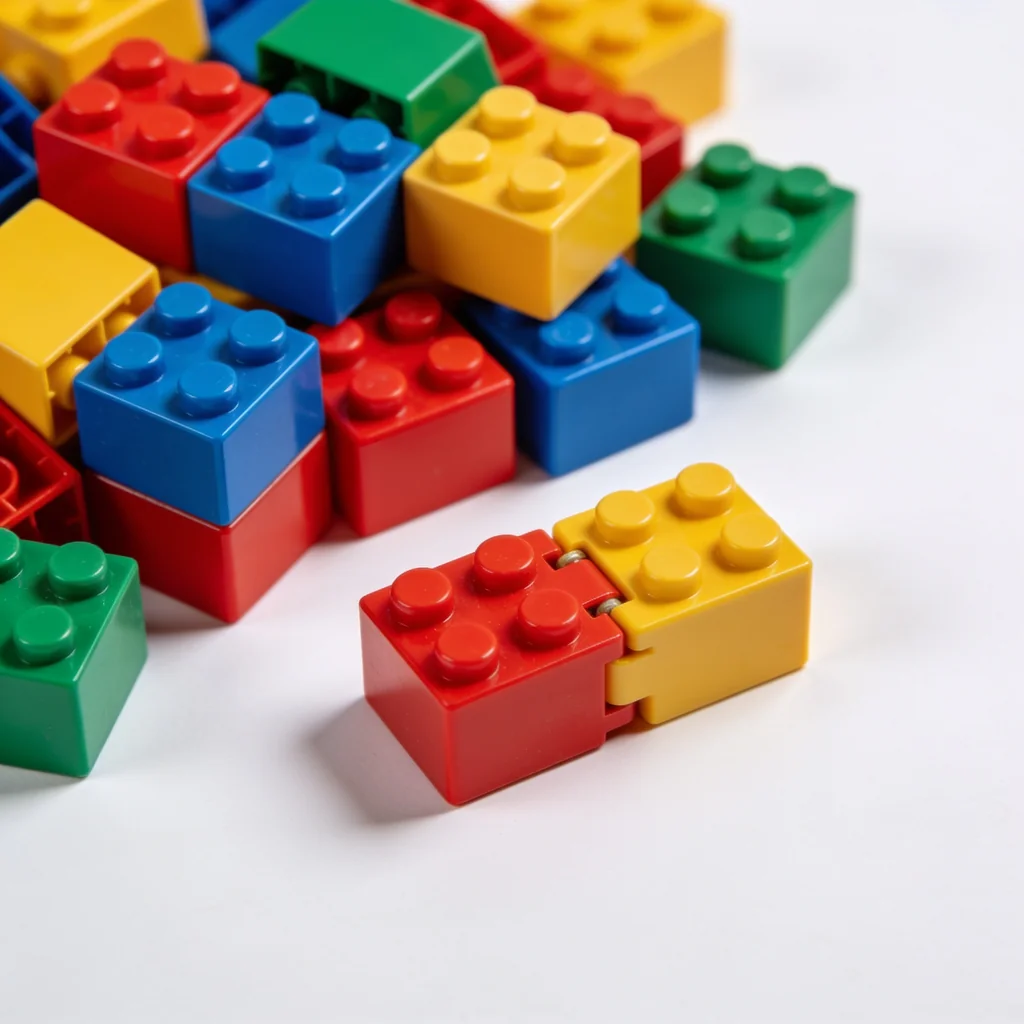
Toy photography carries three independent fidelity problems: the displayed object must be the owned design, the exact parts and play configuration must match the SKU, and no image can stand in for age grading or safety evidence. A glossy, colorful render can be wrong on all three while still looking retail-ready.
This test sent one fictional colorful interlocking-building-brick brief through Seedream 4.5, Nano Banana 2, GPT Image 2, and FLUX.2 Pro. The four original outputs below show useful differences in visible plastic highlights, stud shape/detail, pile arrangement, crop, surface, and light. No original prompt, owned toy, design drawing, bill of materials, dimensions, part count, color standard, assembly guide, package contents, age grade, warnings, rights search, test report, certification, or product record was supplied.
Evidence boundary: this is one displayed output per model from an unpublished prompt. The observations describe visible fictional studded-brick concepts—not original design, ownership, trade-dress scope, infringement, sellability, exact material/color, part compatibility, age grade, safety, compliance, model reliability, current price/value, shoot replacement, or preservation of a real toy SKU.
Quick answer
- Closest displayed glossy-plastic macro: Seedream 4.5 in this run.
- Cleanest displayed white-background pile: Nano Banana 2 in this run.
- Most visible displayed molded-like stud detail: GPT Image 2 in this run.
- Softest, roundest displayed stud treatment: FLUX.2 Pro in this run.
- What all four establish: each route made one plausible fictional colorful studded-brick concept.
- What none establish: originality, ownership, rights clearance, exact part geometry/count, compatibility, material/color, age grade, warnings, safety, compliance, or repeated reliability.
All four visibly resemble familiar studded interlocking-brick systems. That resemblance is a commercial screening flag, not a legal conclusion. The USPTO defines trade dress as a trademark type that can consist of a product's three-dimensional configuration, while the scope and outcome of any specific rights analysis require product- and jurisdiction-specific evidence.
First define the toy offer
| Offer type | Fidelity target | Required evidence |
|---|---|---|
| Fixed single toy | One exact owned design, size, colorway, feature set, accessory set, label, and package. | Approved drawings/CAD, physical sample, bill of materials, multi-angle photography, dimensions, colors, mechanisms, age/warning records, packaging, rights, and current SKU data. |
| Set, kit, or construction system | The exact piece inventory and every supported/advertised build or configuration. | Numbered parts list, counts/colors/shapes, compatibility rules, instructions, completed and intermediate builds, spare pieces, package contents, age/warning records, packaging, and fulfillment mapping. |
| Assorted or naturally variable product | A disclosed assortment/range rather than the exact displayed combination. | Approved assortment probabilities or range, minimum/typical counts, colors/forms, substitutions, packaging, representative-photo disclosure, inventory mapping, and age/safety evidence for every possible item. |
A generated image must not add a part, remove a required piece, show an impossible connection, imply that props are included, or display an unapproved lookalike design.
The controlled concept brief
The original article did not publish the exact prompt. A bounded concept prompt for future testing is:
Fictional brand-free arrangement of colorful rounded geometric construction pieces using an original non-rectangular connection system, primary red, blue, yellow, and green, on a clean light-gray sweep, soft studio light, square toy concept photograph. No real toy format, circular top studs, underside tubes, logo, letters, numbers, character, person, age label, safety claim, package, price, badge, or extra product.
This is deliberately not a reconstruction of the unpublished prompt or the displayed rectangular bricks. It can test scene direction for a new fictional concept. It cannot establish originality because the model invents the geometry, connectors, parts, fit, scale, material, color, mechanisms, play pattern, age suitability, and hidden surfaces; rights and safety still require independent review.
Four first-hand outputs
Seedream 4.5 made the closest view of glossy-looking plastic surfaces, circular top studs, brick edges, highlights, and several primary-color pieces. A red and yellow foreground pair appear joined side-by-side by a small hinge-like connector, implying an unsourced part or mechanism. The image does not establish ABS or another material, calibrated color, underside connector geometry, dimensional compatibility, part count, owned design, rights clearance, or safe use.
Nano Banana 2 made the cleanest white-background catalog concept, with multiple rectangular brick sizes and colors in a loose pile. The arrangement is easy to scan but not to verify: overlap hides undersides, connectors, damage, complete part counts, and size relationships. A factual set image needs an exploded inventory view plus verified assembled states.
GPT Image 2 showed the most visible molded-like detail on some top studs alongside bright glossy surfaces. Small generated marks can increase resemblance to familiar products or imply production detail that was never supplied. Inspect every mark, connector, proportion, part, and surface against owned sources and the rights review; do not treat detail density as fidelity.
FLUX.2 Pro displayed somewhat rounder, softer-looking studs and edges at article scale while retaining familiar rectangular studded-brick cues. That visual difference is not enough to establish an original design or rights clearance. The hidden underside, connector system, tolerances, counts, materials, scale, and safety record remain untested.
What this comparison supports
| Question | What the four images show | What remains untested |
|---|---|---|
| Can the routes make colorful studded-brick concepts? | Yes, once each for the unpublished brief. | Reliability across seeds, owned designs, references, parts, assemblies, materials, packages, prompts, and current routes. |
| Do visible surface and pile treatments differ? | Yes; highlights, crop, background, stud/edge softness, molded-like detail, arrangement, and color treatment vary. | Exact geometry, connectors, dimensions, tolerance, material, color, part inventory, damage, and physical compatibility. |
| Do the images resemble familiar building-brick systems? | Yes; rectangular bricks with circular top studs are visible in all four. | Source, ownership, registrations, protectable/nonfunctional features, market context, confusion analysis, jurisdiction, defenses, license, and legal conclusion. |
| Is a real toy SKU preserved? | No evidence; no owned product source was supplied. | Drawings/CAD, bill of materials, parts/counts/colors, assemblies, mechanisms, dimensions, accessories, package, inventory, and fulfillment mapping. |
| Are age grade, safety, or compliance established? | No. | Intended age, small parts, edges/points, magnets, cords, batteries, projectiles, pinch/entrapment, materials/chemicals, testing, warnings, labels, certificates, and market requirements. |
The old article repeatedly declared every image a LEGO clone and unsellable, asserted protected trade dress and accurate ABS/color, named a craft winner, and promised owned-design fidelity from a reference. Those are not conclusions these four images alone can support. The defensible result is narrower: four routes made visually familiar studded-brick concepts once, and that resemblance should trigger rights screening before commercial use.
Toy fidelity and safety checklist
Build the rejection sheet from owned drawings/CAD, physical samples, bills of materials, exploded and assembled photography, dimensions/tolerances, colors/materials, mechanisms and use states, package contents, age-determination records, warnings/instructions, test/certification files, rights searches/licenses, packaging, fulfillment mapping, and current product data:
- Identity and rights: owned design version, designer/source, CAD/drawings, distinctive and functional features, marks/logos/characters/art, comparison set, searches, registrations/licenses, territory/use scope, approvals, and qualified review. Visual similarity is a flag, not the final legal analysis.
- Parts and geometry: exact part numbers/counts/colors, shape, scale, dimensions, tolerances, studs/connectors/sockets/axles/gears, underside, joints, articulation, fasteners, seams, gates, edges/points, openings, clearances, and complete exploded inventory.
- Assembly and function: allowed builds, instruction sequence, connection orientation, fit, movement/range, mechanism access, load/stability, pinch/entrapment-facing gaps, breakaway/release, projectile action, wheels, sound/light/electrical states, and no impossible or unapproved configuration.
- Material and finish: approved resin/wood/metal/textile-facing surface, coating/paint/ink, gloss/texture, calibrated colors, translucency, decals/printing, molded marks, scratches/stress-whitening, cracks, burrs, flash, defects, and no unsupported ABS/non-toxic/sustainable inference.
- Age and hazard record: intended age and age determination; small parts/choking, accessible edges/points, cords/straps/elastics, magnets, batteries, projectiles, pinch/crush/entrapment, sound, electrical/thermal, flammability, chemicals, mouth contact, abuse/durability, and product-specific hazards.
- Packaging, labels, and instructions: exact package art/copy, age grade, warnings, assembly/adult-supervision and use instructions, producer/tracking/batch marks, contents/counts, batteries included/not, labels/certification marks, barcode, language/territory version, window visibility, and packaging condition.
- Scene and child-facing presentation: product-only factual views plus approved lifestyle use; correct age/ability of any person, supervision/protective-equipment context, assembly state, scale, environment, no hazardous misuse, no mouth/sleep/crib/road/water implication unless approved, and no implied included prop.
- Variant and fulfillment: exact set/edition/color/size/age/package version, part substitutions, spare pieces, characters/accessories, batteries/charger, instructions, inventory/batch, thumbnail mapping, shipping state, recall/condition status, sold configuration, and fulfillment record.
For U.S. businesses, the CPSC's current toy-safety guidance explains that applicable requirements vary by toy and covers subjects including small objects, accessible edges and points, cords, projectiles, batteries, magnets, labeling, testing, and certification. Determine the requirements for the actual product and market; an image cannot perform that analysis.
An owned-design toy workflow
1. Capture authoritative sources
Photograph the approved toy front, back, sides, top, base, every part, connector, mechanism, assembly stage, allowed completed build, accessory, label, warning, instruction, package, and scale. Store CAD/drawings, bills of materials, dimensions/tolerances, colors/materials, age determination, test/certification and rights records, package contents, variants, and current fulfillment data.
2. Build the scene separately
Generate or photograph an empty studio, playroom, tabletop, shelf, outdoor, classroom, or editorial plate at the final crop. Composite approved toy photography, then build contact, shadow, reflection, hand interaction, scale, and occlusion deliberately. Use child/lifestyle imagery only after age, use-state, supervision, and hazard review.
3. Test a constrained reference edit
masonry image "Change only the environment to a clean light-gray studio sweep with soft light. Keep the supplied toy unchanged: exact owned silhouette, every part and count, geometry, dimensions, connectors, joints, colors, materials-facing surface, molded marks, mechanisms, assembly state, accessories, labels, warnings, package contents, and sold configuration. Add one natural contact shadow. Add no child, character, logo, text, extra part, alternate build, battery, prop, price, badge, or package." \ --model gemini-3.1-flash-image-preview \ --ref ./approved-owned-toy.png \ --aspect 1:1 \ --output toy-scene-candidate.png
The instruction is not an identity, parts, geometry, rights, age, safety, compliance, or SKU lock. Compare the candidate with owned sources, the full bill of materials, dimensions, assemblies, package contents, warnings, rights and safety/compliance records, packaging, variants, and fulfillment data. Composite approved product photography when exactness matters.
For a fictional exploration that intentionally avoids the displayed brick format:
masonry image "Fictional brand-free arrangement of colorful rounded geometric construction pieces using an original non-rectangular connection system, primary red, blue, yellow, and green, clean light-gray sweep, soft studio light, no real toy format, circular top studs, underside tubes, logo, letters, numbers, character, person, age label, safety claim, package, price, badge, or extra product" \ --model seedream-4-5 \ --aspect 1:1 \ --output toy-concept.png
Toy acceptance sheet
| Area | Pass condition |
|---|---|
| Source match | Candidate is compared with owned drawings/CAD, approved front/back/sides/top/base, every part, exploded inventory, assembly states/builds, mechanisms, dimensions, materials/colors, accessories, labels/warnings/instructions, tests/certificates, rights, package, variants, fulfillment, and product data. |
| Identity, parts, and function | Owned design/version, exact geometry, part count/color/shape, connectors, undersides, joints, assembly, movement, mechanisms, scale, tolerances, use state, damage/defects, hidden-side logic, and physical review match. |
| Age, safety, and presentation | Intended age, hazards, tests, warnings, instructions, labels, certifications, product/use imagery, child age/ability, supervision, protective context, environment, scale, and no unsafe or unapproved use implication match current records. |
| Package and fulfillment | Exact set/variant/edition, contents, spare parts, accessories, batteries/charger, package version/art/copy, age/warnings, producer/tracking marks, labels, barcode, inventory/batch, substitutions, recall/condition status, sold configuration, and fulfillment record match. |
| Claims and rights | No ownership/originality/license/non-infringement, material/non-toxic, age/safe, tested/certified/compliant, educational/developmental, performance, sustainable, affiliated, delivery, or warranty claim is inferred from appearance. |
Bottom line
These four outputs are useful as a plastic-highlight, stud-detail, pile, crop, and lighting comparison. They are not evidence that any design is owned or infringing, that a no-logo prompt creates an original toy, that a reference preserves every part, that a fictional set is ready to list, or that safety/compliance is established.
Use fictional concepts only for early scene/design exploration. Use owned design sources, exact product photography, full parts and assembly records, dimensions, materials/colors, package contents, age/warning and safety/compliance evidence, rights clearance, variants, packaging, fulfillment mapping, and product facts to decide whether an asset can ship. Compare the broader AI product photography model review, build a controlled scene in Masonry’s product photography tool, or automate candidates with the Masonry CLI.


