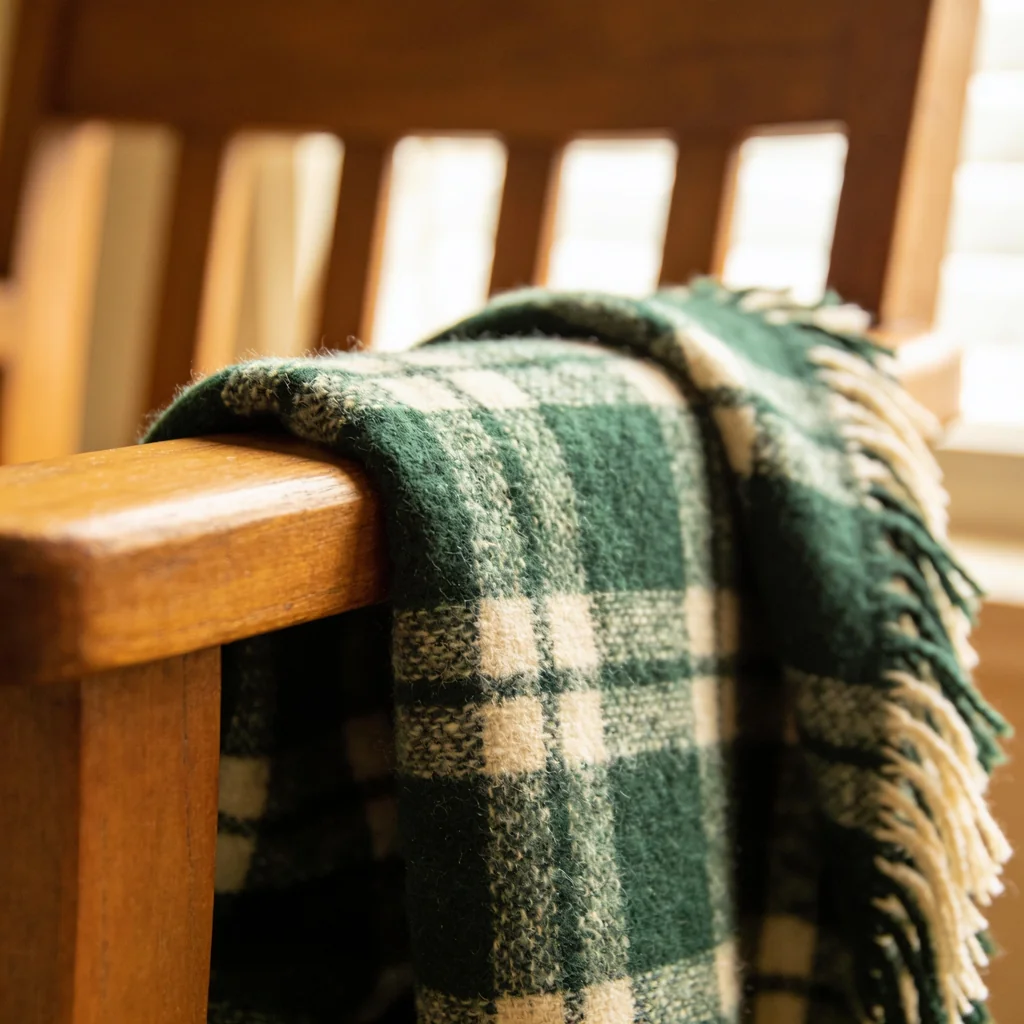
Textile photography has two visual traps: a plausible surface may not be the specified fiber or construction, and a pattern may look coherent while changing repeat, scale, color order, or alignment across folds. A cozy image can still depict the wrong throw.
This test sent one fictional green-and-cream plaid wool-throw brief through Seedream 4.5, Nano Banana 2, GPT Image 2, and FLUX.2 Pro. The four original outputs below show useful differences in visible texture, pattern, fringe, crop, and drape. No real textile, pattern artwork, color target, dimensions, fiber specification, construction sheet, care label, packaging, or product data was supplied.
Evidence boundary: this is one text prompt and one displayed output per model. The observations describe visible fictional throws—not fiber identity, weave specification, pattern accuracy, physical drape, color accuracy, softness, warmth, model reliability, price/value, studio replacement, or preservation of a real SKU.
Quick answer
- Most fibrous displayed surface: Seedream 4.5 in this run.
- Clearest displayed diagonal weave cue: Nano Banana 2 in this run.
- Cleanest displayed buffalo-check concept: GPT Image 2 in this run.
- Softest displayed texture: FLUX.2 Pro in this run.
- What all four establish: each route made one plausible fictional plaid-throw concept.
- What none establish: the correct pattern, repeat, fiber, yarn, weave, color, dimensions, edge, fringe, label, packaging, product facts, or repeated reliability.
One output per route does not establish a universal winner. At article scale, all four patterns appear broadly coherent across their displayed folds; that is not the same as matching an approved repeat or construction.
The controlled concept brief
The original article did not publish the exact prompt. A bounded version matching the displayed subject is:
Fictional forest-green and cream buffalo-check wool-look throw draped over a simple chair, visible woven surface and fringed edge, soft warm window light, square home-textile product photograph. Keep the broad plaid grid visually continuous over the folds. No brand, label, care tag, words, person, pet, packaging, fiber-content claim, dimension, price, certification, watermark, or extra blanket.
This prompt can test composition and visible textile cues. It cannot preserve a SKU because the model invents the repeat, line widths, color values, yarn, structure, dimensions, weight, pile, edges, fringe, seams, labels, and hidden side.
Four first-hand outputs
Seedream 4.5 produced the most pronounced fuzzy surface and individual fiber-like detail of the four displayed candidates, with a warm macro crop and visible fringe. That supports an art-direction observation about the rendering. It does not establish wool content, yarn construction, weave, weight, finish, warmth, softness, durability, or an exact pattern match.
Nano Banana 2 rendered a crisp diagonal twill-like surface, broad green-and-cream checks, a chair fold, and detailed fringe. The pattern reads continuously at article scale. Because no artwork or textile source was supplied, “continuous” cannot be upgraded to “correct,” and the apparent structure cannot establish the manufactured fabric.
GPT Image 2 made the cleanest broad buffalo-check concept of the displayed set, with an orderly window-lit scene and a tidy edge. It is easy to inspect at article size, but the repeat, line width, intersections, color, yarn, edge construction, and drape were not compared with an approved product.
FLUX.2 Pro produced a plausible draped throw in a softer overall rendering. The broad checks and fringe remain visible, while individual surface detail is less inspectable. That may work for a distant editorial placement; full-resolution SKU review is still required because responsive zooms and marketplace crops can reveal hidden changes.
What this comparison supports
| Question | What the four images show | What remains untested |
|---|---|---|
| Can the routes make a plaid-throw concept? | Yes, once each for this fictional brief. | Reliability across seeds, textiles, patterns, colors, crops, references, prompts, and current routes. |
| Do visible surface treatments differ? | Yes; fiber-like detail, diagonal texture, softness, contrast, and fringe vary. | Fiber, yarn, weave/knit, pile, weight, finish, hand, softness, warmth, performance, and durability. |
| Do the displayed plaids follow folds broadly? | They appear broadly continuous at article scale. | Exact artwork, repeat, scale, color order, line width, intersections, grain, alignment, seams, hidden areas, and full-resolution continuity. |
| Is a real SKU preserved? | No evidence; no product source was supplied. | Dimensions, pattern, colorway, structure, edges, fringe, seams, labels, packaging, contents, and defects. |
| Are product facts established? | No. | Fiber content, care, origin, certification, safety, performance, sustainability, warranty, and every marketed claim. |
The old article treated a plausible-looking weave and broad grid as proof that weave and drape were solved. The defensible conclusion is narrower: four routes made attractive fictional throws once, and their displayed surface treatments differ.
Textile product fidelity checklist
Build the rejection sheet from approved flat and draped photography, macro sources, pattern artwork, color standards, measurements, construction specifications, labels, packaging files, and current product data:
- Overall product: width, length, thickness, weight, shape, front/back, orientation, shrinkage allowance, stretch direction, and sold size.
- Fiber and yarn-facing cues: fiber content stays in approved data; visually compare yarn diameter, twist, slub, fuzz, sheen, loft, pile, nap, density, mélange, and intentional irregularity.
- Structure: woven, knit, felted, tufted, quilted, nonwoven, or composite construction; warp/weft or course/wale direction, twill, plain weave, rib, cable, pile, quilting, backing, and layers.
- Pattern artwork: repeat dimensions, motif, check size, stripe width, color order, intersections, registration, grain direction, placement, mirroring, seams, matching, borders, and cropped edges.
- Color and finish: approved color target under the intended illuminant, contrast, dye effect, print, wash, brushing, distressing, coating, waterproofing cues, and finish boundaries.
- Construction: hems, selvage, binding, piping, seams, stitches, quilting, fringe, tassels, knots, corners, closures, hardware, labels, tags, and attachment points.
- Drape and state: fold plan, compression, thickness, gravity, pile direction, wrinkles, crease memory, stretch, contact, shadow, chair/bed relationship, and approved styled state.
- Labels and packaging: brand, SKU, size, fiber, care, origin, certification and legal copy, symbols, barcode, carton, belly band, bag, insert, accessories, and sold configuration.
- Product facts: fiber, thread count, GSM/weight, warmth, softness, breathability, waterproofing, stain resistance, flame performance, allergens, care, origin, certification, sustainability, safety, durability, and warranty remain in approved data.
If the room looks inviting but the pattern, color, construction, dimensions, label, packaging, or product facts differ, it is the wrong textile asset.
A source-first textile workflow
1. Capture authoritative sources
Photograph the product flat, front, back, both orientations, draped, folded, edge, corner, seam, fringe/tassel, closure, label, care tag, packaging, defects, and scale. Add raking-light and macro views of the actual structure, pattern artwork, repeat measurements, dimensions, color targets, and current product data.
2. Build the room separately
Generate or photograph an empty chair, bed, sofa, shelf, laundry, or editorial plate at the final crop. Composite approved textile photography and shape its contact, fold, shadow, and occlusion deliberately. This keeps the pattern and construction deterministic.
3. Test a constrained reference edit
masonry image "Change only the environment to a simple warm room with soft camera-left window light. Drape the supplied textile over a plain chair while keeping the product unchanged: dimensions and thickness cues, front/back orientation, exact pattern artwork and repeat, line widths, intersections, colorway, grain, visible structure, pile, hems, seams, fringe, labels, and marks. Add one natural contact shadow. Add no person, pet, text, claim, packaging, or extra textile." \ --model gemini-3.1-flash-image-preview \ --ref ./approved-textile-flat-and-draped.png \ --aspect 1:1 \ --output textile-scene-candidate.png
The instruction is not a pattern lock. Compare the candidate against the approved flat, draped, macro, artwork, color, dimension, label, and packaging sources; composite the approved textile when exactness matters.
For a fictional concept:
masonry image "Fictional forest-green and cream buffalo-check wool-look throw draped over a simple chair, visible woven surface, fringed edge, soft warm window light, no brand, label, words, person, pet, packaging, material claim, dimension, price, or extra blanket" \ --model seedream-4-5 \ --aspect 1:1 \ --output textile-concept.png
Textile acceptance sheet
| Area | Pass condition |
|---|---|
| Source match | Candidate is compared with approved flat, draped, front, back, edge, corner, seam, fringe, macro, label, packaging, scale, dimensions, artwork, color, construction, and product data. |
| Pattern and color | Repeat, scale, motif, line widths, color order, intersections, registration, grain, placement, borders, seams, crop, and approved color targets match. |
| Structure and surface | Fiber identity is not inferred; visible yarn, weave/knit, pile, nap, density, loft, sheen, finish, backing, layers, and intentional irregularity match the approved product. |
| Construction and state | Dimensions, thickness, orientation, hems, seams, stitches, quilting, fringe/tassels, closures, hardware, labels, fold, drape, compression, contact, and shadow match. |
| Packaging and delivery | Tags, care label, belly band, bag, box, insert, accessories, sold configuration, crop, dimensions, responsive variants, color management, and format are approved. |
| Claims and rights | No fiber, thread count, weight, softness, warmth, breathability, performance, care, origin, certification, sustainability, safety, durability, warranty, or design-clearance claim is inferred from appearance. |
Bottom line
These four outputs are useful as a surface-and-drape art-direction comparison. They are not evidence that weave and drape are solved, the plaid is correct, a fictional throw is ready to list, or one route is always the best value.
Use fictional concepts to choose the room and mood. Use the approved pattern, color, construction, dimensions, labels, packaging, and product data to decide whether an asset can ship. Compare the source-first clothing test, the broader AI product photography model review, or build controlled candidates in Masonry’s product photography tool and Masonry CLI.