


Furniture product photography asks an image model to solve two different problems: place an object believably in a room, and show the exact product a customer will receive. In this first-hand test, four models handled the first task better than expected. None could answer the second, because the brief supplied a category description rather than a real SKU reference.
That split is the useful finding. Every output below shows a plausible mid-century lounge chair at a believable room scale. Every output also shows a different chair.
Evidence boundary: this is one text prompt, one displayed output per model, and one reviewer's visual assessment—not a multi-seed benchmark or a reference-fidelity test. The recorded credit figures can change. No measured room dimensions, product dimensions, or camera calibration were supplied, so “believable scale” here means visually plausible, not dimensionally verified.
Quick answer
- Preferred wide rooms in this run: Nano Banana 2 and FLUX.2 Pro. Both produced a coherent full-room composition with a grounded chair.
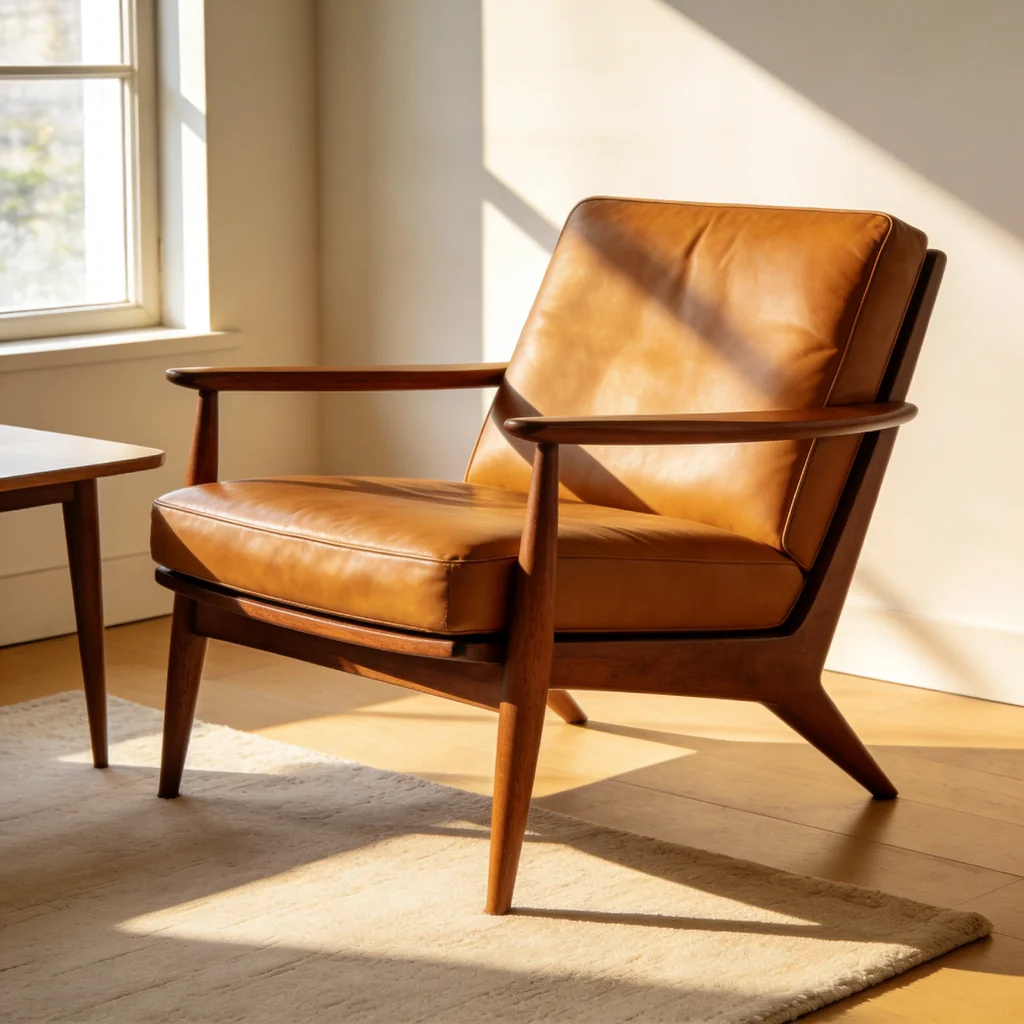
- Preferred material-focused heroes in this run: Seedream 4.5 and GPT Image 2. Their tighter crops emphasized leather and walnut detail.
- Shared failure: each model invented a different chair. A text prompt can produce the style category; it does not preserve a real SKU.
- Production implication: generate or restyle the room, then compare or composite the approved product rather than treating a plausible chair as the catalog item.
Starting from a supplier photo? Use the complete ecommerce image-set workflow to carry one approved source through hero, detail, square, and lifestyle candidates with explicit accept-or-reject evidence. For furniture, add dimensions, joinery, cushion count, finish, and included parts to the invariant sheet before generating the room.
The controlled brief
The original test used the same core instruction for all four routes:
Mid-century walnut lounge chair with tan leather upholstery in a sunlit minimalist living room. Show believable scale relative to the sofa, rug, window, and sideboard; consistent perspective; a natural floor contact shadow; photoreal materials; no logos or text.
The prompt deliberately described a fictional product. It did not include a photograph, CAD render, dimensions, or a known camera. The test can compare room composition and the model's invented design; it cannot measure preservation of a real chair.
Four outputs from the same brief
Nano Banana 2 produced the most usable wide room according to the reviewer. The chair reads plausibly against the sofa, sideboard, rug, and plant; the camera perspective is coherent; and the floor contact does not look like a cutout. It is still a newly designed chair. “Faithful to the brief” would only mean it resembles the requested category, not that it matches a sellable SKU.
Seedream 4.5 produced the reviewer's preferred hero image in this run. Raking window light, creased tan leather, and visible walnut grain make the object feel tangible. The tight crop makes room-scale judgment weaker than in the wide outputs, and the chair remains the model's design rather than an approved product.
GPT Image 2 landed between a room scene and a hero crop. The exposed walnut frame and tan upholstery are detailed, and the chair sits plausibly against the sofa behind it. This one displayed output does not establish whether the higher recorded cost buys better acceptance rates across seeds or products.
FLUX.2 Pro produced another strong wide room. The chair is grounded, the perspective is coherent, and the walnut shell has useful texture. It also makes the identity problem easiest to see: the curved shell-back silhouette is a substantial design choice. The result can be a concept image; it cannot represent a different real chair.
Side-by-side result
| Model | Room-scale assessment in this run | Material assessment | Framing | Product identity | Recorded credits |
|---|---|---|---|---|---|
| Nano Banana 2 | Visually plausible full room | Strong | Wide | Invented from the category brief | ~9.3 |
| Seedream 4.5 | Plausible but harder to judge in a tight crop | Reviewer's preferred detail | Hero | Invented from the category brief | ~4.8 |
| GPT Image 2 | Visually plausible against the sofa | Strong | Mid-crop | Invented from the category brief | ~26.4 |
| FLUX.2 Pro | Visually plausible full room | Strong | Wide | Invented; largest silhouette departure | ~3.6 |
These are observations about four displayed candidates, not model reliability rates. Cost per generated image is also less useful than cost per accepted catalog asset; a production comparison should run multiple seeds and score every output against the same approved source.
Believable scale is not verified scale
All four candidates passed a visual plausibility check: the chair did not obviously float, dwarf the sofa, or contradict the room perspective. That is enough for a concept review. It is not enough for a dimension-sensitive catalog, space planner, or augmented-reality placement.
For stronger evidence, add known constraints:
- product width, depth, height, and seat height;
- one or more room dimensions and reference objects of known size;
- camera height, focal length, and view direction when matching a plate;
- required wall and circulation clearances;
- explicit occlusion and floor-contact requirements;
- a measured post-render check, not “looks about right.”
If the asset must communicate exact fit, a conventional 3D scene or composited product render may be more appropriate than a generative approximation.
A reference-first furniture workflow
- Lock the approved product source. Use a clean packshot, transparent render, or multi-angle photography of the exact SKU.
- Define the invariants. List silhouette, dimensions, joinery, cushion count, seams, material, finish, hardware, branding, and included parts that cannot change.
- Generate the environment. Ask for the room style, season, light direction, surfaces, negative space, and camera placement.
- Review the candidate against the source. Check shape before judging beauty; a polished room can hide a changed arm, leg, cushion, or finish.
- Composite when identity matters. Preserve the generated room and place the untouched approved furniture render into it if the generative edit drifts.
- Verify grounding. Match contact shadow, reflections, perspective, occlusion, and scale so the composite belongs in the room.
- Record approval. Keep the source, prompt, model ID, size, seed when available, candidate, composite, and final sign-off.
Current Masonry CLI examples
The executable Nano Banana 2 model ID checked August 4, 2026 is gemini-3.1-flash-image-preview, and its current route requires a size or aspect:
masonry image "Mid-century walnut lounge chair with tan leather upholstery in a sunlit minimalist living room. Show believable scale relative to the sofa, rug, window, and sideboard; consistent perspective; a natural floor contact shadow; no logos or text." \ --model gemini-3.1-flash-image-preview \ --aspect 1:1 \ --output furniture-concept.png
For a reference-first candidate:
masonry image "Place this exact chair in a warm sunlit living room. Keep its silhouette, proportions, joinery, cushion count, upholstery color, wood finish, seams, and hardware unchanged. Add a natural contact shadow and no text or extra products." \ --model seedream-4-5 \ --ref ./approved-chair.png \ --aspect 1:1 \ --output furniture-room-candidate.png
A reference is not a product lock. Compare the result at full size and composite the approved chair when the output changes a defining detail.
Furniture acceptance sheet
| Area | Reject the asset when… |
|---|---|
| Identity | silhouette, dimensions, joinery, cushion count, seams, finish, hardware, or branding differs from the source |
| Scale | product size contradicts known room measurements or reference objects |
| Perspective | vanishing lines, camera height, product base, and room plane do not agree |
| Grounding | contact shadow, reflection, occlusion, or floor contact makes the product float or sink |
| Scene truthfulness | an accessory, module, feature, color, or included item is invented |
| Delivery | crop hides required product detail or the final composite has visible edges, halos, or mismatched grain |
The bottom line
This test produced four believable rooms and four different chairs. That is a better conclusion than “scale is solved”: a single fictional hero can look spatially plausible while exact product identity, dimensions, and repeatability remain untested.
Use text-to-image for concepts and room direction. For a catalog asset, start from the approved SKU, state the invariants, compare every candidate, and composite when the model drifts. The product-photography model guide covers broader selection; the clothing reference test shows the same identity problem on a different product type.


