


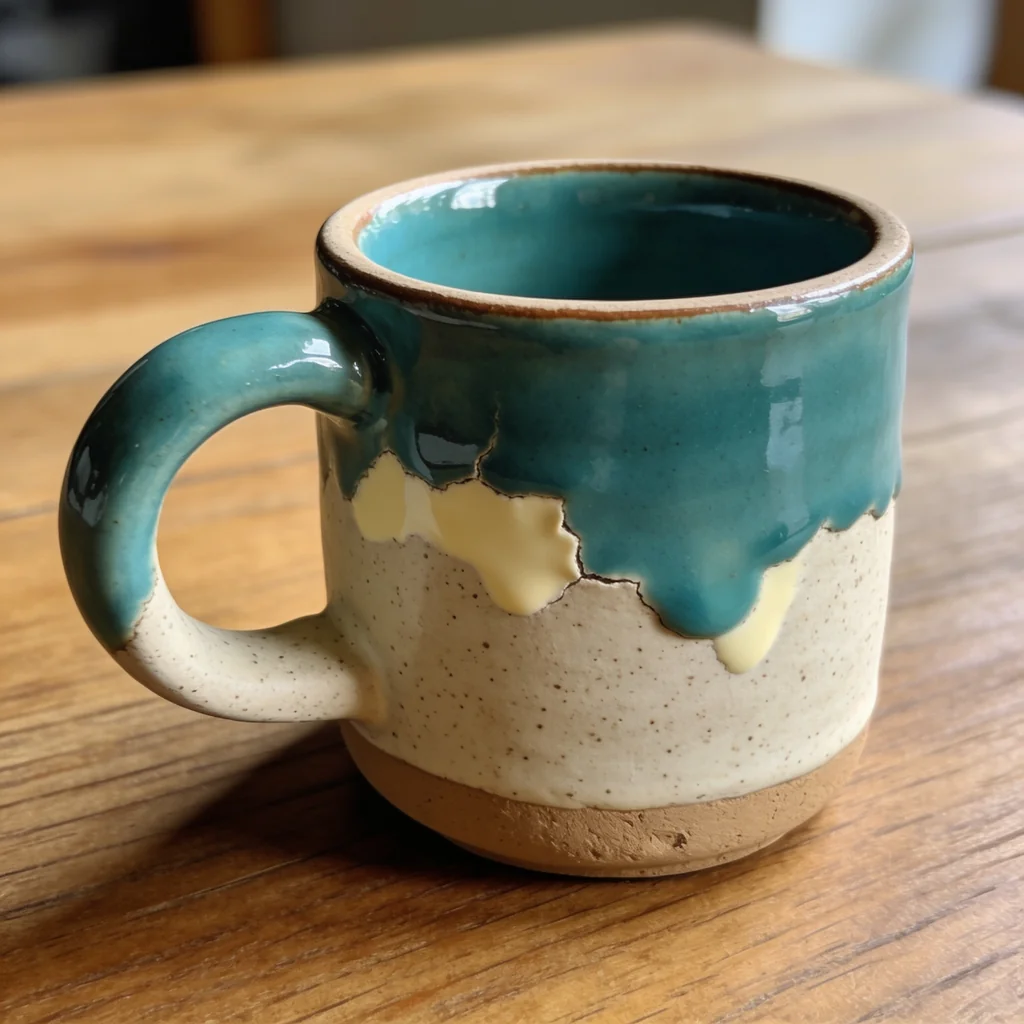
Handmade ceramics combine visible variation with hidden performance. Two mugs from one firing can differ in glaze break, speckle, run, throwing marks, and profile, but the listing still promises a defined form, dimensions, volume, weight, handle, foot, condition, safety record, and included configuration.
This test sent one fictional teal-and-cream mug brief through Seedream 4.5, Nano Banana 2, GPT Image 2, and FLUX.2 Pro. The four original outputs below show useful differences in displayed drips, glaze boundary, form, handle, foot, surface rings, props, crop, and light. No real mug, clay body, glaze formula, firing record, dimensions, volume, weight, profile drawing, handle specification, variation rule, condition standard, safety test, packaging, or product data was supplied.
Evidence boundary: this is one text prompt and one displayed output per model. The observations describe visible fictional mugs—not exact clay, glaze, firing, construction, dimensions, volume, weight, hidden condition, safety, performance, model reliability, current price/value, shoot replacement, or preservation of a real ceramic SKU.
Quick answer
- Most vivid displayed teal drips: Seedream 4.5 in this run.
- Strongest displayed horizontal surface-ring cues: Nano Banana 2 in this run.
- Tidiest displayed horizontal glaze boundary: GPT Image 2 in this run.
- Roundest displayed belly form: FLUX.2 Pro in this run.
- What all four establish: each route made one plausible fictional glazed-mug concept.
- What none establish: an exact piece or firing range, coherent hidden construction, dimensions, volume, weight, glaze fit, condition, food-contact safety, heat-use claims, or repeated reliability.
One output per route does not establish a universal winner or that glaze and handle construction are solved. A front three-quarter image cannot show whether the rim, interior, opposite handle join, base, foot, balance, hidden cracks, and measured capacity agree.
First define what the customer receives
| Offer type | Fidelity target | Required evidence |
|---|---|---|
| Exact one-of-one piece | The photographed individual object with its current form, glaze, marks, dimensions, weight, capacity, and condition. | Current multi-angle item photography, measurements, volume/weight, glaze/firing link, condition, packaging, fulfillment link, and exact-piece disclosure. |
| Firing- or style-representative SKU | A representative unit within a disclosed handmade/firing variation range. | Multiple firing samples, minimum/typical/range for form, dimensions, volume, weight, handle, glaze/color/speckle/runs, throwing marks, foot, condition, substitutions, and representative-photo disclosure. |
| Fixed molded or tableware-set SKU | One repeatable mold/profile and disclosed glaze, count, size, and packaging configuration. | Approved sample, profile/mold, dimensions, volume, weight, glaze/color tolerance, unit/set count, lids/saucers/accessories, packaging, and current SKU record. |
Do not use one flawless fictional mug to imply that every handmade unit has the same drip, profile, handle, capacity, or cosmetic condition.
The controlled concept brief
The original article did not publish the exact prompt. A bounded version matching the displayed subject is:
Fictional brand-free rounded ceramic mug with a glossy teal-over-cream drip-like glaze, speckled matte-looking lower body, simple curved handle, visible foot, warm wood surface, soft directional light, square pottery product photograph. No clay-body claim, glaze/process claim, food-safety claim, text, logo, maker mark, beverage, steam, person, plant, price, packaging, saucer, or second vessel.
This prompt can test art direction. It cannot preserve a real piece because the models invent the profile, rim, wall, interior, handle curve and joins, glaze line/drips/pooling, speckle, throwing rings, foot, dimensions, capacity, weight, balance, hidden side, condition, and safety-facing details.
Four first-hand outputs
Seedream 4.5 emphasized vivid teal drip-like forms, glossy highlights, a speckled lower body, visible foot, and a curved handle in a close hero crop. Those are art-direction observations. They do not establish reactive-glaze chemistry, throwing, clay type, a sound handle join, calibrated color, exact profile, dimensions, volume, condition, or safety.
Nano Banana 2 made the horizontal surface rings most visible and placed the mug in the fullest rustic scene. A small centered circular irregularity is visible at the lower foot; this image cannot determine whether it represents an intentional mark, trimming feature, damage, or generation artifact. The rings resemble throwing marks, but appearance cannot identify how the object was formed. The plant, linen, board, and other scene elements also require an inclusion check; they are not evidence of what ships with the mug.
GPT Image 2 produced the tidiest displayed horizontal glaze boundary and a comparatively clean, rounded form. That visual uniformity could be useful for concept direction, but it cannot establish the approved glaze break, run tolerance, profile, handle geometry, foot, volume, firing variation, or condition of a real mug.
FLUX.2 Pro made the roundest belly profile, a glossy pooled-looking teal band, horizontal surface rings, and a curved handle. Those cues do not prove wheel throwing, glaze behavior, wall thickness, stable balance, usable handle clearance, sound joins, exact capacity, or food-contact and heat-use performance.
What this comparison supports
| Question | What the four images show | What remains untested |
|---|---|---|
| Can the routes make a glazed-mug concept? | Yes, once each for this fictional brief. | Reliability across seeds, forms, glazes, firings, references, views, scenes, prompts, and current routes. |
| Do visible glaze and form treatments differ? | Yes; drips, boundaries, gloss, pooling, speckle, rings, belly profile, handle, foot, props, crop, and light vary. | Exact piece/firing match, calibrated color, clay/glaze identity, measured form, hidden construction, condition, and production tolerance. |
| Is the handle correct and functional? | A curved handle is visible on each displayed mug. | Opposite join, thickness, clearance, reinforcement, ergonomics, load, cracks, wall integration, and physical testing. |
| Is a real ceramic SKU preserved? | No evidence; no product source was supplied. | Profile, rim, interior, wall, handle, glaze, foot, dimensions, volume, weight, marks, condition, set pieces, packaging, and fulfillment mapping. |
| Are material, safety, or use claims established? | No. | Clay/firing, glaze fit/leach, food contact, lead/cadmium, microwave/dishwasher/oven/freezer, thermal shock, durability, certification, and warranty. |
The old article called pottery reliable, said every handle was properly joined and comfortable, treated construction as largely fixed, named winners, and promised reference-based exactness. The defensible conclusion is narrower: four routes made plausible fictional mug concepts once, and their displayed glaze, form, handle, foot, surface, styling, and lighting treatments differ.
Ceramics fidelity checklist
Build the rejection sheet from current exact-piece or representative-firing photography, profile/mold and measurements, volume and weight, clay/glaze/firing records, approved variation and condition standards, handle/foot specifications, safety/use testing, set/packaging data, fulfillment mapping, and current product data:
- Offer and firing: exact piece, firing/style representative, or fixed SKU; firing/batch/lot, inventory state, allowed handmade/firing variation, substitutions, fulfillment link, and disclosure.
- Form and dimensions: height, rim diameter, maximum diameter, base/foot diameter, profile, taper/belly, wall/rim thickness, interior depth, handle projection/drop/clearance, capacity, weight, scale, shrinkage/tolerance, and stable stance.
- Rim, wall, handle, and foot: rim shape/roundness, lip, interior/exterior continuity, handle curve/section/top and bottom joins, cracks/gaps, clearance, orientation, load path, base plane, foot ring, trimming marks, wobble-facing contact, and hidden-side agreement.
- Clay and surface: approved body/color/speckle/grog-facing appearance, forming-method-facing marks, throwing rings, slab/mold seams, carving, texture, maker mark/stamp, raw/unglazed areas, sanding, dust/residue, and no unsupported material or handmade inference.
- Glaze and firing variation: approved colors, coverage, boundary, drips/runs/pools, break, overlap, gloss/matte, translucency/opacity, speckle, crawling, pinholes, blisters, shivering/flaking-facing cues, crazing, cutlery marks, kiln marks, bare clay, firing range, and cosmetic tolerance.
- Condition and inspectability: chips, hairline cracks, handle/base/rim damage, glaze defects, repairs, stains, residue, seconds status, front/back/interior/base detail, neutral color view, scale, glare, shadow, occlusion, and current condition.
- Set and fulfillment: unit/set count, mug/cup/bowl/plate/lid/saucer/spoon/accessories, matching tolerance, packaging, dividers, labels/barcode, weight, inventory/firing, substitutions, thumbnail mapping, shipping state, and sold configuration.
- Claims and rights: clay body, glaze/process, firing temperature, handmade/origin, food-contact/lead/cadmium, capacity, microwave/dishwasher/oven/freezer, thermal shock, water absorption, durability, sustainable/certified, authenticity/artist, delivery, and warranty remain in approved records.
If the scene looks handcrafted but the profile, rim, handle, foot, glaze, dimensions, volume, weight, condition, firing range, set count, packaging, or claims differ, it is the wrong ceramic asset.
A firing-aware ceramics workflow
1. Capture authoritative sources
For an exact piece, photograph current front, back, both sides, top, interior, rim, handle joins, base/foot, glaze details, marks, defects, packaging, and scale; record dimensions, volume, and weight. For a representative firing/style, photograph several units and document the minimum, typical, and range for profile, dimensions, volume, weight, handle, glaze/color/runs, speckle, marks, foot, condition, and substitutions.
2. Build the scene separately
Generate or photograph an empty table, shelf, counter, studio sweep, or editorial plate at the final crop. Composite approved ceramic photography, then build contact, shadow, reflection, steam or beverage only when approved, and occlusion deliberately. This keeps the physical piece and its condition deterministic.
3. Test a constrained reference edit
masonry image "Change only the environment to a simple warm wood surface with soft directional light. Keep the supplied ceramic piece unchanged: exact profile, rim, interior, dimensions, wall-facing visible thickness, every glaze boundary, drip, run, pool, color, speckle, surface mark, handle curve and both joins, foot, maker mark, defect, condition, and sold configuration. Add one natural contact shadow. Add no beverage, steam, plant, textile, saucer, spoon, second vessel, text, logo, price, badge, or packaging." \ --model gemini-3.1-flash-image-preview \ --ref ./approved-ceramic-piece.png \ --aspect 1:1 \ --output ceramic-scene-candidate.png
The instruction is not a piece, firing, glaze, construction, dimension, condition, safety, or SKU lock. Compare the candidate with current exact-piece or firing sources, measurements, volume/weight, variation/condition rules, safety/use tests, packaging, fulfillment, and product data. Composite approved product photography when exactness matters.
For a fictional concept:
masonry image "Fictional brand-free rounded ceramic mug with a glossy teal-over-cream drip-like glaze, speckled matte-looking lower body, simple curved handle, visible foot, warm wood surface, soft directional light, no clay-body claim, glaze/process claim, food-safety claim, text, logo, maker mark, beverage, steam, person, plant, price, packaging, saucer, or second vessel" \ --model seedream-4-5 \ --aspect 1:1 \ --output ceramic-concept.png
Ceramics acceptance sheet
| Area | Pass condition |
|---|---|
| Source match | Candidate is compared with current exact-piece or representative-firing front, back, sides, top/interior, rim, handle joins, base/foot, glaze/surface, marks, defects, scale, dimensions, volume, weight, variation, testing, set, packaging, fulfillment, and product data. |
| Form and construction | Profile, rim, wall/interior, handle curve/section/clearance/joins, foot/base, stable contact, dimensions, volume, weight, orientation, hidden-side logic, and physical inspection match. |
| Glaze, surface, and condition | Approved clay-facing surface, forming marks, glaze colors/coverage/boundary/runs/pools/gloss, speckle, raw areas, maker mark, defects, chips/cracks/crazing/repairs, firing variation, seconds status, and cosmetic tolerance match. |
| Set and fulfillment | Exact unit/set count, size/form/glaze option, lids/saucers/accessories, matching tolerance, packaging/dividers, label/barcode, inventory/firing, substitutions, shipping state, sold configuration, and fulfillment record match. |
| Claims and rights | No clay/glaze/process, firing, handmade/origin, artist/authenticity, food-contact/lead/cadmium, capacity, microwave/dishwasher/oven/freezer, thermal shock, durability, sustainable/certified, delivery, or warranty claim is inferred from appearance. |
Bottom line
These four outputs are useful as a glaze, form, handle, foot, surface, prop, and lighting art-direction comparison. They are not evidence that pottery is a reliable AI category, handles are correctly built, a reference preserves a firing, a fictional mug is ready to list, safety is established, or one route is always the best value.
Define whether the offer is an exact piece, firing/style representative, or fixed molded/set SKU. Use fictional concepts to choose a scene; use current product photography, profile and measurements, volume/weight, clay/glaze/firing records, variation and condition standards, safety/use tests, set/packaging data, fulfillment mapping, and product facts to decide whether an asset can ship. Compare the broader AI product photography model review, build a controlled scene in Masonry’s product photography tool, or automate candidates with the Masonry CLI.


