


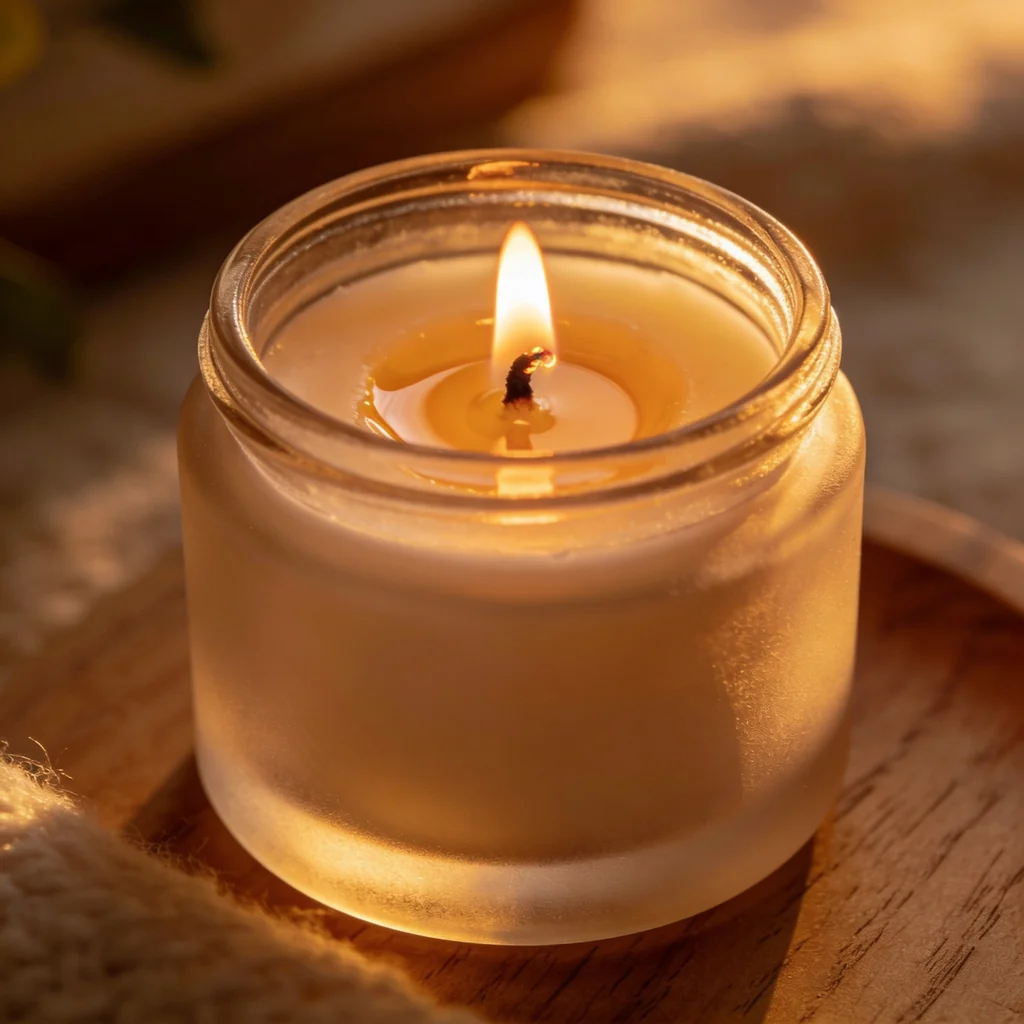
A lit candle asks an image model to render both a product and a light source. A recognizable flame can still fail the shot when it has no visible wick, no melted wax, no transmission through the vessel, and no effect on the surrounding scene.
That was the useful split in this first-hand four-model test. All four outputs contained a flame-shaped object. Their wick, wax pool, vessel glow, and cast light differed sharply—and every jar was fictional because the brief supplied no real product reference.
Evidence boundary: this is one text prompt, one displayed output per model, and one reviewer's visual assessment—not a multi-seed benchmark, a measured lighting study, or a reference-fidelity test. The recorded credit figures can change. The candles are fictional, so the images provide no evidence that a model will preserve your vessel, label, fill, wick, lid, or fragrance cues.
Quick answer
- Preferred internal vessel glow in this run: GPT Image 2. Its frosted jar appeared illuminated from within.
- Preferred material-focused hero in this run: Seedream 4.5. It showed the clearest melted wax pool and useful warm spill onto nearby surfaces.
- Preferred lifestyle composition in this run: Nano Banana 2. It built a complete styled scene, but changed the requested frosted vessel to clear glass.
- Clearest light-integration failure: FLUX.2 Pro. The vessel was polished, while the flame lacked a visible wick, melt pool, and meaningful cast light.
Those are observations about four candidates, not model reliability rates. A production decision should compare multiple seeds against an approved product reference and one acceptance sheet.
The controlled brief
Each route received the same core instruction:
Brand-free lit scented candle in a frosted glass jar on a cozy wooden surface at evening. One soft flame attached to a visible centered wick, a small melted wax pool, warm internal glow through the frosted vessel, and physically coherent light cast onto the table and nearby neutral textile. Photoreal macro product photography. No label, logo, text, smoke, extra flame, or human hand.
The prompt is deliberately observable: flame count, wick continuity, wax state, vessel material, internal transmission, cast light, and prohibited elements can all be checked. It still describes a fictional candle rather than a sellable product.
Four outputs from the same brief
GPT Image 2 produced the strongest internal-vessel lighting according to the reviewer. The frosted glass glows warm, and the halo extends onto the wooden surface rather than ending at the flame edge. This output passed the main visual hypothesis for one fictional vessel; it did not test a real jar or establish how often the route repeats the result.
Seedream 4.5 made the preferred macro hero in this run. The wax is visibly molten around the wick, the vessel has believable translucency, and the surrounding wood and textile receive warm light. Those details make the flame belong to the scene. The model also invented the candle design, so visual richness should not be confused with SKU accuracy.
Nano Banana 2 built the most complete styled scene according to the reviewer. The candle, lavender, cinnamon, window light, and warm flame read as one composition, and a wax pool is visible. It also missed a clear brief requirement by rendering a clear vessel instead of frosted glass. A cozy result is still a failed product candidate when the jar material is part of the SKU.
FLUX.2 Pro makes the diagnostic easiest to see. The vessel itself is polished, but the flame reads as a decorative element: the wick connection is unclear, the wax surface does not show a convincing molten pool, and nearby surfaces receive little light. The image may still be useful as an unlit product concept or a compositing base.
Side-by-side result
| Model | Flame-to-scene integration in this output | Vessel | Wax pool | Composition | Recorded credits |
|---|---|---|---|---|---|
| GPT Image 2 | Reviewer's preferred internal glow | Frosted | Visible | Tight hero | ~26.4 |
| Seedream 4.5 | Strong spill onto wood and textile | Frosted | Clearest in the set | Macro hero | ~4.8 |
| Nano Banana 2 | Warm light integrated into a styled scene | Clear, brief miss | Visible | Lifestyle | ~9.3 |
| FLUX.2 Pro | Weak wick, melt, and cast-light integration | Frosted | Unconvincing | Still-product hero | ~3.6 |
Cost per generated image is not cost per accepted asset. A useful next test would run several seeds per model, supply the same real candle reference, and count how many candidates pass both lighting and product-identity checks.
How to inspect the complete light path
Do not stop at “the flame looks like a flame.” Trace the effect outward:
- Flame: one coherent shape, appropriate scale, no extra tongue or duplicated glow.
- Wick: visibly connects the flame to the candle and remains centered or source-accurate.
- Wax: a plausible molten pool surrounds an actively burning wick without impossible geometry.
- Vessel: translucent or clear material transmits, scatters, and reflects light consistently with the approved product.
- Surface: the table receives believable warm spill, contact shadow, and reflection where appropriate.
- Props: nearby objects respond to the same light direction and do not imply an unapproved fragrance or ingredient.
- Room: ambient and candle light coexist without contradictory highlights or shadows.
This is a visual QA model, not a claim that the rendered scene is a physically simulated measurement.
A reference-first candle workflow
- Lock the approved source. Use a clean photograph or render of the real jar, label, wax fill, wick, lid, and included packaging.
- List the invariants. Vessel silhouette and finish, glass treatment, label copy, wax color, wick count, fill height, lid, and accessories cannot drift.
- Generate the environment and lighting candidate. Specify the desired surface, props, season, crop, ambient light, and flame behavior.
- Compare at full size. Check the product before judging the mood; label, fill, wick, vessel, and fragrance cues must match.
- Composite when needed. Keep a useful generated scene and place the untouched approved product or a photographed flame into it when the model changes identity or light behavior.
- Review truthfulness. Remove any fruit, flower, spice, certification, quantity, or claim that the real product does not support.
Current Masonry CLI examples
Both examples make the output size and destination explicit:
masonry image "Brand-free lit scented candle in a frosted glass jar on a cozy wooden surface at evening. One soft flame attached to a visible centered wick, a small melted wax pool, warm internal glow through the vessel, and coherent light on the table. No label, logo, text, smoke, extra flame, or hand." \ --model gpt-image-2 \ --aspect 1:1 \ --output candle-gpt-image-2.png masonry image "Brand-free lit scented candle in a frosted glass jar on a cozy wooden surface at evening. One soft flame attached to a visible centered wick, a small melted wax pool, warm internal glow through the vessel, and coherent light on the table. No label, logo, text, smoke, extra flame, or hand." \ --model seedream-4-5 \ --aspect 1:1 \ --output candle-seedream-4-5.png
For a real product, attach the approved source and state what cannot change:
masonry image "Place this exact candle on dark walnut at blue hour. Keep the supplied vessel, label, wax fill, wick count, lid, color, and every printed character unchanged. Add one lit flame, a small wax pool, and coherent warm light. Add no ingredients, props, logos, or copy." \ --model seedream-4-5 \ --ref ./approved-candle.png \ --aspect 1:1 \ --output candle-scene-candidate.png
The “unchanged” instruction is not a lock. Compare the candidate with the approved source and composite when it drifts.
Candle acceptance sheet
| Area | Reject the asset when… |
|---|---|
| Product identity | vessel, label, wax, wick, lid, fill, color, or included packaging differs from the source |
| Flame and wick | flame count, scale, shape, or wick connection is wrong |
| Wax state | a lit wick has no plausible melt pool or the wax geometry is impossible |
| Light path | vessel, surface, props, highlights, and shadows do not respond coherently to the flame |
| Scene truthfulness | props imply an unsupported fragrance, ingredient, certification, quantity, or benefit |
| Delivery | required label detail is unreadable or compositing introduces halos, mismatched grain, or false reflections |
The bottom line
The original test's useful finding is narrower than “flames are solved.” Four models drew recognizable flames, while their wick, wax, vessel transmission, and cast light produced materially different levels of realism. At the same time, no output represented a real SKU because no product reference was supplied.
Judge the complete light path and the product identity as separate acceptance areas. Use the candle product studio for your own reference-first run, and the product-photography model guide for broader selection without treating one displayed output as a universal winner.
If the candle image belongs to a PDP, seasonal launch, paid-social test, or lifecycle campaign, choose the commercial finish line first. The AI for ecommerce workflow map routes each job to its required inputs, authority record, acceptance check, and revenue decision.


