


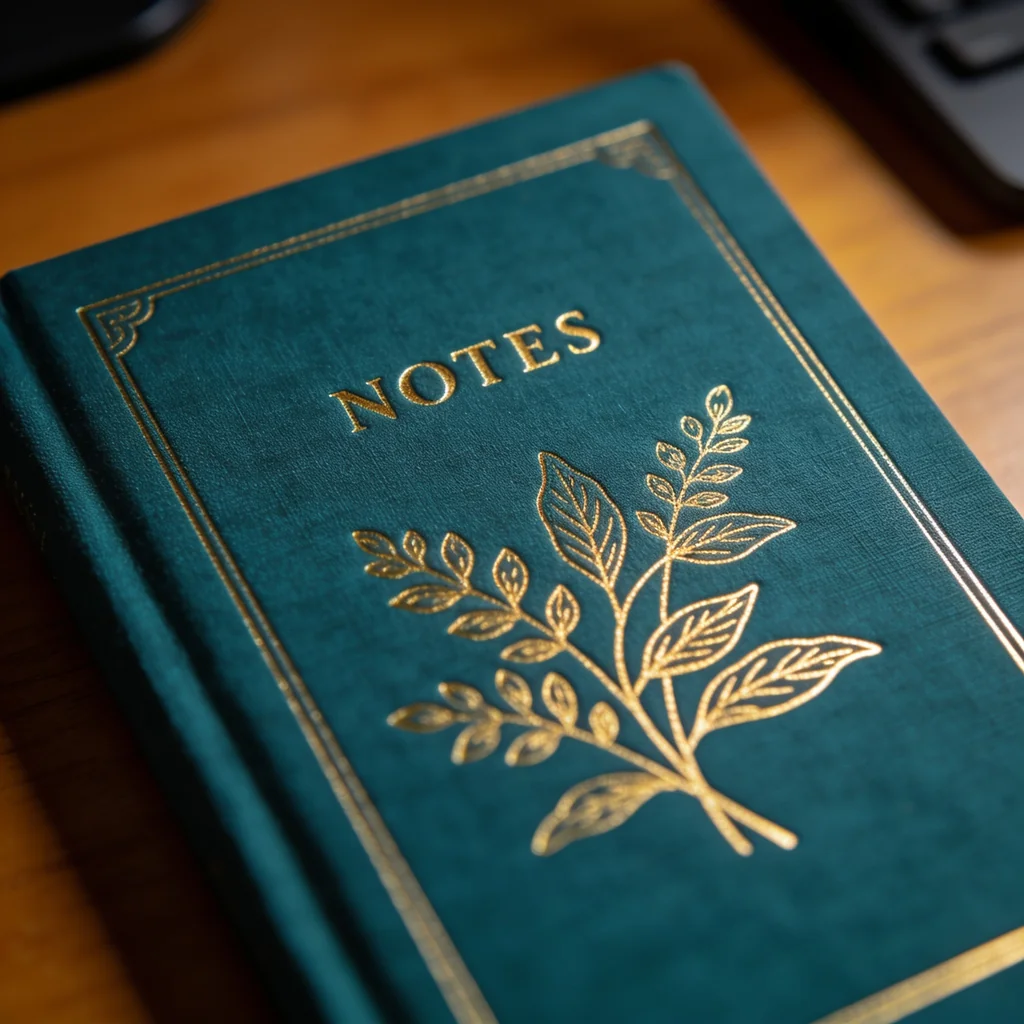
Stationery photography has two separate jobs: show a tactile object, and reproduce a manufactured design. A journal can look convincingly clothbound and foil-stamped while changing the title, motif, border, trim, spine, ribbon, closure, page block, or personalization that the customer is buying.
This test sent one fictional teal-journal brief through Seedream 4.5, Nano Banana 2, GPT Image 2, and FLUX.2 Pro. The four original outputs below show useful differences in visible foil-like highlights, border relief, cover texture, title treatment, props, crop, and light. No real journal, approved artwork, copy deck, font files, dieline, dimensions, material specification, production proof, finish sample, binding specification, personalization record, packaging, or product data was supplied.
Evidence boundary: this is one text prompt and one displayed output per model. The observations describe visible fictional journals—not exact text, artwork, foil, deboss, linen, construction, dimensions, tactile feel, model reliability, current price/value, shoot replacement, or preservation of a real stationery SKU.
Quick answer
- Brightest displayed foil-like highlights: Seedream 4.5 in this run.
- Strongest visible border relief: Nano Banana 2 in this run.
- Cleanest displayed title arrangement: GPT Image 2 in this run.
- Warmest displayed raking-light treatment: FLUX.2 Pro in this run.
- What all four establish: each route made one plausible fictional premium-journal concept.
- What none establish: exact copy, spelling, font, artwork, foil stock, stamping, registration, impression depth, cloth, trim, binding, page block, personalization, set contents, or repeated reliability.
One output per route does not establish a universal winner or reliable copy and finish fidelity. A bright gold region can look like foil in a rendered image without proving how a manufactured foil catches light, aligns to artwork, or feels.
First define the stationery offer
| Offer type | Fidelity target | Required evidence |
|---|---|---|
| Fixed manufactured SKU | One exact journal, notebook, card, invitation, planner, or set. | Approved art and copy, production sample, dimensions, materials, construction, finish map, color targets, set contents, packaging, and current product record. |
| Personalized order | The fixed base SKU plus customer-specific text or artwork. | Everything above plus the signed-off order proof, spelling, glyphs, case, font, line breaks, position, color/finish, quantity, and order-to-asset link. |
| Representative handmade or naturally variable item | A disclosed range rather than one identical unit. | Approved variation range for paper, deckle, fibers, print/foil placement, impression, color, dimensions, handwork, set makeup, defects, and representative-photo disclosure. |
Do not let a generated hero silently change the promise. A personalized wedding suite, fixed wholesale notebook, and handmade deckle-edge card need different sources and rejection rules.
The controlled concept brief
The original article did not publish the exact prompt. A bounded version matching the displayed subject is:
Fictional brand-free deep teal clothbound journal, simple invented gold botanical line motif, one short invented gold title, shallow rectangular recessed-border cue, closed on a warm neutral desk, soft directional raking light, square premium stationery product photograph. No real brand, logo, monogram, date, address, price, certification mark, pen, hand, packaging, or extra product.
This prompt can test visual direction. It cannot preserve a real cover because the models invent the characters, font, motif, layout, line weights, registration, foil behavior, border geometry, cloth weave, trim, spine, page block, ribbon, closure, corners, and hidden surfaces.
Four first-hand outputs
Seedream 4.5 emphasized reflective-looking gold highlights and a close view of the teal cover texture. Those are useful art-direction cues for a finishes-forward hero. They do not verify metallic foil, stamping method, artwork registration, copy accuracy, cloth specification, deboss depth, trim, spine, page block, or repeatable output.
Nano Banana 2 made the rectangular border read most clearly as a recessed form at article scale, with a soft shadow around the impression. It also invented a cover motif, title, ribbon, cloth, edges, and product geometry. A visible recess is not evidence of a specified deboss, letterpress process, tool depth, pressure, registration, or pass/fail production sample.
GPT Image 2 produced the most orderly displayed title-and-motif arrangement of the four. That supports a composition observation, not a claim that supplied copy would remain exact. Full-resolution proofing still needs every character, glyph, accent, line break, case, font, weight, spacing, motif, border, alignment, and foil edge checked against approved art.
FLUX.2 Pro leaned into warm directional light and a softer cover treatment. The central botanical stem visibly crosses the displayed title region, so artwork and copy compete even though the word remains readable at article scale. That kind of lighting can communicate mood, but it can also obscure the neutral cloth color, small copy, registration, edge quality, surface defects, and finish boundaries a buyer or production reviewer needs to inspect.
What this comparison supports
| Question | What the four images show | What remains untested |
|---|---|---|
| Can the routes make a premium-journal concept? | Yes, once each for this fictional brief. | Reliability across seeds, copy, artwork, formats, references, materials, finishes, crops, prompts, and current routes. |
| Do the visible finish treatments differ? | Yes; brightness, glint, border shadow, apparent depth, texture, warmth, and crop vary. | Actual foil, ink, deboss/emboss, letterpress, spot finish, registration, tactile feel, durability, and production tolerance. |
| Is the displayed cover text usable? | Short invented gold title-like forms are visible. | Exact transcription, spelling, font, glyphs, kerning, line breaks, personalization, fine copy, and repeatability. |
| Is a real stationery SKU preserved? | No evidence; no product source was supplied. | Artwork, copy, dieline, dimensions, spine, binding, paper/page block, trim, color, accessories, set contents, packaging, and hidden sides. |
| Are material or sustainability facts established? | No. | Paper weight/fiber, page count, ruling, opacity, recycled content, certification, origin, recyclability, archival quality, durability, and warranty. |
The old article called finishes largely solved, treated short text as predictably clean, named winners, and recommended trusting generated foil and deboss. The defensible conclusion is narrower: four routes made attractive fictional journal concepts once, and their displayed highlight, relief, texture, title, and lighting treatments differ.
Stationery fidelity checklist
Build the rejection sheet from approved artwork and copy, font files, dielines, production samples, neutral and raking-light photography, dimensions, material/color standards, binding specifications, personalization proofs, set/packaging records, and current product data:
- Copy and personalization: every character, spelling, accent, punctuation, glyph, numeral, date, address, URL, monogram, initials, case, line break, font, weight, spacing, alignment, position, variable field, allowed character set, and order record.
- Artwork and layout: logo, motif, illustration, line weight, border, frame, crop, bleed, safe area, hierarchy, orientation, front/back/spine relationship, page art, envelope/card alignment, dieline, and rights clearance.
- Print and finish: ink/foil color, coverage, reflectivity-facing cues, hot/cold/digital foil boundary, registration, knockout, overprint, edge quality, pinholes, scuffing, deboss/emboss/letterpress direction and apparent depth, spot UV, varnish, lamination, gilding, and approved tolerance.
- Materials and color: paper/board/cloth/leather-facing texture, neutral color target, grain, fiber, deckle, coating, translucency, opacity-facing cues, page/edge color, endpapers, ribbon/elastic color, and lot variation.
- Construction: closed/open dimensions, trim, thickness, corner radius, spine, hinge, binding, cover wrap, board, page block, sheet/page count, ruling/grid/dot format, perforation, pockets, elastic, ribbon, pen loop, closure, inserts, and opening direction.
- Set and fulfillment: exact card/envelope/piece count, sizes, variants, personalization, assembly, belly band, tissue, sleeve, box, label, barcode, quantity, accessories, packing state, and sold configuration.
- Scene and inspectability: approved hero/detail crop, neutral-color view plus raking-light finish view, contact, scale, shadows, reflections, glare, occlusion, props, hands, background, and no implied included item.
- Product facts: stock weight, fiber, page count, format, ink compatibility, archival/acid-free, recycled content, certification, origin, handmade status, durability, care, shipping, returns, warranty, and sustainability remain in approved data.
If the scene looks premium but one glyph, motif, finish boundary, dimension, binding feature, personalization field, set piece, or claim changes, it is the wrong product asset.
A production-proof stationery workflow
1. Capture authoritative sources
Photograph the approved sample closed, open, front, back, spine, edges, endpapers, page format, hardware/accessories, set pieces, packaging, and scale. Add neutral-light color views and controlled raking-light finish details. Store the final art, copy, fonts, dieline, dimensions, material/finish specifications, production tolerances, and current product record beside the images.
2. Separate the finish plate from exact art
Generate or photograph an empty desk/background and, if useful, a non-branded journal geometry or lighting concept. Composite an approved product render or photograph for deterministic copy and artwork. Where the visual requires a finish to move with light, use a production-derived material pass or approved multi-light source rather than inventing the manufactured surface from text.
3. Test a constrained reference edit
masonry image "Change only the environment to a simple warm neutral desk with soft directional light. Keep the supplied stationery unchanged: exact cover and spine dimensions, teal color, cloth grain, every character and glyph, font, spacing, botanical artwork, line weights, border, foil areas and registration, deboss geometry, corners, binding, page block, ribbon, closure, edges, and sold configuration. Add one natural contact shadow. Add no hand, pen, extra item, logo, price, badge, or invented copy." \ --model gemini-3.1-flash-image-preview \ --ref ./approved-stationery-proof.png \ --aspect 1:1 \ --output stationery-scene-candidate.png
The instruction is not a copy, artwork, finish, construction, or SKU lock. Compare the candidate pixel-by-pixel and character-by-character with approved art and current product sources. Composite an approved product render or photograph when exactness matters.
For a fictional finishes concept:
masonry image "Fictional brand-free deep teal clothbound journal, simple invented gold botanical line motif, one short invented gold title, shallow rectangular recessed-border cue, closed on a warm neutral desk, soft directional raking light, no real brand, logo, monogram, date, address, price, certification mark, pen, hand, packaging, or extra product" \ --model seedream-4-5 \ --aspect 1:1 \ --output stationery-concept.png
Stationery acceptance sheet
| Area | Pass condition |
|---|---|
| Source match | Candidate is compared with approved front, back, spine, open/closed, edges, page block, finish details, set, packaging, scale, art, copy, fonts, dieline, dimensions, materials, construction, tolerances, personalization proof, and product data. |
| Copy and artwork | Every character, glyph, spelling, date, address, variable field, font, spacing, line, motif, logo, border, layout, bleed, safe area, orientation, and rights-cleared element matches. |
| Finish and color | Ink/foil color, boundary, registration, coverage, edge quality, relief direction/depth-facing cues, spot finish, cloth/paper texture, neutral color, lot tolerance, and both neutral/raking-light references match. |
| Construction and set | Dimensions, trim, thickness, corners, spine, binding, page format/count, cover, endpapers, ribbon, elastic, pockets, cards, envelopes, inserts, quantity, accessories, packaging, and sold configuration match. |
| Claims and rights | No material, stock, fiber, page count, ink compatibility, archival, acid-free, recycled, certified, sustainable, handmade, origin, durability, delivery, warranty, affiliation, or rights claim is inferred from appearance. |
Bottom line
These four outputs are useful as a foil-like highlight, border-relief, texture, title-layout, and lighting comparison. They are not evidence that manufactured finishes are solved, short or personalized copy will stay exact, a reference preserves the product, a fictional journal is ready to list, or one route is always the best value.
Use fictional concepts to choose a scene and lighting direction. Use approved art and copy, production samples, finish references, dimensions, construction, personalization proofs, set/packaging records, and product data to decide whether an asset can ship. Compare the broader AI product photography model review, build a controlled scene in Masonry’s product photography tool, or automate candidates with the Masonry CLI.


