


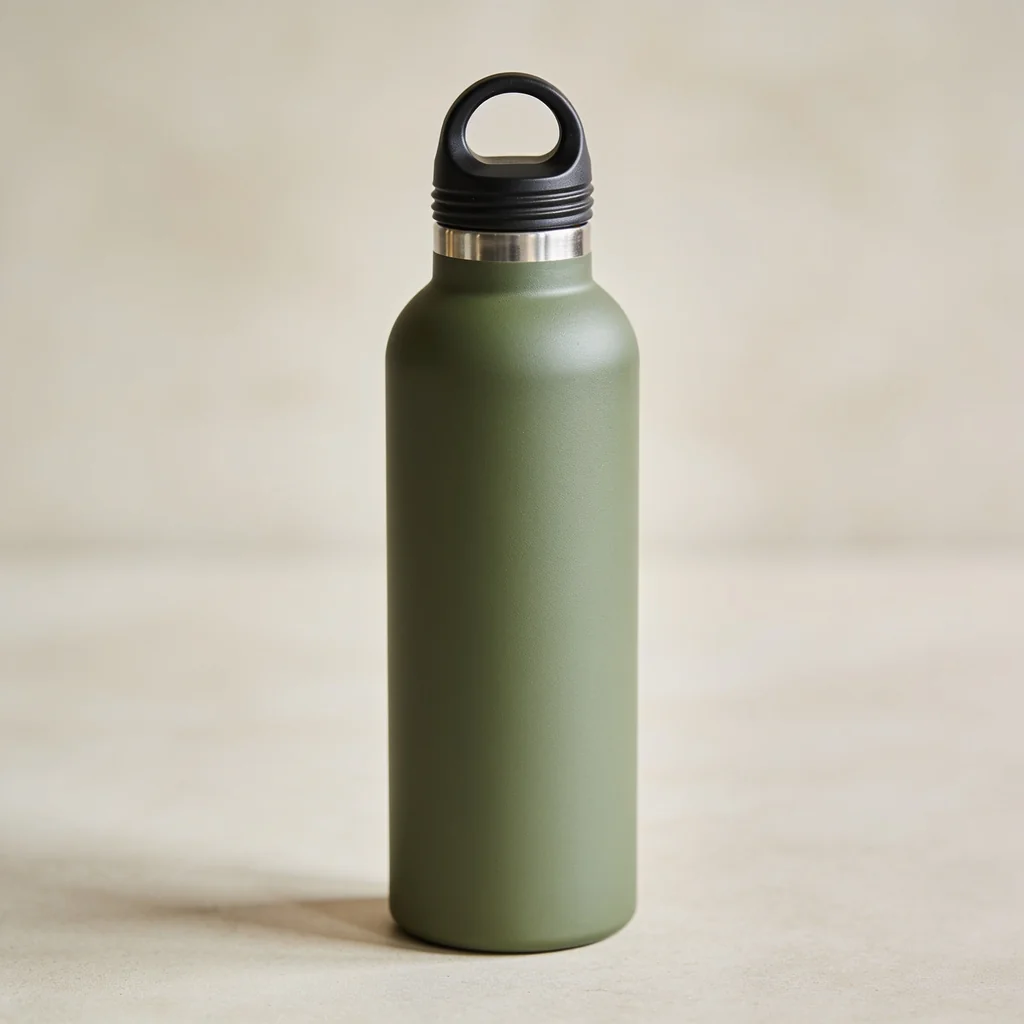
An insulated bottle can look simple: a cylinder, a lid, and a matte finish. For a real product image, those “simple” parts are the product. A changed shoulder, thread, loop, spout, base, or mark can turn a polished scene into the wrong SKU.
This test sent one fictional sage-green bottle brief through SeedDream 4.5, Nano Banana 2, GPT Image 2, and FLUX.2 Pro. The four original outputs below reveal useful differences in finish, silhouette, cap treatment, and invented marks. No real bottle reference was supplied.
Evidence boundary: this is one prompt and one displayed output per model. The bottle was fictional, no approved design or specification sheet was supplied, and no capacity, leak, thermal, food-contact, coating, or repeated-reliability test was possible. The observations describe these images; they are not model pass rates or legal conclusions about product design.
Quick answer
- Strongest displayed concept: Seedream 4.5 made the most distinctive tapered bottle in this run.
- Shared result: all four created attractive low-gloss sage bottles.
- Important variation: body proportions, cap mechanisms, neck treatment, and marks differ. That is invention, not SKU preservation.
- Commercial rule: compare every visible component with approved sources; do not call a fictional silhouette sellable.
- Safer listing path: generate the scene, then composite the approved bottle packshot.
The controlled brief
The original post summarized the prompt. A reproducible version matching the tested subject is:
Fictional brand-free tall insulated stainless-steel water bottle, matte sage-green powder-coated body, black screw cap with a carry loop, three-quarter front view on pale stone, soft camera-left studio light, natural contact shadow, restrained low-gloss highlights, square product photograph. No text, logos, badges, people, liquid, condensation, extra bottles, or watermarks.
The brief intentionally describes a fictional concept. Without a real source, it cannot test bottle or lid preservation.
Four first-hand outputs
Seedream 4.5 produced the most distinctive silhouette in this set: a tapered body rather than a straight cylinder. The low-gloss coating reads clearly and the exposed neck detail is visually plausible. Because there is no source design, that detail is invented; it should not be described as a correct thread or closure.
Nano Banana 2 chose a familiar straight-sided bottle and loop-cap treatment. The surface cues are restrained and the shape reads immediately as insulated drinkware. That familiarity is a flag for design review, not a legal conclusion. Compare a commercial candidate with your approved drawings and seek qualified review where distinctiveness matters.
GPT Image 2 also returned a straight cylinder with a black loop cap. The bottle is visually coherent at article scale, but body proportion, shoulder, cap geometry, and loop construction differ from the other candidates. A clean render does not make any of those invented choices authoritative.
FLUX.2 Pro made another plausible bottle, but a small light mark appears near the base. The prompt prohibited logos. Whether the mark is text, a symbol, or an artifact, it fails the observable requirement and demonstrates why commercial review must include the entire body, cap, base, and scene.
What the comparison actually supports
| Question | What these four images show | What remains untested |
|---|---|---|
| Can the routes make a matte bottle concept? | Yes, once each for this brief. | Reliability across seeds, products, crops, and prompts. |
| Does the coating look matte? | All four use soft, low-gloss surface cues. | Match to real powder texture, color target, gloss, or material specification. |
| Do they converge on category archetypes? | Several use a straight cylinder and loop cap. | Source influence, legal protectability, and market confusion. |
| Is a real SKU preserved? | No evidence; no source bottle was supplied. | Every product-specific dimension, component, mark, and function. |
| Are functional claims supported? | No. | Capacity, insulation, leak resistance, food contact, durability, and safety. |
The earlier version called matte rendering solved and labeled one fictional design sellable. The evidence supports a narrower conclusion: four models made attractive concepts, and their invented shape and marking differences are exactly why a real source is required.
Product fidelity checks for real drinkware
Build the rejection sheet from approved packshots, drawings, artwork, and specifications:
- Body: silhouette, height-to-width ratio, shoulder, taper, diameter changes, base profile, seams, welds, grip zones, and transparent windows.
- Mouth and closure: opening diameter, neck height, thread form and count as visible, cap profile, hinge, loop, handle, spout, straw, button, vent, latch, and gasket visibility.
- Finish: powder-coated zones, exposed metal, color, gloss, texture, edge treatment, gradients, and approved material language.
- Artwork and marks: logo, model name, capacity, measurement scale, warnings, certifications, care marks, legal copy, and every visible character.
- Accessories: straw, boot, infuser, lid alternatives, packaging, and any included part must match the sold configuration.
- Scene: crop, perspective, reflection, cast shadow, contact shadow, surface contact, and hand interaction cannot hide required product features.
- Functional facts: capacity, dimensions, weight, insulation duration, leak resistance, food-contact status, dishwasher safety, and durability belong to approved product data and testing—not generated pixels.
If the cap looks plausible but its hinge, vent, or seal path differs, it is the wrong product.
A reference-first drinkware workflow
1. Prepare authoritative sources
Use front, three-quarter, side, top, base, open-lid, and closure-detail photography plus flat artwork, a color target, and the current specification sheet. Give each reference one role.
2. Generate the scene separately when exactness matters
Create an empty gym bench, stone vanity, desk, or outdoor plate with the final crop and light. Composite the approved bottle photograph, then construct its contact shadow and reflection. This preserves geometry, artwork, and finish placement.
3. Test a reference-conditioned scene
masonry image "Change only the environment to a pale stone gym bench with soft camera-left light. Keep the supplied bottle's silhouette, proportions, mouth, threads, cap, loop, hinge, spout, base, sage finish, artwork, and every visible character unchanged. Add one natural contact shadow. Add no logos, liquid, condensation, people, or extra bottles." \ --model gemini-3.1-flash-image-preview \ --ref ./approved-bottle-three-quarter.png \ --aspect 1:1 \ --output drinkware-scene-candidate.png
The instruction is not a product lock. Compare the candidate with every approved view and composite the source bottle when exact geometry or copy matters.
For a fictional concept:
masonry image "Fictional brand-free tall insulated stainless-steel bottle, matte sage-green powder-coated body, black screw cap with carry loop, three-quarter front on pale stone, soft camera-left light, natural contact shadow, no text or logos, square product photograph." \ --model seedream-4-5 \ --aspect 1:1 \ --output drinkware-concept.png
Drinkware acceptance sheet
| Area | Pass condition |
|---|---|
| Source match | Candidate is compared with approved body, top, base, open-lid, closure, and artwork sources at full resolution. |
| Body | Silhouette, proportions, shoulder, taper, base, seams, grip zones, and windows match. |
| Closure | Mouth, visible threads, cap, loop, handle, hinge, spout, straw, vent, latch, and gasket match. |
| Finish and color | Coating zones, exposed metal, color, gloss, texture, and edge treatment pass controlled review. |
| Artwork and marks | Every approved character and mark matches; no invented symbol, engraving, claim, or background text appears. |
| Scene | Perspective, crop, reflections, shadows, surface contact, and interaction are coherent and reveal required features. |
| Product facts | No capacity, thermal, leak, material, food-contact, cleaning, or durability fact is inferred from the image. |
Bottom line
The four visuals belong here because they show how quickly a generic prompt invents body proportions, closures, and marks while producing a convincing matte finish. Their value is the comparison—not a claim that any fictional bottle is ready to sell.
Use the images to choose a scene direction. Use the approved bottle and specification set to decide whether an asset can ship. Compare other controlled tests in the AI product photography model review, or build a reference-first workflow in Masonry's product photography tool and automate candidates with the Masonry CLI.


