


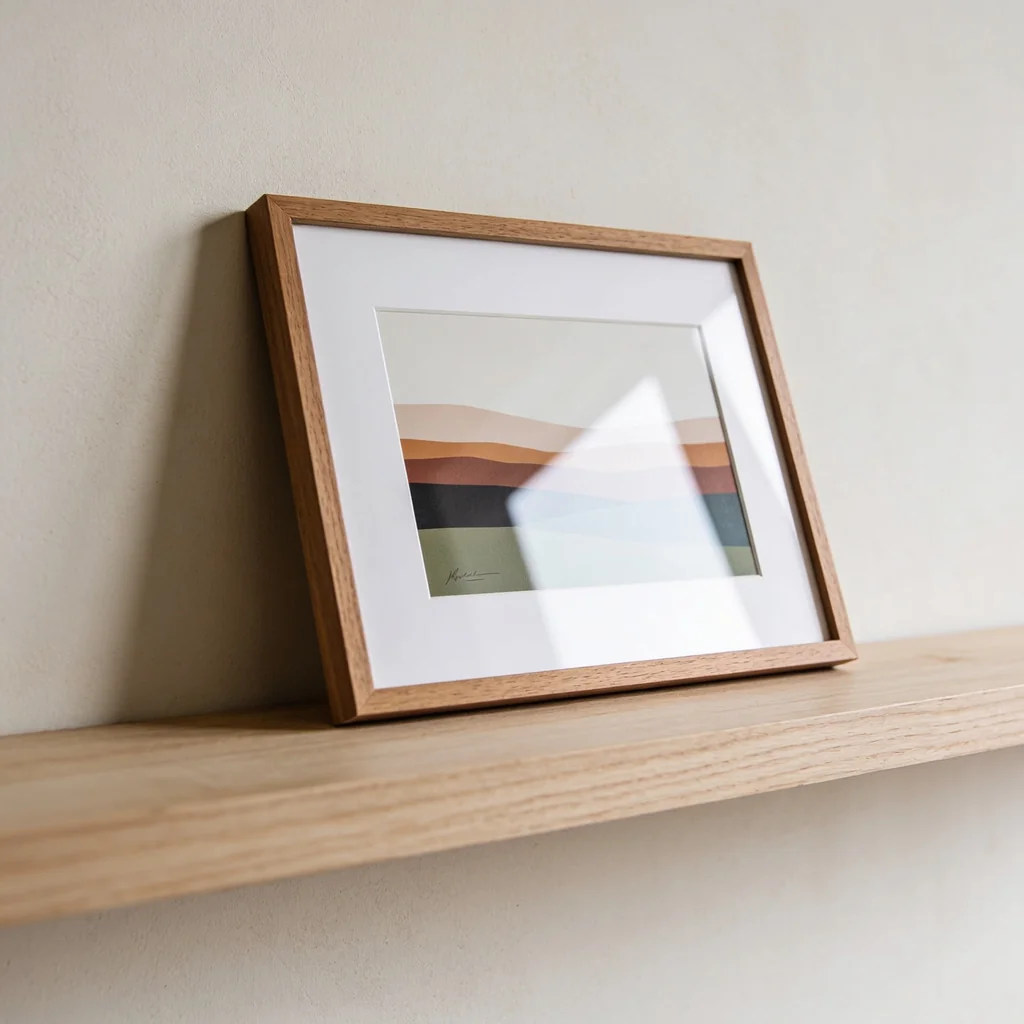
Wall-art photography has an unusually strict identity rule: the image inside the frame is the product. A convincing room can still misrepresent the SKU if it changes the artwork, crop, aspect ratio, color, border, signature, edition mark, print size, substrate, mat, frame, glazing, or what is included.
This test sent one fictional framed-landscape brief through Seedream 4.5, GPT Image 2, Nano Banana 2, and FLUX.2 Pro. The four original outputs below show useful differences in frame crop, mat, invented artwork, styling, reflection, and light. No approved art master, artist record, color target, print file, crop, dimensions, paper/canvas specification, edition, signature, frame profile, mat specification, glazing, hardware, packaging, rights record, or product data was supplied.
Evidence boundary: this is one text prompt and one displayed output per model. The observations describe visible fictional framed landscapes—not artwork fidelity, color accuracy, print quality, frame construction, glazing physics, scale, edition, authenticity, model reliability, current price/value, shoot replacement, or preservation of a real wall-art SKU.
Quick answer
- Closest displayed frame-and-art crop: Seedream 4.5 in this run.
- Fullest displayed styled shelf scene: GPT Image 2 in this run.
- Most saturated displayed invented artwork: Nano Banana 2 in this run.
- Warmest displayed raking-light treatment: FLUX.2 Pro in this run.
- What all four establish: each route made one plausible fictional framed-art concept.
- What none establish: exact artwork, crop, color, dimensions, paper/canvas, print process, frame profile, mat opening, glazing, signature, edition, hardware, rights, or repeated reliability.
One output per route does not establish a universal winner or that framing, glazing, and reflections are solved. Each route invented the picture inside its frame; a reference workflow still needs a deterministic check on the product itself.
First define the wall-art offer
| Offer type | Fidelity target | Required evidence |
|---|---|---|
| Unframed open-edition print | One approved artwork/crop across disclosed print sizes and substrate options. | Master art, aspect/crop policy, color proof, border, dimensions, paper/canvas, print process, size-specific files, packaging, and product record. |
| Framed ready-to-hang SKU | The exact print plus one disclosed frame, mat, glazing, backing, and hanging configuration. | Everything above plus measured frame profile, mat opening/reveal, glazing, depth, hardware, orientation, outer dimensions, weight, and included-pieces record. |
| Limited-edition or signed work | The exact or representative edition with controlled authenticity cues. | Approved art and production sources plus edition size/number policy, signature, title, date, certificate, chop/embossing, provenance, fulfillment link, and representative-photo disclosure. |
| Digital download | The licensed files and ratios—not a physical framed object. | Exact downloadable files, pixel dimensions, color space, ratios, license, included formats, usage terms, and an explicit mockup/physical-product disclaimer. |
A lifestyle mockup must not silently add a frame to an unframed print, turn a download into a physical product, resize a limited edition, or show a different crop at each option.
The controlled concept brief
The original article did not publish the exact prompt. A bounded version matching the displayed subject is:
Fictional brand-free abstract landscape artwork in muted earth and blue tones, displayed in a simple light-oak-look frame with a wide white mat and clear glazing, propped on a warm neutral shelf, soft directional daylight, subtle reflection, square wall-art product photograph. No real artist, title, signature, edition number, logo, certificate, price, text, person, or second framed work.
This prompt can test room and frame direction. It cannot preserve a real SKU because the models invent the artwork, crop, palette, brush/texture cues, border, mark, frame profile, joinery, mat opening, glazing/reflection, scale, hardware, and hidden back.
Four first-hand outputs
Seedream 4.5 produced the closest frame-and-art view, making the mat, frame edge, invented landscape, lower-corner mark, and diagonal reflection cue relatively inspectable at article scale. The small mark is signature-like but has no supplied artist or rights record. It must be treated as invented decoration, not attribution, authorship, edition, or authenticity.
GPT Image 2 made the fullest styled scene, placing the fictional framed landscape among decorative objects and a window-like reflection. That is useful room-direction evidence. It also creates inclusion ambiguity: without a product record, a buyer cannot know whether the frame, mat, glazing, bowl, vessel, stems, shelf, or any hardware is included.
Nano Banana 2 used the most saturated displayed palette and a styled vase beside the frame. That makes it the clearest example of why a pleasant mockup can change the product: palette, tonal range, crop, and artwork content need to come from the approved master, while props and frame configuration need an explicit inclusion check.
FLUX.2 Pro leaned into warm directional light across the wall and frame. Darker vertical bands appear near the lower art/glazing area, but this one view cannot identify their physical source or establish glazing accuracy. The treatment communicates atmosphere while making neutral color and some artwork detail harder to inspect. A listing needs at least one factual view where glare, props, shadow, and color cast do not obscure the full print.
What this comparison supports
| Question | What the four images show | What remains untested |
|---|---|---|
| Can the routes make a framed-art concept? | Yes, once each for this fictional brief. | Reliability across seeds, artworks, ratios, frames, references, rooms, crops, prompts, and current routes. |
| Do the displayed frame and reflection treatments differ? | Yes; crop, frame width, mat reveal, props, shadow, reflection shape, warmth, and saturation vary. | Measured frame/mat geometry, glazing type, optical accuracy, hardware, scale, neutral color, and production match. |
| Is the artwork a real saleable print? | No evidence; each displayed landscape was generated for the concept. | Master-file match, crop, palette, gamut, resolution, texture, borders, marks, signatures, editions, provenance, and rights. |
| Is the offered configuration clear? | No; fictional frames, mats, glazing, and props are visible. | Whether the listing sells a download, unframed print, framed print, mat, glazing, hardware, props, or a limited-edition object. |
| Are quality, edition, or rights claims established? | No. | Substrate, ink/process, archival life, signature, edition, authenticity, artist approval, copyright/license, origin, certification, and warranty. |
The old article called the mockup and glass glare solved, named winners, promised unlimited mockups, and treated a reference as if it returned the actual art. The defensible conclusion is narrower: four routes made attractive fictional framed-art concepts once, and their displayed crop, styling, color, mat, frame, and reflection treatments differ.
Wall-art fidelity checklist
Build the rejection sheet from the approved master file, artist/rights records, color proof, size-specific crops, print samples, dimensions, substrate and production specifications, frame/mat/glazing/hardware records, edition/authenticity data, packaging, and current product data:
- Artwork master: exact image pixels/content, aspect ratio, crop, rotation, borders, bleed, whitespace, composition, marks, signature, title/date, texture/grain, orientation, series relationship, and no invented or removed element.
- Color and tone: embedded profile, working/output color space, calibrated master, gamut mapping, black/white points, saturation, contrast, neutral grays, paper white, proof tolerance, lot variation, and at least one neutral-light factual view.
- Print production: output dimensions, pixel dimensions/PPI, paper/canvas/metal/acrylic-facing surface, weight/thickness, ink/process, coating, texture, deckle, wrap, border, mounting, laminate/varnish, edge treatment, and approved sample.
- Frame and mat: included/not included, material-facing cues, profile width/depth, outer and opening dimensions, color, finish, corners/joinery, mat color/layers/opening/reveal, spacers, backing, glazing, stand, hanging hardware, orientation, weight, and sold configuration.
- Edition and authenticity: open/limited edition, edition size/number, artist signature/initials, title/date, chop, embossing, watermark, certificate, provenance, fulfillment mapping, representative disclosure, and no invented mark.
- Scale and room: print/frame outer dimensions, aspect ratio, measured wall/furniture relationship, mounting height, perspective, vanishing points, contact/shadow, reflection, occlusion, crop, props, adjacent art, and no implied included item.
- Files and variants: each size-specific art file/crop, frame/mat/color/substrate option, physical versus digital product, downloadable ratios/resolution/formats, naming, thumbnail-to-variant mapping, packaging, and fulfillment record.
- Claims and rights: artist, copyright holder, license scope, model/property/trademark permissions, edition/authenticity, origin, archival/fade resistance, sustainable/certified, handmade, print method, shipping, returns, warranty, and affiliation remain in approved records.
If the room looks good but the art, crop, color, mark, dimensions, frame, mat, glazing, edition, included pieces, or rights differ, it is the wrong wall-art asset.
An artwork-first mockup workflow
1. Capture authoritative sources
Store the approved master and size-specific crops with color profile, dimensions, artist/title/rights data, border and signature rules, print proofs, substrate/process specifications, frame/mat/glazing/hardware variants, edition records, packaging, and current product data. Photograph physical samples in neutral light plus controlled detail views.
2. Build a measured room and frame mask
Generate or photograph the empty room and, if useful, a blank measured frame plate. Define the opening aspect ratio, outer dimensions, mat reveal, perspective plane, glazing/reflection layer, wall scale, and sold configuration. Place the approved artwork into that mask with a deterministic transform; do not regenerate the pixels that constitute the product.
3. Test a constrained reference edit
masonry image "Change only the environment to a simple warm shelf with one light-oak-look frame and white mat. Keep the supplied artwork unchanged: every pixel and subject, aspect ratio, crop, orientation, color, tonal range, texture, grain, border, whitespace, signature/mark, and edge. Preserve the specified frame opening and outer dimensions. Add one subtle glazing reflection that does not obscure the art, one natural contact shadow, and no extra framed work, person, text, logo, certificate, price, or implied included prop." \ --model gemini-3.1-flash-image-preview \ --ref ./approved-art-master.png \ --aspect 1:1 \ --output wall-art-scene-candidate.png
The instruction is not an artwork, crop, color, frame, glazing, scale, edition, or rights lock. Compare the candidate with the approved master and physical/product sources. For deterministic artwork fidelity, place the approved pixels into a measured mask or composite after scene generation.
For a fictional frame concept:
masonry image "Fictional brand-free abstract landscape in muted earth and blue tones, simple light-oak-look frame, wide white mat, clear glazing, warm neutral shelf, soft directional daylight, subtle reflection, no real artist, title, signature, edition number, logo, certificate, price, text, person, or second framed work" \ --model seedream-4-5 \ --aspect 1:1 \ --output wall-art-concept.png
Wall-art acceptance sheet
| Area | Pass condition |
|---|---|
| Source match | Candidate is compared with the approved master, size-specific crops, color proof, physical print, dimensions, substrate/process, frame/mat/glazing/hardware variants, edition/authenticity, packaging, rights, and current product data. |
| Artwork and color | Every element, crop, ratio, orientation, border, mark, signature, texture, profile, gamut-facing color, tone, black/white point, saturation, and neutral-light reference matches approved evidence. |
| Print, frame, and scale | Print/outer/opening dimensions, substrate-facing surface, frame profile, mat reveal, glazing, backing, hardware, perspective, wall/furniture scale, shadow, reflection, and sold configuration match. |
| Edition and variants | Physical/digital type, size file, crop, substrate, frame/mat/color option, signature, edition, certificate, included pieces, packaging, thumbnail mapping, and fulfillment record match. |
| Claims and rights | No artist, ownership, copyright/license, authenticity, edition, archival/fade-resistant, print method, origin, handmade, sustainable/certified, delivery, warranty, affiliation, or rights claim is inferred from appearance. |
Bottom line
These four outputs are useful as a frame, mat, shelf-styling, color, and reflection art-direction comparison. They are not evidence that glazing is solved, a reference preserves exact art, a fictional print is ready to list, unlimited variants remain faithful, or one route is always the best value.
Use fictional concepts to choose a room and frame direction. Use the approved master, deterministic placement, color and print proofs, dimensions, frame/mat/glazing specifications, edition records, packaging, product data, and rights to decide whether an asset can ship. Compare the broader AI product photography model review, build a controlled scene in Masonry’s product photography tool, or automate candidates with the Masonry CLI.


